


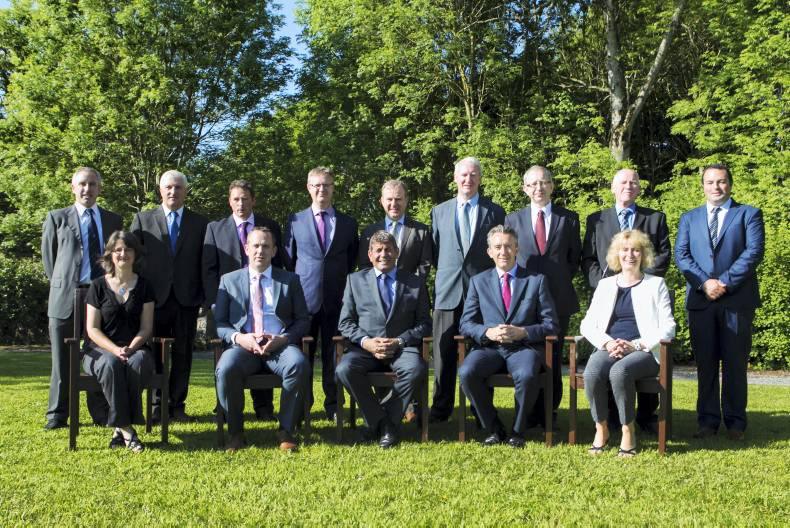
What do timber felling licences and forest road construction in Ireland have in common with the Arab Spring uprisings and the housing market in China?
They all affect wood mobilisation and price, according to a number of speakers at last week’s national forestry conference in Enfield, organised by the Society of Irish Foresters and the Wood Marketing Federation.
While local issues dominated the conference, international topics were also discussed by speakers who reminded the audience that we now export most of our sawn timber and virtually all of our panel board products.
Minister of State with responsibility for forestry Andrew Doyle set the tone for the conference when he outlined the importance of a viable afforestation programme to supply the Irish sawmilling and timber processing industry, but emphasised the need to optimise the existing forest resource.
“We must also maximise the volume of raw material that is harvested from our forests, not just roundwood for our processers, but also the less traditional assortments for our growing renewable energy sector,” he said.
“The forest machine operator training course and the proposed establishment of forest certification groups will both contribute to the mobilisation of timber and meet demand for certified timber.”
The Tip O’Neill phrase that “all politics is local” could also be applied to forestry, although it is less local than it used to be, as illustrated by Richard Lowe in his presentation on international timber markets.
The slump in China’s house-building programme and reduction in timber importation by a number of north African countries after the Arab Spring uprisings on the face of it shouldn’t affect Ireland.
However, as the Coillte, sales and marketing director pointed out, both developments led to European and international timber suppliers turning their attention to alternative markets, especially the UK.
“The UK is Ireland’s greatest market, but it is also the biggest importer of wood products in Europe, with an annual consumption of approximately 9m cubic metres,” he said.
While Ireland has 6% of the UK market share – the same as Russia and greater than France, Germany and Spain – this is a fiercely competitive environment.
Ireland competes successfully against the dominant producers Sweden, Latvia and Finland, which command 75% of the market share. However, seismic international events such as the Arab Spring uprising and dramatic downturns in other economies put supply and price pressure on our timber processors, which has an effect down the line on the forest owner and contractor.
Continuity of supply
While price is a major factor for timber growers and processors, continuity of supply is probably just as important.
Alex Kelly of Irish Wood Producers (IWP) outlined the importance of providing a continuous supply of wood chips for her customers. These include Danone in Wexford, which uses wood as a major renewable energy source.
Purchasers of timber products in Ireland and overseas need continuity of supply from timber processors, which is only possible if processors themselves can source a continuous supply of logs.
Coillte, along with its sawmill customers, acknowledges the principle of continuity of supply, which is why both parties agreed on a timber sales system last year based on annual contracts.
“This new system gives our sawmill customers more surety around supply and log prices that move with the end market, while maintaining the flexibility to purchase additional material through our auction system,” maintained Richard Lowe.
“This change has brought increased stability to our sawmill customers, giving them confidence to make necessary investments to upgrade their facilities and allow the sawmill to spend more management time to focus further down the supply chain.”
Continuity was also stressed by Noel Kenna, who provided the contractor’s perspective at the conference.
“Continuity of well-planned work is essential for contractors, who are the most important link in the timber supply chain from landowner to the end user,” the MD of Roundwood Timber Contractors told the conference.
“The contractor and machine operators are responsible for quality logging and environmental issues,” he said. “We are today’s harvesting process instructors and managers.”
He outlined the need for investment in machinery and accompanying technology, which is costly.
Even a small-scale contractor with two harvesting and forwarder units for both thinning and clearfell now needs to invest a minimum of €1.4m he said, but also stressed the need for investment in people, especially training, which he maintained is urgently required.
“Operators need to be trained to a higher standard and on an ongoing basis,” he said. He outlined the need for at least a one-year training course to cover all harvesting operations, timber measurement, harvesting plans, health and safety, routine machine maintenance, site protection and computer system calibration.
Operational issues
Roading and felling licence approval are still major issues for wood mobilisation, according to Daragh Little, chair Irish Forestry and Forest Products Association and MD Forestry, Veon Ltd.
He said felling licence and roading schemes were too bureaucratic and time consuming, with too many hurdles along the way, including public consultation, budgeting, environmental restrictions and planning barriers.
He acknowledged that the forest road scheme had been amended to make it simpler, and, while a planning permission solution has been found, “it needed implementation”.
He recommended a programme manager for wood mobility, whose responsibilities would include “drawing the various forestry sector players together and focusing on efficiencies within the sector”.
John Ryan, forestry manager with the Murray Timber Group, said the company purchases a significant volume of their 500,000m3 production from private forest owners. He stressed the need to create a marketing and production climate to make it easier to do business. He said felling licences should be speeded up, as often “markets can change while growers are waiting for approval and the opportunity for a profitable sale may be lost”.
He claimed that it is no surprise to see a fall in road construction, as “the maximum road grant at €40 per metre in the majority of cases will not pay for the road with the current specification”.
Brendan Lacey, CEO Irish Forestry Unit Trust (IForUT) and chair Irish Timber Growers Association (ITGA) outlined a number of ITGA initiatives, such as the Wood Price Quarterly, which can be further developed into a comprehensive collective timber sales system.
He also recommended that the Forest Service implement the findings of the recent COFORD report, “in particular those related to facilitating voluntary forest certification”.
“There is likely to be a potential shortfall in supply of approximately two million cubic metres on the island by 2020, half in sawlog and half in energy wood.” maintained Dr Eugene Hendrick, chief inspector, Forest Service.
To meet some of this shortfall, Stuart Goodall, CEO of Confor – the organisation representing the UK forestry and forestry products industry – recommended greater recovery of wood biomass, especially for the burgeoning wood energy market. “This will require new equipment to increase the width between brash mats and to allow the recovery of brash, either by brash baling or lifting it loose and roadside chipping,” he said.
Dr Hendrick summed up the challenge to the industry, which “is to achieve and potentially exceed forecasted levels of roundwood production in a sustainable manner”.


SHARING OPTIONS