The Celtic herd name and indeed Brickley family name has long being associated with Simmental cattle. Gerard’s father, Tom Brickley, imported his first Simmental cattle from Austria back in 1974. Since then, the breed has had a special connection with the home farm in Coolrain, Co Laois.
The farm has gone through a number of changes over those 40 years, the biggest of these back in 2013 when the decision was made to go milking.
“I had been breeding since I was a child and an opportunity arose where we could go full-time farming. With this came the decision to switch from the then beef enterprise to the dairy sector. We sold our pedigree Simmentals before the quota went and bought in dairy weanlings instead. These were primarily based on Holstein genetics due to their availability and price. The aim was to have these calving down by time for the abolition of the EU milk quotas in April 2015,” Gerard says.
Gerard and his wife Angela went about putting a robotic milking machine in place, but it wasn’t until this decision was made that the idea of non-Friesian genetics came to mind.
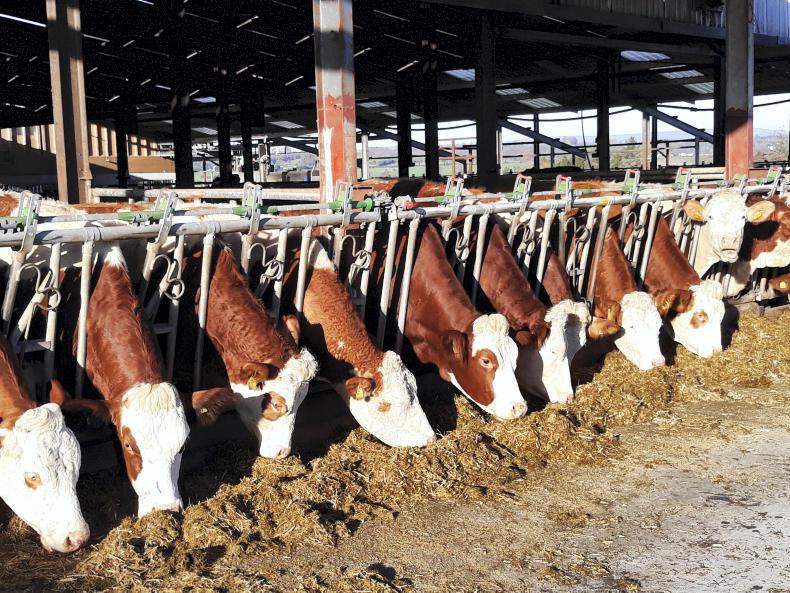
Fleckvieh cattle in the Celtic herd.
“Once we had the building sorted, we had a bit of time on our hands so we delved into the idea of Fleckvieh. I had seen them before when I was over looking at beef Simmentals in Austria but never really looked at them seriously, from a milk point of view.”
Even after seeing how the breed was doing in its home countries, Gerard adds that they did a serious amount of research before anything was purchased.
Continued from back page
“At the time, we only had the in-calf Holstein Friesians on the farm so it gave us a lot of spare time to research the idea. We did a huge amount of research that year, looking at different herds all across Austria and Southern Germany. We then went and looked at how they performed, not only as purebreds but also as crossbreds – visits to the Netherlands and Northern Ireland confirmed that the breed was working very well in crossbreeding.”
Having visited a large number of herds in Austria, the duo were very impressed with the yields they produced, with a lot of herds clocking in herd averages at over 10,000 litres. This, combined with the excellent health and functionality seen in crossbred herds, meant the husband and wife were sold on the breed and returned to Austria once again to purchase.
“The first ones we imported were from Austria in 2014. There was a group of 16 – a mix of in-calf heifers and maiden heifers. They came in October of that year. The most we bought off any farm was two. We paid above the average for them but we tried to buy the very best when we were starting a new herd. Any farm you go into looking for only the best one or two you’ll always have to pay for them.
Milk production
“We focused on milk production. I wanted as much milk as I could get. I also looked at the calving interval and solids a fair bit too, going back through what the mothers and grandmothers had done. I couldn’t help but look for the beefier type with my background, but the Austrians were advising me to concentrate on milk and they were right because they had beef anyway.”
As the herd had initially bought Friesian-cross weanlings, these were all in-calf to Holstein bulls before the decision was made to go into the Fleckvieh breed. However, when they calved down they were all bred to Fleckvieh to build up the number of crossbreds both for the herd and available to sell.
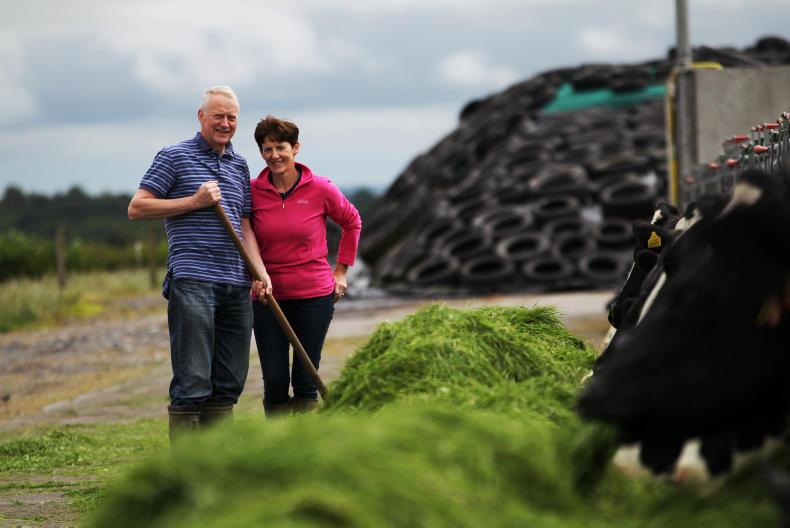
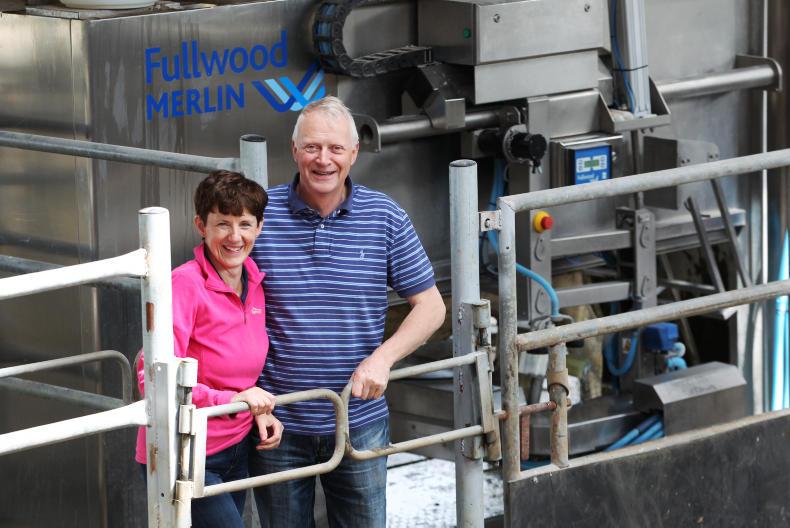
Ger Brickley and his wife Angela on their dairy farm at Coolrain, Co Laois.
“In 2017, we milked 70, of which 40 were black and whites and 30 Fleckvieh. In 2018, this is reversed, with Fleckvieh eventually accounting for the whole lot. Seventy is really our limit with the robot in place. We don’t have plans to expand as we’d have to rent land also. We have 83 acres and grew over 16t/ha in 2017, and while we hope to improve on that, realistically, there’s not much more in it – our land poaches easily, so we have to have cattle off it from mid-October at the latest.”
“So far, we’ve recorded only first and second lactations for the purebreds and we are very happy with the results. The first lactations came in at over 5,700kg at 4.03% fat and 3.45% protein, while the second-calvers averaged 6,684kg with 502kg solids. The Holsteins, by comparison, were about 10% higher in litres, but 0.15% lower in fat and protein. That’s just our own farm experience.”
“We’re in a grass area, and don’t have any maize silage or wholecrop on the farm, but we are zero-grazing so we’re getting an extra litre or so a day from that during the summer.”
With every pedigree herd there is always that one cow that stands out from the rest and, with the Fleckvieh breed, this is no different.
“There’s one alright that stands out. She did 7,244 litres in her 305-day lactation – 525kg solids – and to top it off she went in-calf to her first straw. One of the biggest pluses I find is the Fleckvieh are keeping in-calf faster. They’re averaging at only 1.3 straws per pregnancy.”
Along with bringing in female breeding stock from Austria, Gerard also went about importing semen. Since then, Celtic sires, which originally sold top-end Simmental semen, has been awarded the agency for all Austrian Fleckvieh semen in the Republic.
“Eighty-five per cent of the Austrian dairy herd is Fleckvieh. There is a joint genomics and progeny testing programme run with Germany, so the bloodlines are tested in both countries.
Bull sales
“We only use proven bulls. I want to know what the bulls are doing before we use them. We have semen available from 15 of the top Austrian bulls at the moment. Sales are going very well; we’ve seen a big jump last year. We sold roughly twice the amount of units last year as we did the previous year and it looks like we’ll do at least that, doubling again this year.
“But we are coming from very small beginnings so it’s taking time to gain traction. It was great to see the breed make an appearance on the ICBF list of dairy semen usage for the first time in 2017. Seeing countries like the Netherlands and Northern Ireland, who are so strongly profit-driven, increasing usage is very positive too.”
As for progeny, although maintaining most of the pedigree heifers as replacements, the Brickley family are already seeing the benefits when it comes to selling. From bull calves to cull cows, the Celtic herd is reporting massive increases in their bottom line.
“The purebred bulls, we sell some of the lesser quality ones as calves and keep the better ones for breeding. We sold three pedigree calves this past year in the mart at 26 days last year and they averaged €373. Sixteen Fleckvieh crossbreds were sold at an average of 28 days to make €313 each. Considering that some other breeds used in a crossbreeding setup nearly cost money to get rid of, it’s a big advantage to bring in this extra income.
Supply and demand
“The bulls we keep for breeding, we have had good trade for them. They usually leave the farm at 12 to 14 months and are sold based nearly solely on production. We import some bulls also for sale and in the last two years. We haven’t been able to fully supply the demand. This year, there are even more buyers looking for these top-end Fleckvieh bulls.”
“We haven’t killed many cows yet but those we have are getting more than €1,000 cull value straight from milking. That’s about €400 more than we’re used to, and is quite substantial, but the biggest difference is in the surplus bulling heifers who are selling to the suckler market for around €1,350.”
With the dedication Gerard and Angela have shown over the past four years, it’s clear to see the hopes they have for the breed to move forward in an Irish setup. When asked for any closing comments, Gerard left some solid advice that would do a lot of good for many to listen to.
“I suppose the one thing I notice about the Fleckvieh, and the information from the robot makes it very easy to see, is they have a way flatter lactation. They don’t kill themselves for the first two months and you can see it then in the fertility and all the health traits. We see a much more balanced income with them, and with 70 or 80 cows and followers, we can handle most of the work ourselves. We’re very focused on overall farm profit, but we also have a decent lifestyle and we have time to enjoy our work.”
The Celtic herd name and indeed Brickley family name has long being associated with Simmental cattle. Gerard’s father, Tom Brickley, imported his first Simmental cattle from Austria back in 1974. Since then, the breed has had a special connection with the home farm in Coolrain, Co Laois.
The farm has gone through a number of changes over those 40 years, the biggest of these back in 2013 when the decision was made to go milking.
“I had been breeding since I was a child and an opportunity arose where we could go full-time farming. With this came the decision to switch from the then beef enterprise to the dairy sector. We sold our pedigree Simmentals before the quota went and bought in dairy weanlings instead. These were primarily based on Holstein genetics due to their availability and price. The aim was to have these calving down by time for the abolition of the EU milk quotas in April 2015,” Gerard says.
Gerard and his wife Angela went about putting a robotic milking machine in place, but it wasn’t until this decision was made that the idea of non-Friesian genetics came to mind.
Fleckvieh cattle in the Celtic herd.
“Once we had the building sorted, we had a bit of time on our hands so we delved into the idea of Fleckvieh. I had seen them before when I was over looking at beef Simmentals in Austria but never really looked at them seriously, from a milk point of view.”
Even after seeing how the breed was doing in its home countries, Gerard adds that they did a serious amount of research before anything was purchased.
Continued from back page
“At the time, we only had the in-calf Holstein Friesians on the farm so it gave us a lot of spare time to research the idea. We did a huge amount of research that year, looking at different herds all across Austria and Southern Germany. We then went and looked at how they performed, not only as purebreds but also as crossbreds – visits to the Netherlands and Northern Ireland confirmed that the breed was working very well in crossbreeding.”
Having visited a large number of herds in Austria, the duo were very impressed with the yields they produced, with a lot of herds clocking in herd averages at over 10,000 litres. This, combined with the excellent health and functionality seen in crossbred herds, meant the husband and wife were sold on the breed and returned to Austria once again to purchase.
“The first ones we imported were from Austria in 2014. There was a group of 16 – a mix of in-calf heifers and maiden heifers. They came in October of that year. The most we bought off any farm was two. We paid above the average for them but we tried to buy the very best when we were starting a new herd. Any farm you go into looking for only the best one or two you’ll always have to pay for them.
Milk production
“We focused on milk production. I wanted as much milk as I could get. I also looked at the calving interval and solids a fair bit too, going back through what the mothers and grandmothers had done. I couldn’t help but look for the beefier type with my background, but the Austrians were advising me to concentrate on milk and they were right because they had beef anyway.”
As the herd had initially bought Friesian-cross weanlings, these were all in-calf to Holstein bulls before the decision was made to go into the Fleckvieh breed. However, when they calved down they were all bred to Fleckvieh to build up the number of crossbreds both for the herd and available to sell.
Ger Brickley and his wife Angela on their dairy farm at Coolrain, Co Laois.
“In 2017, we milked 70, of which 40 were black and whites and 30 Fleckvieh. In 2018, this is reversed, with Fleckvieh eventually accounting for the whole lot. Seventy is really our limit with the robot in place. We don’t have plans to expand as we’d have to rent land also. We have 83 acres and grew over 16t/ha in 2017, and while we hope to improve on that, realistically, there’s not much more in it – our land poaches easily, so we have to have cattle off it from mid-October at the latest.”
“So far, we’ve recorded only first and second lactations for the purebreds and we are very happy with the results. The first lactations came in at over 5,700kg at 4.03% fat and 3.45% protein, while the second-calvers averaged 6,684kg with 502kg solids. The Holsteins, by comparison, were about 10% higher in litres, but 0.15% lower in fat and protein. That’s just our own farm experience.”
“We’re in a grass area, and don’t have any maize silage or wholecrop on the farm, but we are zero-grazing so we’re getting an extra litre or so a day from that during the summer.”
With every pedigree herd there is always that one cow that stands out from the rest and, with the Fleckvieh breed, this is no different.
“There’s one alright that stands out. She did 7,244 litres in her 305-day lactation – 525kg solids – and to top it off she went in-calf to her first straw. One of the biggest pluses I find is the Fleckvieh are keeping in-calf faster. They’re averaging at only 1.3 straws per pregnancy.”
Along with bringing in female breeding stock from Austria, Gerard also went about importing semen. Since then, Celtic sires, which originally sold top-end Simmental semen, has been awarded the agency for all Austrian Fleckvieh semen in the Republic.
“Eighty-five per cent of the Austrian dairy herd is Fleckvieh. There is a joint genomics and progeny testing programme run with Germany, so the bloodlines are tested in both countries.
Bull sales
“We only use proven bulls. I want to know what the bulls are doing before we use them. We have semen available from 15 of the top Austrian bulls at the moment. Sales are going very well; we’ve seen a big jump last year. We sold roughly twice the amount of units last year as we did the previous year and it looks like we’ll do at least that, doubling again this year.
“But we are coming from very small beginnings so it’s taking time to gain traction. It was great to see the breed make an appearance on the ICBF list of dairy semen usage for the first time in 2017. Seeing countries like the Netherlands and Northern Ireland, who are so strongly profit-driven, increasing usage is very positive too.”
As for progeny, although maintaining most of the pedigree heifers as replacements, the Brickley family are already seeing the benefits when it comes to selling. From bull calves to cull cows, the Celtic herd is reporting massive increases in their bottom line.
“The purebred bulls, we sell some of the lesser quality ones as calves and keep the better ones for breeding. We sold three pedigree calves this past year in the mart at 26 days last year and they averaged €373. Sixteen Fleckvieh crossbreds were sold at an average of 28 days to make €313 each. Considering that some other breeds used in a crossbreeding setup nearly cost money to get rid of, it’s a big advantage to bring in this extra income.
Supply and demand
“The bulls we keep for breeding, we have had good trade for them. They usually leave the farm at 12 to 14 months and are sold based nearly solely on production. We import some bulls also for sale and in the last two years. We haven’t been able to fully supply the demand. This year, there are even more buyers looking for these top-end Fleckvieh bulls.”
“We haven’t killed many cows yet but those we have are getting more than €1,000 cull value straight from milking. That’s about €400 more than we’re used to, and is quite substantial, but the biggest difference is in the surplus bulling heifers who are selling to the suckler market for around €1,350.”
With the dedication Gerard and Angela have shown over the past four years, it’s clear to see the hopes they have for the breed to move forward in an Irish setup. When asked for any closing comments, Gerard left some solid advice that would do a lot of good for many to listen to.
“I suppose the one thing I notice about the Fleckvieh, and the information from the robot makes it very easy to see, is they have a way flatter lactation. They don’t kill themselves for the first two months and you can see it then in the fertility and all the health traits. We see a much more balanced income with them, and with 70 or 80 cows and followers, we can handle most of the work ourselves. We’re very focused on overall farm profit, but we also have a decent lifestyle and we have time to enjoy our work.”





SHARING OPTIONS