


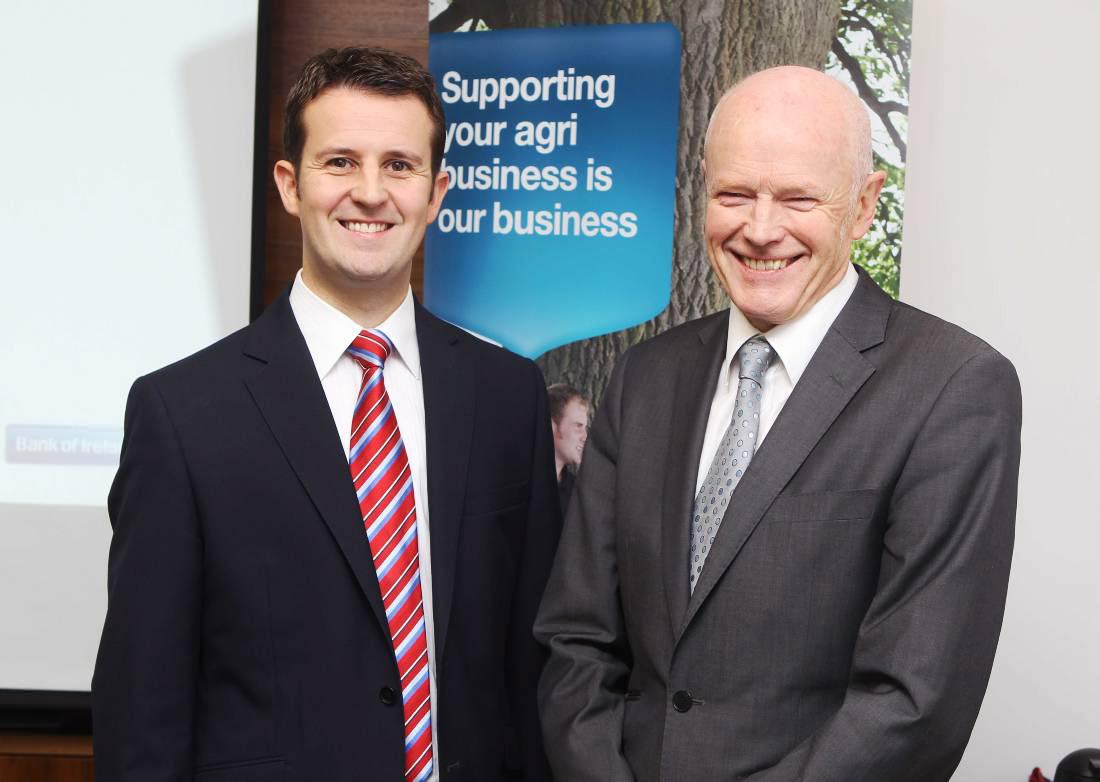
A commitment to support their farming customers in Northern Ireland has been declared by Bank of Ireland (BOI), whose senior managers have indicated that the bank is well aware of the challenges of volatile global markets.
BOI NI agri manager William Thompson told agricultural journalists: “Looking ahead, the short term will be challenging for a number of sub-sectors, particularly milk producers. But BOI UK is still taking a long-term view of the agri-food sector and remains fully committed to supporting progressive and profitable operators.”
Thompson seems to be aware that some of the more ‘‘progressive’’ operators may not be among the ‘‘profitable’’ ones during the short-term period ahead.
He said that 2014 had been a good year for most sectors but local agribusinesses will have to learn to adapt. “The challenge for farmers or small food processors is to focus their efforts on aspects of their business within their control and strive to increase profit margins through technical efficiency,” he said.
Strategic
BOI UK has a real strategic commitment to the agri-sector, according to Ian Sheppard, head of business and corporate banking in NI. “We have invested £10m in our branch network and we are trying to make it as convenient as possible to deal with us. We have a business manager in every branch who can deal with a business proposition on the spot.”
Announcing new credit approvals of £456m for NI businesses between January and September this year, Sheppard indicated that the agribusiness sector was performing strongly, with a 55% increase in the number of agri-lending packages approved for producers, processors, retailers and food-related businesses in the first nine months of 2014 compared with the same period in 2013.
Thompson gave examples of lending for land purchase, business expansion, working capital, re-financing and a broiler house. He also referred to a loan of up to 70% of the cost of a wind turbine, where there is collateral and recourse to an existing business with profits.
The sum borrowed by farmers has not been revealed but it is known that BOI has a relatively small share of the lending to farms in NI. There is an aspiration to grow that share, given that BOI serves an estimated 50% of the farmers and provides 35% of the agri-lending in the Republic of Ireland.
The new lending to businesses of all sizes in NI is up 59% on the January to September period last year and the total approved for 2014 is expected to be well ahead of last year’s £500m.
The bank’s figures were released as it launched its tenth enterprise week across NI, which runs from 14 to 21 November. During the week, local companies and agribusinesses will showcase their products and services in all 36 BOI branches. Under the theme of ‘‘Let’s Connect’’, the bank will host more than 20 networking events, seminars and clinics with business leaders and experts across the region.
According to BOI UK economist Alan Bridle, three factors are affecting the agri-sector. Global food prices are down an average of around 10% in the last six months, the Russian import ban is affecting the industry and there is fierce price competition between supermarkets.
“While this is bringing some relief to stretched household budgets, we should not overlook the wider effects on the agri-food sector in NI. It means the drive for efficiency in production and further export growth must be relentless.”
Bridle referred to the period of austerity ahead regarding tighter government spending. He predicted that a rise in UK interest rates has been ‘‘pushed back’’ and is unlikely to occur before the third quarter of 2015. He said that the breakup of the euro is inevitable but the timing of that cannot be predicted.


SHARING OPTIONS