


As one of the leading meat processors in Ireland and the UK, Dunbia would be of interest to many suitors. It is unclear at this stage who a potential buyer may be, but it may be a Brazilian or Chinese buyer rather than a local one.
While the company has stressed it is business as usual, for the 22,000 producers across Ireland and the UK there will be concern about what any changes may mean for buying cattle, sheep and pigs. Any potential sale could include the whole business, or a large part of its operations, which are scattered throughout the UK and Ireland.
Dunbia is typical of many others in the Irish beef processing industry, with a long family tradition of cattle dealing moving into processing through the establishment of a butcher shop in the Co Tyrone village of Moygashel near Dungannon almost four decades ago.
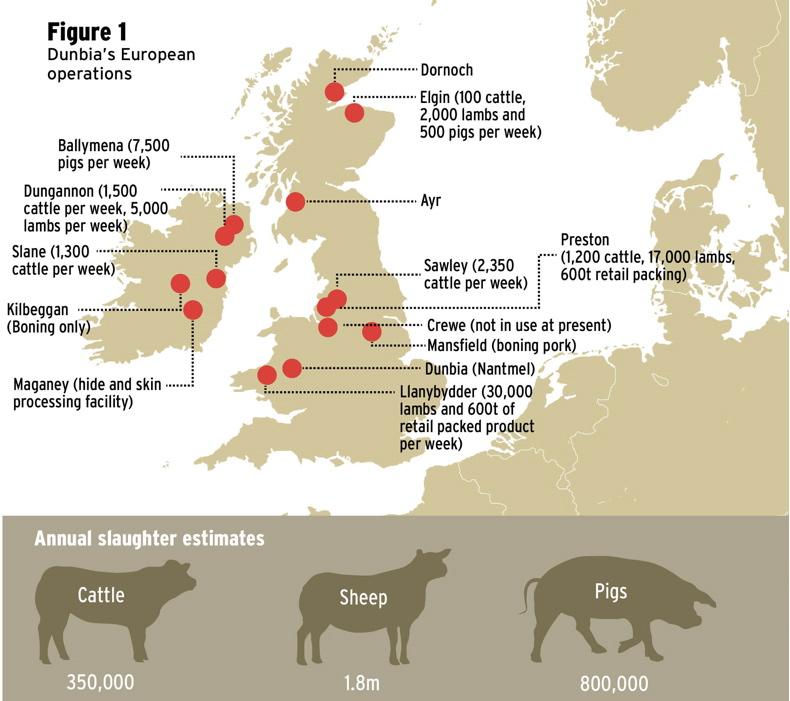
Set up in 1976 by brothers Jim and Jack Dobson, Dunbia now employs almost 4,000 people over 13 sites in the UK and Ireland and trades in over 36 countries.
Dunbia now slaughters and processes 350,000 cattle (or almost 10% of the UK and Ireland kill). It also processes 800,000 pigs and 1.8m lambs.
Dunbia Limited
Dunbia Ltd is a UK-registered company. It rebranded from Dungannon Meats to Dunbia in 2006. It became a limited company again in 2014 after the company had gone private in the late 1990s after recording significant profits at that time.
In its latest set of accounts to year end 30 March 2014, turnover increased 6% to £764.2m (€1.05bn). Operating profit decreased 13% to £6.6m (€9.2m) and the fall in profit was a result of a once-off cost of £1.75m (€2.4m) associated with the winning of a contract to supply beef to Sainsburys. Stocks at year end almost doubled to £44.5m, suggesting that business was struggling to achieve sales.
Operating margins
Considering the amount invested and the turnover of the company, operating margins at the company have been very thin at 0.86% in 2014 and 1.05% in 2013. Net debt increased by £12m (€16.5m), due to significant investments to £56.1m (€77.3m) at year ended 30 March 2014.
Dunbia Ireland is a subsidiary of Dunbia Ltd and is a southern registered company that is involved in the deboning of cattle along with the wholesale distribution and retail packing of meat and meat-related products. It is also 100% owned by the Dobson families.
In its latest set of accounts to end March 2014, it made a profit of €2,468, down from €1.58m in March 2013. Operating profit fell from €1.63m to €72,532 and the company blamed the significant increase in cattle prices. Turnover was in line with the previous year (down 0.16%) at €112.8m, which would suggest that this business accounted for all of their Irish operations.
The business, which has 200 employees, saw its gross profit margins fall from 5.21% to 3.62% in 2014. Operating margins were also thin at 0.06%, down from 1.44% in 2013.
Over the years, the brothers expanded their business through a combination of acquisitions and capital investment. From their early beginnings, they decided to build their own facilities in Dungannon, which remains their headquarters.
Several further expansions and acquisitions followed, with facilities in Slane and Kilbeggan joining the Stevenson’s pork business outside Ballymena in Co Antrim as their main acquisitions on the island of Ireland.
Acquisitions
Several businesses have been acquired across Britain, including the largest lamb processing business in the UK and Ireland. It then invested £12m (€16.5m) in this lamb facility at Llanybydder in Wales. This is now one of the largest suppliers of lamb, supplying over 1.5m lambs each year to markets throughout Europe.
The company was awarded sole supply of lamb to Asda in 2013.
It has invested £7.5m (€10.3m) at the former Dairygold site in Felinfach, Wales, after it won back a contract to supply Sainsbury’s with about 30% of its meat requirement. This was a significant move as Dunbia had lost this contract to ABP in 2006.
Following the loss of this contract, the company went on to snap up three businesses within a 10-month period as it diversified into pork. It purchased two additional pork facilities in Crewe (formerly Heathfield Foods) and Mansfield (formerly G Woods & Sons).
It expanded its Scottish operations when it acquired Lynch Quality Meats based in Ayr. Earlier this year, Dunbia entered into a joint venture agreement with Dutch-based meat company Shannon Meats.
In addition, over the years they have developed by-product and offal businesses.
Challenges
No doubt the rise of discounters such as Lidl and Aldi, along with the competing supermarkets, is having a huge impact on producers and processors like Dunbia and this is reflected in the very tight operating margins. This is driving the need for scale across the industry to ensure businesses remain buoyant, growing and profitable.
Processors are becoming increasingly vulnerable to the power of supermarkets. For example, in 2006 when the whole beef business for Sainsbury’s was put out to tender, Dunbia was unsuccessful.
Overnight it lost 65% of its business, which was a significant blow to Dunbia.
However, it survived and went after new business with other supermarkets and diversified into pork.
Eight years later, Dunbia re-tendered for the Sainsbury’s contract and has now regained its lost percentage share.
Position
However, it now finds itself in a similar position again with its pork. A major contract between Dunbia and Sainsbury’s, which has been in place since 2009, is to end next year after Sainsbury’s decided to switch its pork supplier to Karro, one of the largest pig processors on the island of Ireland, at its Cookstown, Co Tyrone, factory. This pork deal was one of the major factors in the decision by Dunbia back then to take on the Stevensons pork business in County Antrim.
With four decades of growth and success, many will wonder why they are looking around at options. There is logic for a family company to ponder what is best for the business in what is an ultra-competitive low margin sector. The company has experienced setbacks from which it always seemed to bounce back.
Like the top teams in the English premier league continual investment is necessary to keep pace at the top. Rival processor ABP have demonstrated that they have the firepower to continue growth throughout Europe and demonstrated locally last week by their acquisition of the Allen family’s share of Slaney Foods.
ABP have always been larger than Dunbia and it would be no surprise that Dunbia would decide to look at external investment in their business to take them from a major regional processor to a large European player of scale. But it raises the question, would Dunbia consider selling to them? However, competition authorities may have issue with this.
The Irish Farmers Journal last week mentioned that in the turbulent world of meat processing we shouldn’t be surprised if a larger player attracts the interest of the big global players.
JBS, the largest meat processor in the world have arrived in Northern Ireland with their acquisition of Moy Park’s poultry business in a deal worth close to £1bn. They would be an obvious suitor but if Dunbia were looking to sell they would be of interest to any global player looking at entry to the lucrative UK and EU market.
The Chinese, who are mopping up food businesses around the world, could be a surprising outsider who may make a play for this well invested business.



SHARING OPTIONS