


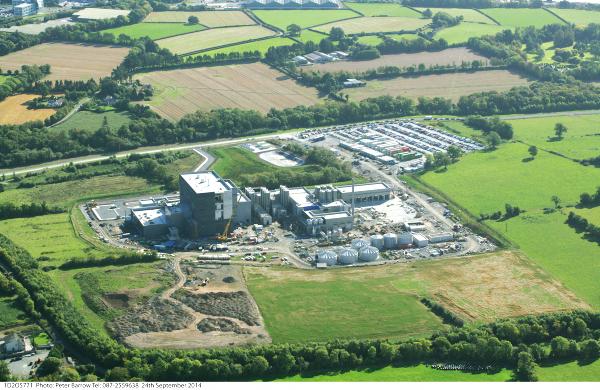
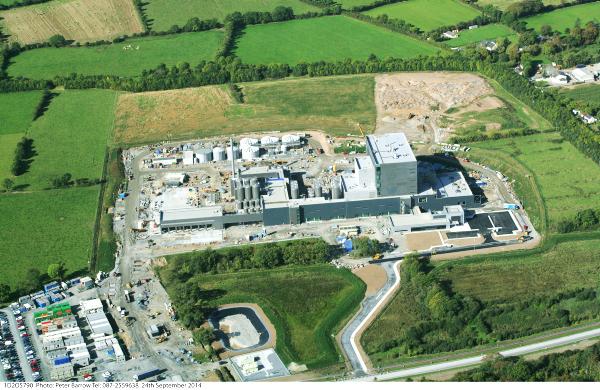
Glanbia Ingredients Ireland (GIIL), the 40:60 joint venture between Glanbia PLC and the co-op, has published its first full year set of accounts. This is for a thirteen-month period to January 4 2014, to bring the new company in line with the PLC’s accounting period.
GIIL recorded revenues for the 13-month period of €954.7m. To ease analysis, we look at a 12-month period which would be equivalent to revenue of €881.3m. To put this into context, when the proposed new structure was put to co-op members in 2011, the business projected to have sales of €738m. The reason for the large increase is mainly down to dairy markets rising over the intervening period, but the €20m investment in WPI has also helped move the product mix into higher value.
Similarly at the time, profits (EBITDA) were projected at €44m, while operating profits were expected to be €33m, giving a 4.5% operating margin.
Helped by high milk prices, the business has outperformed over the past 24 months as CEO Jim Bergin managed significant change and grasped the task of running Ireland’s largest dairy processor. Couple this with a €200m investment programme to handle the expected 60% increase in milk from their 4,400 suppliers and it seems like a large undertaking.
Analysing their first full set of accounts, it appears that the new structure and model is working. Customers are bedding down, investments are on target both financially and to time, and debt is at a manageable level.
Extrapolating for a 12-month period, sales were €881.3m, operating profit was €40.6m and earnings (EBITDA) were €55.4m. Net debt stood at €59m at the end of the period, giving a net-debt to EBITDA ratio of 1:1, which means the business is financially strong.
No doubt the financial position has been helped by the parents initially putting in €29.6m and topping this up to €59.6m. GIIL has strong credit facilities, which include a nine-year term loan facility, of which €65m runs to 2023. There is also a €210m revolving credit facility which has been extended out to July 2017.
It is significant that there is no dividend to be paid to the parents before the end of 2018, which means that all the profits which were made last year (€35m for 13 months) and until 2019 will be retained in the business, which can be used to reduce debt or to fund future growth.
Earlier this year, the board of GIIL agreed to remove the 2c/l farmer contribution which was to be levied on milk suppliers. This would have added €60m to the balance sheet, but was dropped because of the initial equity injection and the underlying performance of the business.
Investments
Along with the Belview investment, which is costing €150m and will add an extra 600m litre capacity per annum, GIIL has invested €17m in Ballyragget, increasing butter production by 33% up to 80,000t. It is also doubling capacity at its MPC plant in Virginia at a cost of €9m. A further €2.5m is also being invested in its JV with Corman Miloka, which produces technical butter, a blend of butter for the baking industry.
New business model
Glanbia will pay out a total €12m in addition to manufacturing milk price this year. And this is a key point that the new structure allows.
Earlier this year, the co-op announced a €5m manufacturing milk price stability fund to be used before the end of 2015. The key difference under the new structure is that in the past that €5m would have gone back to the PLC. But now, this money can be kept and brought forward. Half of this fund was used in August to support and hold the milk price at 33c/l.
In tandem with this, Glanbia co-op is debt free and has cash. Last year, it received a dividend income from the PLC of €11.6m. The PLC continues to go from strength to strength and this should be a sustainable and consistent income for the co-op into the future. It also provides for the patronage bonus to support active members. A €7m bonus is to be paid to GIIL suppliers who are members of the co-op next January (subject to shareholder approval).
As it stands today, Jim Bergin says he is “acutely aware” that some suppliers who are not co-op members are not eligible beneficiaries of the patronage bonus, but he says that strengthening the milk pool is important to the business. This is evident with their recent agreements with Five Mile Town and Wexford Creamery. It is understood that currently 95% of suppliers have signed the milk supply agreement.
Markets
GIIL has established routes to market and has relationships with the three infant formula manufacturers here.
It is the largest supplier to the IDB, with about 20% of sales going to the IDB. Its products, the large majority of which are exported, include milk powders, butter, cheese, whey protein, milk protein and casein. With as little as 5% of product sold to Glanbia PLC, the majority of its customers include many of the large global food and infant formula manufacturers as well as more regionally focused players across Europe, the Middle East, Africa and Asia.
Bergin says the growth will be in value-added products such as infant formula ingredients and enriched milk powders (EMP). Africa is a large focus for the company, which ships large volumes of EMP along with processed cheese ingredients to north Africa.
Bergin’s vision for the business is that it becomes a dairy based solution partner of choice that is business to business. He believes in an integrated supply chain and in building tight partner relationships with bluechip customers such as Danone, Abbot, Nestle and Diageo.
Milk price outlook
GIIL paid a weighted average price of 35.5c per litre in 2014. Last week, GIIL announced a price drop 2.5c/l to 30.5c/l but say that “based on the current market outlook, no further milk price reductions are expected in 2014”. This may provide some security to farmers who are planning for next season.
Taking current prices of butter, skim and whole milk powder, the gross return works out at less than 34c/l before processing costs are deducted. On outlook, Bergin says that based on current market returns, it is likely that over the next year milk price will be below 30c/l. He added, however, that the longer-term fundamentals are strong, based on population growth projections and rising incomes.
Comment
What makes the GIIL business unique is that it is now purely a milk processing business. Management has no distractions such as trading of farm inputs and no non-core assets or businesses. This provides for transparency and real clarity when analysing the business.
The operating margins are very respectable at 4.6%, although it is a factor of the milk price. Last year, the large co-ops had operating margins ranging from 1.2 to 3.2%. The one exception is Carbery. It continues to outperform, with operating margins of 5.1%, while its West co-op parent continues to pay the highest milk prices.
Both financially and commercially, GIIL is strong. Although it may not be at the top of the milk price league, to give it fair comparison, it must be taken into account that there are no levies for milk growth, no share-up costs, and no mandatory revolving share plans. There is only the milk price and then the bonuses to be taken into account.
If further value can be added and processing efficiencies can be attained through expansion, there is no reason why GIIL cannot achieve high operating margins and balance that with paying one of the highest milk prices in the country.
After all, milk suppliers and farmer shareholders make a living by selling milk and anything that boosts that monthly cheque will be welcomed.




SHARING OPTIONS