



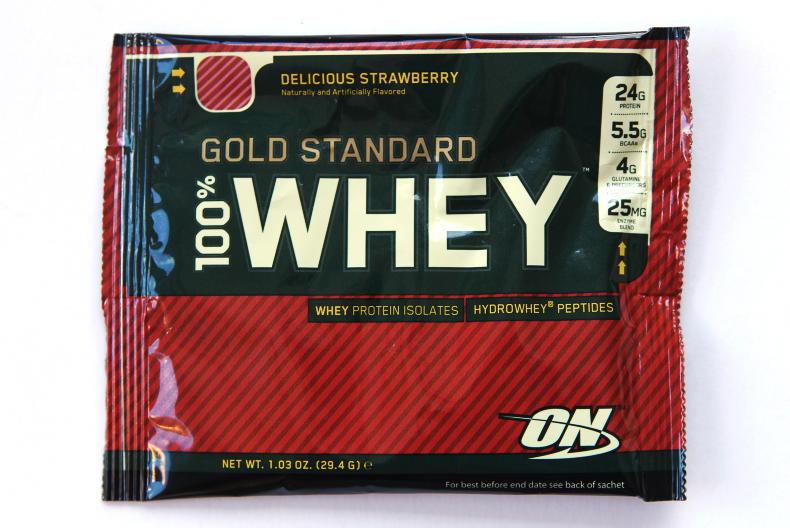
The global protein trend is well established and dairy companies around the world are bringing more and more production on stream to meet current and projected demand.
While forecasts vary on how fast the market will grow over coming years, the projections for the medium and long term all point in the same direction – demand will increase in every year over the forecast horizon.
Last week, analysts at Bank of America (BofA) attempted to pour some cold water on the protein outlook, and specifically the profitability available in the whey protein sector.
The analysts were running the numbers on Glanbia, the largest player in the global whey protein market through its Optimum Nutrition brand, and highlighting what they saw as a too-high stock-market valuation for the company.
In a piece of research titled Whey too Expensive, they pinpointed three challenges faced by Glanbia: High input cost inflation will require price hikes that could dent volumes; rising industry capacity that will increase supply; and a more competitive whey powder industry which will rebalance Glanbia’s market share.
BofA also looked at whey demand in the US and highlighted some early signs that interest in the product could be starting to wane. The analysts cited global Google search results for “protein”, which have slowed down in recent months after a very strong first half of 2026. They also noted that the average US consumer already purchases enough protein to meet recently updated government recommendations.
They also noted that the protein sector in the US, as one of the most attractive nutrition growth areas, has attracted its own excess.
“Product launches are proliferating at a pace that appears increasingly disconnected from realistic end-demand growth,” the analysts say, giving the example of high-protein breakfast cereal which is formulated with ground beef.
There is also a market risk from what BofA calls “protein washing” where products that are otherwise unhealthy due to high sugar, salt or fat content are marketed on their protein content to wellness-minded consumers.
Added to this are signs that protein maxxing is losing appeal among consumers. Protein maxxing is a fad within the wider protein trend where some social media influencers treat protein like a magic potion which leads to weight loss, muscle growth and even reverses the signs of aging, and recommend increasing consumption to levels far above recommended daily amounts.
Taken together, the threats from increased competition in the market added to the softening of some of the current excesses on the demand side mean that there are downside risks to Glanbia’s earnings outlook, BofA said. The analysts put a price target on Glanbia’s shares of €19.50, around 10% below the company’s stock price when the analysis was published.
The stock market reacted immediately to the publication, pushing the share price from €21.56 to €18.54 in the last two trading sessions of last week. There has been some recovery since, with shares close to BofA’s target price at that time of going to press.
Outlier
BofA’s outlook is a bit of an outlier for Glanbia. The company is covered by analysts from nine other financial institutions, with five of those having the stock as a “buy” and the other four having it as a “hold”. The average stock target price across all analysts covering the stock, including BofA, is €23.50.
It is notable that BofA has not covered Glanbia for several years, and the analysis published last week was part of the reinstatement of coverage. The analysis released has certainly caught plenty of attention and has led to a significant move in Glanbia’s share price, so it could be seen as a successful restart of that coverage.
Wider market
The analysis by BofA concentrates on one company (Glanbia) and developments in one market (US), so to get an idea of how close the world might be to peak protein demand, a wider view has to be taken.
GLP-1 weight-loss drugs have been acknowledged by Glanbia as a major driver of demand in recent years. Use of those drugs is forecast to grow further in both the US and globally over the coming years.
The link between increased use of those drugs and increased protein demand is causal, so there is a solid base for future protein demand there.
Recent analysis of the global market suggests that the next big driver of global protein demand will come from the Asia-Pacific region, rather than the US. As well as weight loss and muscle building, protein is essential for maintaining muscle in older people.
By 2050 there will be 1.3 billion people aged over 60 in the Asia-Pacific region, suggesting sustained demand for protein.
Supply side
The economics of increasing production in whey are a two-part process. Whey is a by-product of cheese manufacturing.
This means that in order to increase the volume of whey protein, there also has to be an increase in the volume of cheese produced. For every 1kg of cheese produced, there is about 9kg of whey.
A market for the cheese, the knowledge of how to filter and dry the whey to meet customer demands and the capital to invest in the expensive facilities are required
However, there is only around 1% protein in that whey. Ultrafiltration, drying and recovery pushes the volume of the whey from 9kg to around 100g, and raises the protein concentration to more than 80% to make WPC-80 (whey protein concentrate with more than 80% protein).
This process needs three essential ingredients to make economic sense. A market for the cheese, the knowledge of how to filter and dry the whey to meet customer demands and the capital to invest in the expensive facilities are required.
Tirlán’s €126m investment in its whey facility seems to tick all the necessary boxes. The co-op is already making the cheese and selling it, both through its fully owned facilities and the Kilkenny Cheese joint-venture with Royal A-ware.
It has plenty of in-house expertise on valorising liquids to maximise returns, and through its long-standing relationship with Glanbia, has a strong understanding of customer requirements.
Crucially, the decision to make the investment in processing was taken when whey prices were less than half of what the product currently commands in global markets. This means that it still should be a viable business even if there was a large drop-off in whey prices.
The fact that whey production is part of an integrated process which requires significant expertise and investment mean that high barriers to entry for fresh supplies remain in place.
Any business case for expanding output will be based on long-term whey prices and not the current elevated level.
Comment
The analysis from Bank of America certainly got the attention of investors in Glanbia, and perhaps that was some of the reasoning behind it. However, the read across the wider industry, and Irish dairy prices are probably minimal at worst. While an end to the “protein maxxing” fad seems possible, it is unlikely to derail the long-term global demand growth trend for protein.
It is important to distinguish between the fad and the trend here. The growth in whey protein consumption has been steady over many years. The investments behind it are large and slow to come on stream, so there will be supply/demand mismatches which will lead to price spikes such as the market is currently seeing. More supply will come to the market in the coming months and years which should help cool prices a little, but there is nothing to suggest that we will see a return to whey prices at the level they commanded even a few years ago.
To illustrate how far from a fad whey protein is, look no further than an interview with Pat O’Neill, then CEO of Avonmore Creameries Ltd, recorded in 1988 and available on RTÉ Archives. In it, he said: “A good deal of the whey in the country has been sold for animal feeding. In the future, that whey will find a home in human food applications. We will have substantial investment in that area in the years ahead.”
Irish dairy might not have arrived at the place it needs to on whey as fast as O’Neill predicted almost 40 years ago, but it would be very wrong to view such a long-lived opportunity as a fad which could easily be derailed.





SHARING OPTIONS