



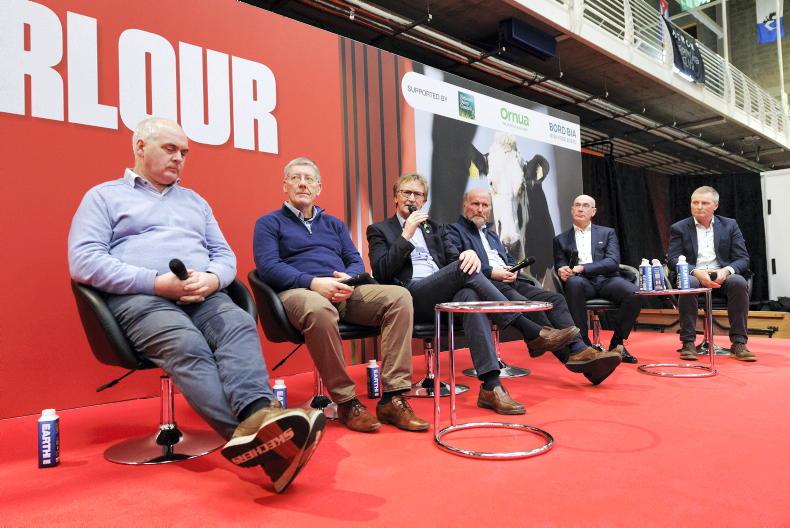
Speaking at Dairy Day in Limerick on Saturday, John Murphy, chair of Tirlán, insisted “competition is good, it keeps us all on our toes”. He was answering a question around Tirlán’s expansion of its Truly Grass Fed butter brand in the US and how it is jostling for market share with Ornua’s Kerrygold brand.
Murphy said that if you go into any US supermarket “you’ll see 40 grass-fed brands”, adding that there it would be wrong to think that Ornua has a monopoly on grass-fed butter. He pointed to the growth of New Zealand butter exports to that key market.
Looking at the most recent data available from the US Foreign Agricultural Service on butter imports, we can see that New Zealand has made significant inroads into that butter market this year. Between 2020 and 2024, New Zealand accounted for between 10% and 20% of US butter imports. In the first seven months of this year, that had risen to 30% of butter imports (see Figure 1).
The changing market dynamics in the US, where demand for grass-fed butter has exploded, means that the increase in New Zealand’s market share has, until now, had almost no effect on the growth in Irish butter exports. But it is notable that while the US data shows butter imports from Ireland more than doubled from $214m to $501m (€185m to €433m) between 2020 and 2024, imports from New Zealand increased five-fold across the same period.
It is probably worth noting the scale of the US market for Irish dairy. It made up approximately 30% of Irish butter exports, and around 8% of total Irish dairy exports in 2024.
However, Kerrygold butter sales to the US are among the highest margin dairy exports from Ireland. As former chair of Ornua Aidan O’Driscoll told the Irish Farmers Journal last year, every co-op member of Ornua wants their milk to go into Kerrygold to get the best return for their members.
On the same panel at Dairy Day, Pat Clancy, chair of Dairygold, called for Ornua to do more with the Kerrygold brand saying: “They haven’t really leveraged their Kerrygold brand into cheese or other products.
“They need new markets, they need new products. They have been successful in butter, but they haven’t leveraged that brand across other products.”
He added that Ornua has a new strategy which is to increase branded sales over the next five years “by over a billion euro”, a target which he called “a big ambition”.
Ornua has outlined ambitious plans in the past, with former CEO Jim Jordan saying in 2022 that sales for the Kerrygold brand would reach €2bn by 2025.
A spokesperson for Ornua told the Irish Farmers Journal: “We’re always focused on meeting consumer needs and maintaining the Irish grass-fed proposition that sets Kerrygold apart. In the past two years, we’ve introduced 40 new product innovations across the global Kerrygold portfolio, including entry to new categories like cream cheese.
“We are ambitious for the brand’s growth and see innovation in products and formats as a driver of value for our consumers, Members and farmers, alongside continued growth in butter and cheese.”
Global supply
In the shorter term, global dairy markets remain in the doldrums with no speaker at Saturday’s conference suggesting a quick rebound in milk prices is on the cards. Pat Murphy, CEO of Kerry Dairy Ireland, said: “There are further corrections to be done over the next couple of months.
“At the moment there is a big difference between what we are getting out in the market place for the products we’re selling compared to what we’re paying the farmer. This is going to take a bit of pain over the next six months.”
The latest World Agricultural Supply and Demand Estimates (WASDE) report from the US Department of Agriculture showed an increased estimate for US milk production both this year and in 2026, and a reduction in the estimated milk prices. The WASDE report also forecast lower US butter imports and higher US butter exports, putting the country on track to be a net butter exporter. It raised the forecast price for whey protein on the back of continued strong demand.
Christophe Lafougère, dairy market analyst at Gira, gave a brief overview at Dairy Day of the headwinds facing European dairy at the moment including oversupply of butter and cheese, weak consumer demand and an unfavourable exchange rate with the US dollar.
Adding to this is the rapid increase in US dairy output with high milk and butter production.
However, over the longer term, Lafougère is considerably more optimistic. “The demand is there and the demand will continue to grow,” he said, adding that the demand for dairy protein is really growing fast. He said that the healthy living trend and protein demand from people using GLP-1 medication will add around 83,000 tonnes to dairy protein demand from the EU and US by 2030.
On the global demand outlook, he pointed to the huge and growing market in South East Asia, a region which is already buying three times as much skim milk powder as China.
Taking an even longer look ahead, he said that, according to a Gira study, “by 2050 there won’t be enough proteins to feed the world … so in the long term there is absolutely a need to have more”.
Comment
With October milk prices being slashed by more than 3c across the board this week, dairy farmers are starting to get anxious about when the bottom will finally be reached.
There may be some comfort for the majority of farmers from the fact that the 2025 season is almost over so the timing of the plunge in prices is better than it could have been.
However, in looking for a turnaround ahead of next year’s peak milk season farmers need to be aware of the trends driving the current drop. Right now, it seems to be a mixture of oversupply for some products in some markets, coupled with sluggish consumer demand.
This is part of a normal supply and demand cycle, even if the size of the price swings can feel quite violent.
What processors in Ireland need to do is to continue to make sure that they have the right product mix to meet future demand.
Tirlán’s announced investment in whey processing seems smart, considering the projections for consumer demand over the coming years.
For companies like Ornua which have done so well from US consumers over the past few years, it might be worth looking at what other opportunities are available worldwide.
One thing that really came out from the Dairy Day panel of co-op chairs was how they all generally favour working more closely together.
If that willingness can be turned into increased cooperation on processing, then they might be able to reduce costs which would help weather the current downturn.
There is no doubt that the future for dairy in bright over the longer term.
It is critical that the Irish dairy processors get their long-term strategy right, as an industry, to ensure that this country’s dairy farmers are in a position to maximise their returns from that global market.






SHARING OPTIONS