



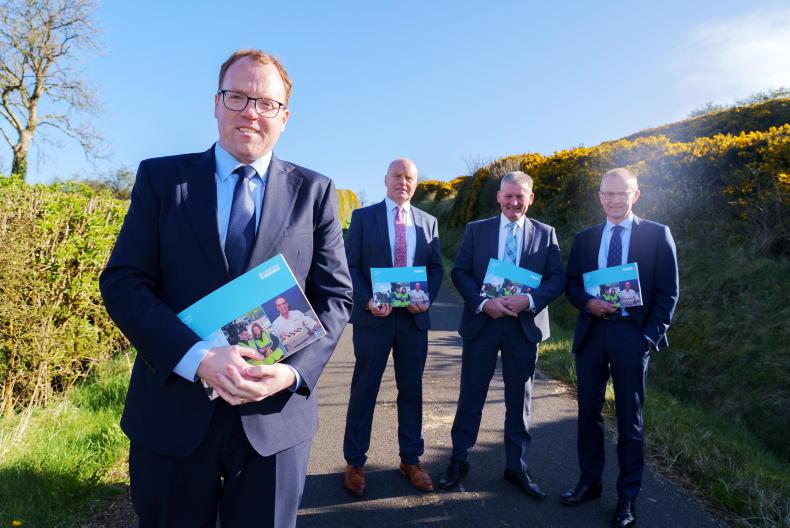
Lakeland Dairies reported the co-op’s financial performance was strong last year despite global dairy market volatility in the second half of 2025.
Revenue grew by 10% to €1.93bn and profit after tax was 19% higher at €25.2m.
Lakeland said that the growth reflected higher milk volumes, a more balanced product mix and continued growth in value-added market segments.
Milk volumes were 2.14bn litres, a record high, and the co-op paid €1.05bn to its suppliers.
Revenues from Lakeland’s food ingredients business were €1.26bn, from its foodservice and consumer foods were €544m and agribusiness at €119m, all higher than in 2024.
Year of two halves
The Irish Farmers Journal met with Colin Kelly, Lakeland CEO, to discuss the results from what he called a positive year for the co-op.
“It was certainly a year of two halves, where we saw a 16c/l swing from the start of the year to the end of the year,” Kelly said.
We are going into a tricky period over the next number of months
“It was a better year than 2024, but for many of us when we look at the most recent months it won’t have felt like that. We are going into a tricky period over the next number of months.”
Kelly highlighted that Lakeland is continuing to invest in its processing facilities, saying that capital expenditure at €39.5m in 2025 was well ahead of depreciation of €28m.
One of the interesting developments on processing capacity at Lakeland was the reopening of the Lough Egish facility in Co Monaghan, which Lakeland had closed in 2023.
None of those challenges have gone away, but milk supply has remained strong
“When we closed it, we said that we would be retaining it and maintaining it in case our view on milk [supply] was wrong. If you think back to 2022 and 2023 there was a lot of talk about the challenges facing the future of mill supply.
“None of those challenges have gone away, but milk supply has remained strong,” Kelly said, confirming that the site was used across peak milk supply in 2025 and is open for the same period in 2026. “It is essentially our balancing site for milk supply.”
Future investment
During the year the new liquid milk plant in Killeshandra and the milk intake upgrade in Bailieborough were completed which “add capability and capacity” Kelly said, adding that there will be investments in Newtownards and Killeshandra in 2026.
You’re not going to see us putting up dryers to make skim milk powder
“The investments over the next period of time will be geared towards our food-service consumer business. Investments from a food ingredients perspective will have to be in the capability rather than the capacity space. You’re not going to see us putting up dryers to make skim milk powder,” Kelly explained.
He cited the example of the DeBrandt business which was purchased in 2024. He said it has performed particularly well, and was important in 2025 during periods of strong milk flows. The specialised butter manufacturer gives Lakeland the opportunity to move cream which could have been put into commodity butter into a value-added texturised product. The vast majority of that product is produced in Ballyrashane Co Derry.
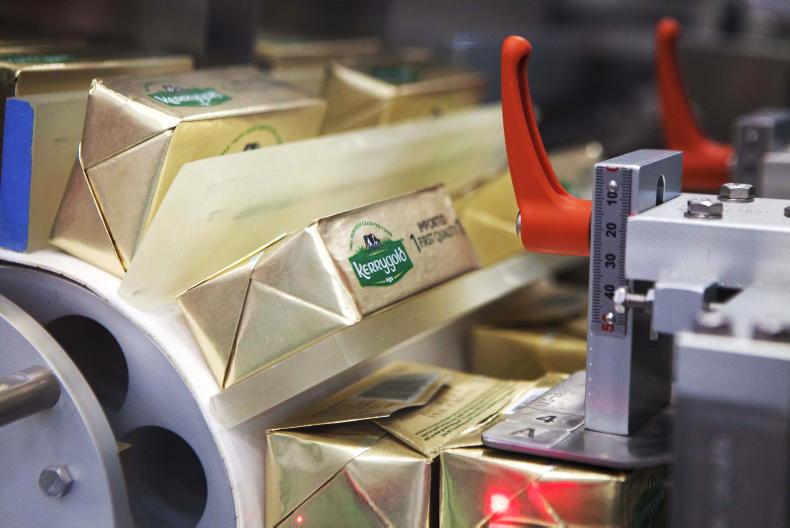
Speaking of butter, Kelly said that Ornua took more butter from Lakeland in 2025 than ever before. “We’re keen to sell more cream and more product to Ornua.”
Lakeland also has its own relationship with Vital Farms in the US, where the co-op supplies butter which is packed by the American firm for retail sale.
“They’re different products. If you look at Kerrygold, it is Republic of Ireland, SDAS (sustainable dairy assurance scheme) approved, grass fed product produced from week seven to week 44,” he said.
I would love if Ornua would take Northern Irish milk into the fold
“That means that around 46% of Lakeland’s milk – ie our Republic of Ireland milk – has a chance of qualifying for it. The product we do with Vital Farms is an island of Ireland product and it also has a higher fat content,” Kelly explained.
“I would love if Ornua would take Northern Irish milk into the fold, like they did previously. We’d be very open and have had those discussions with Ornua.”
Looking ahead for the rest of the year, Kelly said that he would be positive that the milk price by the end of the year would be ahead of current levels, but that the world does need a supply correction to drive that. “In some areas the cost of production is higher than the current milk price. The big variable is why supply correction we will see in the second half of the year and what impact the war in the Middle East will have on consumer sentiment.
“The medium and long term is very positive from a dairy perspective as demand continues to grow, but we may be in an unfortunate part of the cycle where we are seeing 4-5% growth in global milk coinciding with a significant rise in on-farm costs,” Kelly said.
Lakeland’s financial results for 2025 show a co-op that managed to navigate a challenging year quite successfully. Both returning a profit and completing investments during the year show a business that is being sustainably run.
The reopening of Lough Egish was an interesting development from a strategic perspective. When the announcement of that plant closure was made in November 2023, the co-op said that after a decade of milk volume growth, the coming years would be more about adding value than capacity.
In 2023, it certainly seemed like the period of increasing milk output was over in Ireland, and nobody criticised co-ops for taking a look at their available capacity. However, as we have seen since, the increase in output has continued (Lakeland itself saw record deliveries in 2025) meaning that Lough Egish had to be reopened across peak months as the capacity was needed.
This is not meant as a criticism of Lakeland’s decision to close the dryer in 2023; forecasts at the time suggested it was the correct move.
However, it does point to the difficulties across the industry in trying to align capacity with supply on one hand and to align product mix with consumer demand on the other hand. While there is no easy solution to either problem, there is probably more that can be done within the co-op structure to balance those challenges.
Spending money on capital infrastructure is always risky, and traditionally co-ops have always taken care of their own stainless steel. We often talk on these pages about the need for Ireland to have fewer, larger, co-ops in order to increase efficiency, but also to reduce the risks from large capital investments for smaller operations.
If co-ops are unwilling or unable to merge – and the regulatory landscape for co-op mergers is far from ideal as Kelly pointed out when he spoke to the Irish Farmers Journal – perhaps some investments could be derisked through a greater use of joint-ventures between co-ops.




SHARING OPTIONS