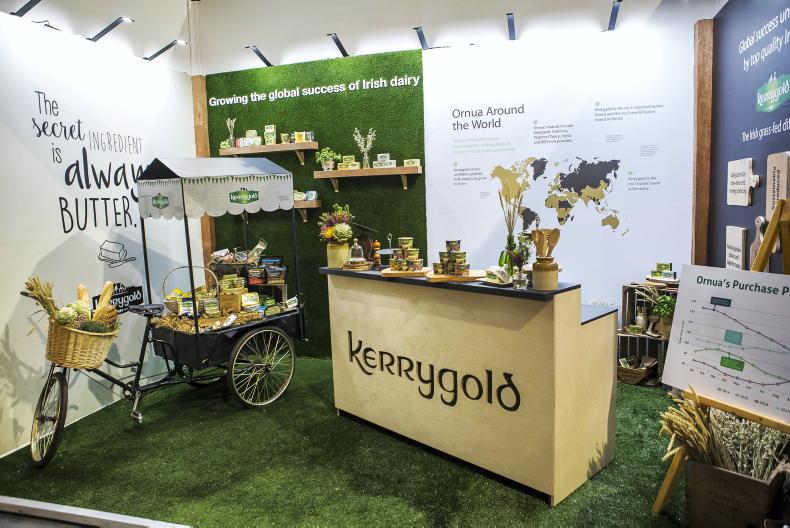
It is clear from comments made by farmers at the Tullamore Show last weekend that feelings are running high around Tirlán’s decision to enter the US private label butter market, in competition with Ornua’s iconic Kerrygold brand.
Taking a step back to look at what Tirlán has decided to do, it quickly becomes obvious that there are arguments on both sides.
For Tirlán, the motivation is financial. A spokesperson for the co-op said that its “focus remains on growing value for Tirlán dairy farmers across multiple routes to market”. The Irish Farmers Journal understands that the multi-year contract signed with Costco to supply its Kirkland private label grass-fed butter will provide Tirlán with a better price per kg of product than the one Tirlán receives from the Ornua. This is despite the Kirkland brand retailing at the significant discount to Kerrygold on Costco’s shelves.
As has been pointed out previously on these pages, the US market for grass-fed butter is both large and expanding. Annual Irish butter exports to the US have risen from less than 10,000t a decade ago to over 70,000t in the 12 months to the end of May this year. Irish butter exports to the US in that period, at €630m, were worth more than total global Irish butter exports a decade ago.
Add to that the fact that the export price for butter to the US is 40% higher than to the UK and 50% higher than to Germany, and it is clear that the US is the place to be selling Irish butter right now.
Ornua pays one price to Irish co-ops for its grass-fed butter, no matter which market is sold into. Therefore, the price earned by suppliers to Ornua is based on a blended price for what it receives across all its export markets.
Tirlán, by signing the contract to supply into the most profitable market, is just taking a slice of the richest pie, without having any of the drag on returns from the lower prices in the rest of the world.
It is no wonder then that a product like Kirkland, which sells at a significant discount to the US Kerrygold price, provides a better return for Tirlán than the co-op gets for butter supplied into Ornua’s global Kerrygold product.
We can accept therefore that the decision by Tirlán is in the best short-term interests of its suppliers. Greater profit per kg of butter will ultimately mean a higher milk price.
It is also fair to suggest that the trend in the US butter market for grass-fed butter has remained strong and that there is no reason to think that the entry of Tirlán into the market will make any great waves in consumer demand.
After all, the Kirkland grass-fed butter product has been on sale in Costco for some time, albeit sold as New Zealand butter. Even after Tirlán starts supplying the product, it will not be clearly labelled as Irish butter, so it won’t even be in direct competition with Kerrygold.
On the other hand, the longer-term effects of the Tirlán move could be negative for all of Ireland’s dairy farmers, including those supplying Tirlán. An Ornua spokesperson told the Irish Farmers Journal: “We do not believe competing on price alone is in the best interests of the farmers we represent, as it devalues the Irish grass-fed butter proposition”.
We have already seen the effects of increased private-label competition in Germany where there are many brands of grass-fed butter available.
Exports of Irish butter to that market are half of what they were four years ago. Some of this drop in volume is probably driven by Irish exports seeking better returns in other markets, but that can only happen where those better returns are available.
If the new benchmark price for grass-fed Irish butter exports to the US is ‘a little more than the global average return available from Kerrygold’ then the risk becomes a scenario where the current healthy margins on butter exports to the US will disappear.
If an Ornua salesperson is trying to do a deal with a major customer in the US, they will be told that they are charging too much for Kerrygold, as that customer will have seen how much the Kirkland brand is selling for, and know that an Irish butter manufacturer who is also supplying Ornua is making a good return at the Kirkland price.
Ornua could easily find itself having no loss in volume or market share, but still being unable to maximise the value from the Kerrygold brand as its customers will refuse to pay anything above the Kirkland price.
The loss of the higher margin on US Kerrygold would inevitably feed through to Ornua’s payments to members for their butter and to the Ornua Value Payment which stood at over €74m in 2025.
With demand continuing to grow for grass-fed butter in the US there is clearly room for both products, but without the premium price for the premium Kerrygold product, the size of the market alone will not be enough to sustain returns to farmers.
What next?
Once the dust settles, there are three separate groups of people who have to make decisions on what to do next. Management at Tirlán needs to decide if they are going to make further moves into the US market, perhaps supplying private label butter to other retailers. Ornua needs to decide how to fight this latest challenge. Importantly, the other co-op members of Ornua need to decide what they will do.
If there are better returns available for supplying butter direct to US retailers, then they may well decide that is way to go for themselves. In recent years we saw Lakeland supply a premium branded product into the US for the Vital Farms brand. That relationship ended recently, but Lakeland might be tempted to go back in if it can find a private label partner.
Having one supplier challenging Kerrygold in a key market will certainly be a challenge to Ornua, but if it were to start a rush of new private label deals with US customers, then it could be the start of the end of the Kerrygold brand as each co-op concentrate on their own customers.
Ornua’s ability to do anything to stop Tirlán is very limited. However, it does have a nuclear option it could use. Under the rules of the society, Ornua can remove a member. Specifically, Rule 6(a)(i) states that the board shall have power to reprimand, suspend or to terminate the membership of any member “who shall offend against the rules of the Society, or be guilty of conduct detrimental to the Society”.
This would block Tirlán from supplying any product to Ornua, and stop Tirlán getting any share of the Ornua Value Payment.
Speaking of nuclear options, Tirlán could decide that it has had enough of dealing with Ornua and sell its stake in Ornua – around 25% – to the other co-op members. Or even go the other way and try to buy out the other members entirely and take the Kerrygold brand for itself.
Good news
Away from butter battles, both Tirlán and Ornua got some good news recently. The strong half-year results from Glanbia last week sent shares in that company higher. Despite significantly reducing its holding over the last two years, Tirlán still holds 31.5m Glanbia shares.
Ornua got some good news on the tariff front, with the latest measures from President Donald Trump meaning the tariff on Kerrygold into the US has dropped back to 15% since 1 August. Measures introduced by Trump since last year’s Turnbery agreement had pushed the rate to 25%.