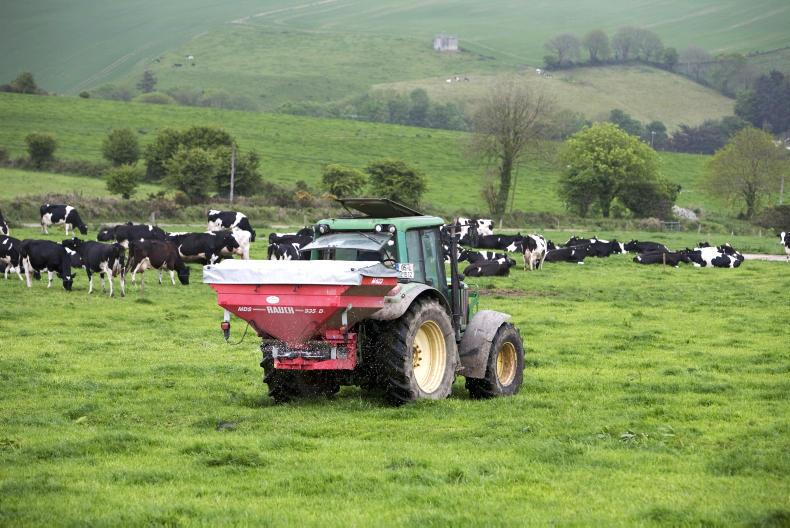
The grazing season is only a matter of weeks old for the majority of the BETTER Farm programme farms, but already the attention is turning to provision of winter forage. Grazing of the silage ground is now part and parcel of the first rotation on the BETTER Farms and, for many, this was a new approach to grazing of livestock in early spring.
Silage ground is being grazed using two different methods, depending on land type. On drier farms where it is possible to get stock out in late February to early March, the general plan is to graze the driest parts of the normal grazing block first. The silage ground is then grazed afterwards.
The reason for this is that grass growth rates are lower in early March and there is a danger of running out of grass if regrowth does not materialise on the grazing block. Grazing the silage ground in the second half of March provides an opportunity to get the grazing block fertilised with slurry and chemical nitrogen. It also gives two to three weeks for regrowth on the grazing block in time for the next grazing.
On heavier farms, turnout dates are generally later in March if ground conditions allow. As this is closer to the usual closing date for silage and grass growth rates are higher than in early March, the silage ground is grazed and then closed up for cutting.
As there is a tendency for silage ground to be the driest fields on heavy farms, grazing the silage ground first gives the benefit of early turnout as well as providing more time for ground conditions to improve on the grazing block.
Fertilizer
The programme farmers and their advisers are currently busy working out their fertilizer requirement for first-cut silage. Fertilizer type and application rate will be based on soil analysis reports from samples taken this winter.
Table 1 outlines the nutrient requirement for first-cut silage. The ideal soil index for both phosphate (P) and potassium (K) is three. An index of one or two means that the soil is nutrient-deficient and grass yields will be lower if the crop demand is not met.
First-cut silage requires 100 units of nitrogen for productive ryegrass swards. This is the equivalent of 3.7 bags of CAN, or 2.2 bags of urea, assuming that no slurry has been applied to the sward. Ryegrass swards normally utilise two units of nitrogen per day, which means a minimum growing phase of 50 days between closing and harvesting silage.
Older swards with a low percentage of ryegrass should receive up to 80 units of nitrogen for first-cut silage as they are unlikely to utilise the higher rate of nitrogen application.
Slurry
Silage removes large quantities of potassium (potash) from the soil which can quickly deplete soil fertility. Slurry is a fertilizer that is normally high in potassium and can return much of the soil nutrients that were harvested in the silage back to the soil. But do not overestimate the value of your slurry.
Silage that is grown from a nitrogen-only fertilizer such as CAN or urea will be low in P and K unless there are high volumes of meal being fed to cattle during the winter period. Undiluted cattle slurry has the following typical nutrient value per 1,000 gallons:
Nitrogen – six units.Phosphate – five units.Potassium – 38 units.Silage Quality
Silage quality is influenced by a number of different factors that are outlined in Table 2. While the farms have little control over the cutting date if the weather is not suitable, the farms have been making efforts to improve silage quality through reseeding and tight grazing before closing up for cutting.
Fertilizer rates
Taking a silage sward at soil index three for both P and K, there is a fertilizer requirement of:
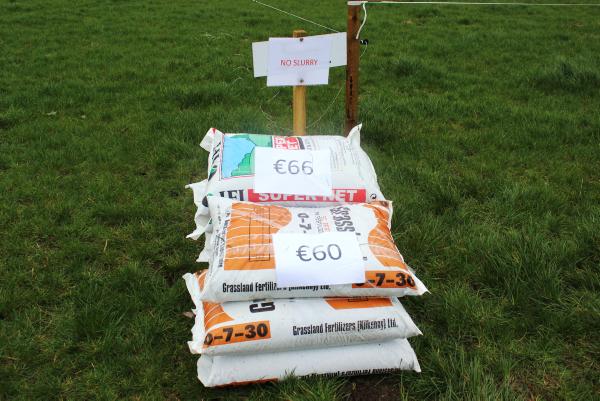
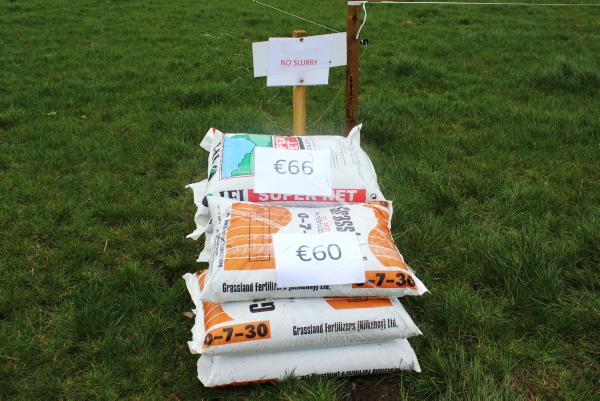
100 units of N.16 units of P.96 units of K.Photo 1 depicts the amount of bagged fertilizer that is required for the crop if no slurry is available on the farm. On out-farms, access to slurry may be limited if there is no housing facilities available. To meet the 100-16-96 units needed, the sward requires three bags of 0-7-30 to supply the right amount of P and K.
The sward will then be topped up with four bags of CAN to supply nitrogen. The CAN costs €66 and the 0-7-30 costs €60, bringing the total fertilizer cost to €122/acre. While this seems excessive, it is the amount required to match all N-P-K requirements by first-cut silage to maintain soil at index 3.
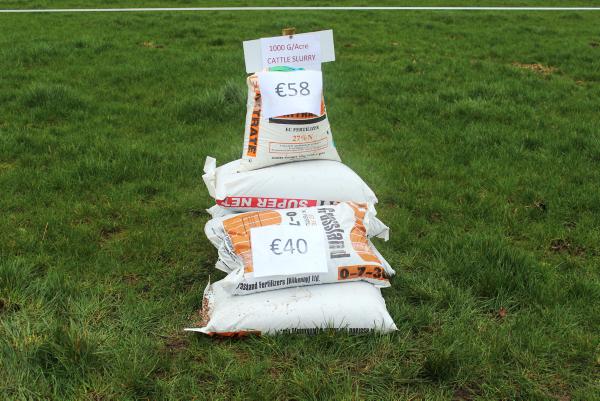
Photo 2 depicts the amount of bagged fertilizer that is required if 1,000 gallons/acre has been applied to the sward at index 3. Again the crop requires 100-16-96 units of N-P-K and 1,000 gallons of slurry will supply 6-5-38 units. To balance the crop requirement, a further two bags of 0-7-30 are required plus 3.5 bags of CAN. The total fertilizer cost is €98 per acre.
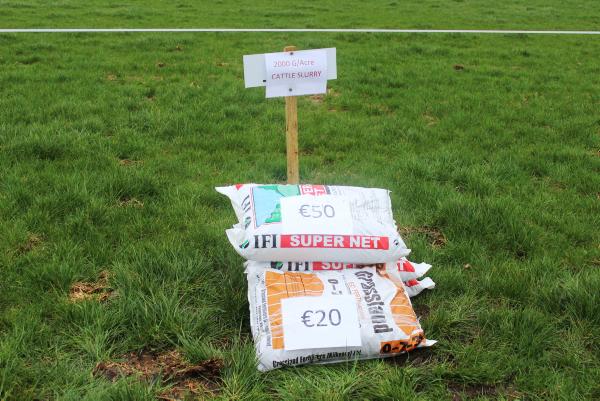
Photo 3 depicts the amount of bagged fertilizer that is required if 2,000 gallons/acre of slurry has been applied to the sward at index 3. The slurry will supply 12-10-72 units of N-P-K. To balance the crop requirement, a further bag of 0-7-30 is required and three bags per acre of CAN. The total fertilizer cost is €70 per acre.
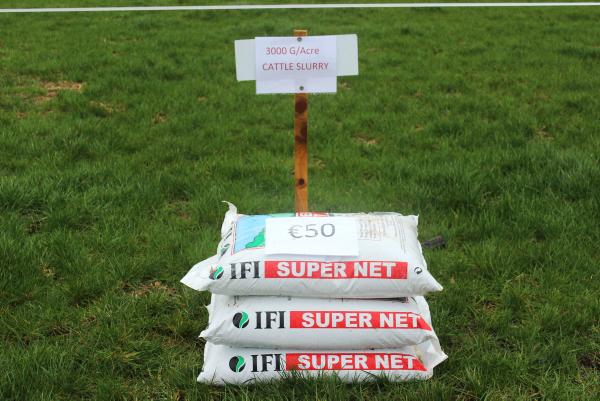
Photo 4 depicts the amount of bagged fertilizer that is required if 3,000 gallons/acre has been applied to the sward at index 3. The slurry will supply 18-15-110 units of N-P-K. As the slurry supplies all of the P and K required, the sward can be topped up with three bags of nitrogen at a cost of €50 per acre.
The grazing season is only a matter of weeks old for the majority of the BETTER Farm programme farms, but already the attention is turning to provision of winter forage. Grazing of the silage ground is now part and parcel of the first rotation on the BETTER Farms and, for many, this was a new approach to grazing of livestock in early spring.
Silage ground is being grazed using two different methods, depending on land type. On drier farms where it is possible to get stock out in late February to early March, the general plan is to graze the driest parts of the normal grazing block first. The silage ground is then grazed afterwards.
The reason for this is that grass growth rates are lower in early March and there is a danger of running out of grass if regrowth does not materialise on the grazing block. Grazing the silage ground in the second half of March provides an opportunity to get the grazing block fertilised with slurry and chemical nitrogen. It also gives two to three weeks for regrowth on the grazing block in time for the next grazing.
On heavier farms, turnout dates are generally later in March if ground conditions allow. As this is closer to the usual closing date for silage and grass growth rates are higher than in early March, the silage ground is grazed and then closed up for cutting.
As there is a tendency for silage ground to be the driest fields on heavy farms, grazing the silage ground first gives the benefit of early turnout as well as providing more time for ground conditions to improve on the grazing block.
Fertilizer
The programme farmers and their advisers are currently busy working out their fertilizer requirement for first-cut silage. Fertilizer type and application rate will be based on soil analysis reports from samples taken this winter.
Table 1 outlines the nutrient requirement for first-cut silage. The ideal soil index for both phosphate (P) and potassium (K) is three. An index of one or two means that the soil is nutrient-deficient and grass yields will be lower if the crop demand is not met.
First-cut silage requires 100 units of nitrogen for productive ryegrass swards. This is the equivalent of 3.7 bags of CAN, or 2.2 bags of urea, assuming that no slurry has been applied to the sward. Ryegrass swards normally utilise two units of nitrogen per day, which means a minimum growing phase of 50 days between closing and harvesting silage.
Older swards with a low percentage of ryegrass should receive up to 80 units of nitrogen for first-cut silage as they are unlikely to utilise the higher rate of nitrogen application.
Slurry
Silage removes large quantities of potassium (potash) from the soil which can quickly deplete soil fertility. Slurry is a fertilizer that is normally high in potassium and can return much of the soil nutrients that were harvested in the silage back to the soil. But do not overestimate the value of your slurry.
Silage that is grown from a nitrogen-only fertilizer such as CAN or urea will be low in P and K unless there are high volumes of meal being fed to cattle during the winter period. Undiluted cattle slurry has the following typical nutrient value per 1,000 gallons:
Nitrogen – six units.Phosphate – five units.Potassium – 38 units.Silage Quality
Silage quality is influenced by a number of different factors that are outlined in Table 2. While the farms have little control over the cutting date if the weather is not suitable, the farms have been making efforts to improve silage quality through reseeding and tight grazing before closing up for cutting.
Fertilizer rates
Taking a silage sward at soil index three for both P and K, there is a fertilizer requirement of:
100 units of N.16 units of P.96 units of K.Photo 1 depicts the amount of bagged fertilizer that is required for the crop if no slurry is available on the farm. On out-farms, access to slurry may be limited if there is no housing facilities available. To meet the 100-16-96 units needed, the sward requires three bags of 0-7-30 to supply the right amount of P and K.
The sward will then be topped up with four bags of CAN to supply nitrogen. The CAN costs €66 and the 0-7-30 costs €60, bringing the total fertilizer cost to €122/acre. While this seems excessive, it is the amount required to match all N-P-K requirements by first-cut silage to maintain soil at index 3.
Photo 2 depicts the amount of bagged fertilizer that is required if 1,000 gallons/acre has been applied to the sward at index 3. Again the crop requires 100-16-96 units of N-P-K and 1,000 gallons of slurry will supply 6-5-38 units. To balance the crop requirement, a further two bags of 0-7-30 are required plus 3.5 bags of CAN. The total fertilizer cost is €98 per acre.
Photo 3 depicts the amount of bagged fertilizer that is required if 2,000 gallons/acre of slurry has been applied to the sward at index 3. The slurry will supply 12-10-72 units of N-P-K. To balance the crop requirement, a further bag of 0-7-30 is required and three bags per acre of CAN. The total fertilizer cost is €70 per acre.
Photo 4 depicts the amount of bagged fertilizer that is required if 3,000 gallons/acre has been applied to the sward at index 3. The slurry will supply 18-15-110 units of N-P-K. As the slurry supplies all of the P and K required, the sward can be topped up with three bags of nitrogen at a cost of €50 per acre.







SHARING OPTIONS