


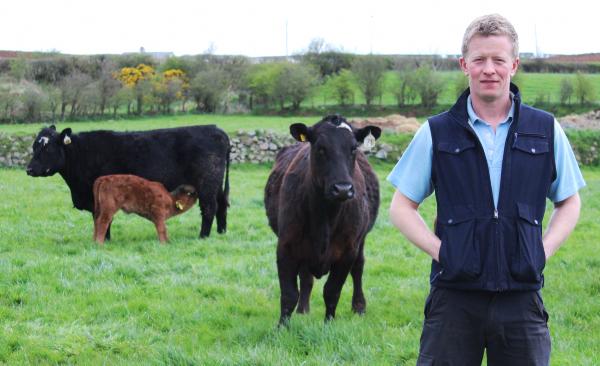

James Taylor, Portrush, Co Derry
The stock bulls went out with the cows on 30 May, which was a couple of days earlier than normal. We have just finished our annual TB test and it was more convenient to put the bulls out after the test rather than waiting until 1 June.
The cows are split in two groups for breeding. The first group consists of 41 cows and the second group has 29 cows. The smaller group includes first-calved heifers as well as cows. I am running two Stabiliser bulls and the breeding period will last for nine weeks.
The stock bulls were bought because they possess strong maternal traits. They are also polled, which saves time and labour.
I am planning to increase cow numbers over the next few years, so getting plenty of maternally-bred heifers on the ground is essential if this is to happen.
I do not want to buy in cows because of the disease risk. Also, you can never be sure of how these cows will perform unless they are repeatedly sourced from the same herd. I also have a group of 22 heifers running with an Angus bull at the moment.
I have been measuring the pelvic opening of heifers using a Rice Pelvimeter for three years now. The purpose of this is to identify cows which will be hard to calve and unsuitable for breeding.
The pelvic area of my heifers is measuring on average 180cm2. The bottom 10% of heifers are culled as they will have calving problems.
All being well, there should be approximately 85 to 90 cows calving down in early March next year.
We have a reasonably dry farm and there is an opportunity to get cows out to grass shortly after calving. Cows have been vaccinated for BVD, Lepto and IBR. Calves got the first shot for Blackleg around three weeks ago. They will get their booster shot in another two to three weeks.
We have started measuring grass on a weekly basis over the past two months and already I can see the benefits of this.
We do not measure the whole farm, just one of the main grazing blocks where cows and calves are grazing. It is a great exercise in learning to manage grass better.
Grass growth is 56kg DM/ha this week with cows having a grazing demand of 40kg DM/ha/day. Average farm cover is 2,453kg DM/ha and we have 19 days ahead.
Cows are grazing on an outfarm and they were brought home for a TB test a fortnight ago. They stayed on the home farm until after the results were read.
During this time, grass on their normal grazing block has become too strong for grazing. The land block is not suitable for baling but we will get it topped to bring grass back under control.
We have taken out 100 bales from grazing ground this spring to maintain sward quality, as well as topping grass as it heads out. Most of the grazing ground received 27 units/acre of CAN a fortnight ago after topping and regrowth is excellent.
We harvested 115 acres of silage on 24 May. Normally, we cut around 90 acres of first-cut but with good grass growth, we closed up part of the grazing ground and ensiled it rather than letting it go to waste. Silage yields were close on 10 tonnes per acre and it was harvested in dry weather.
There was definitely a visible difference in grass quality between silage ground that was grazed before closing and the ground that was not.
Where silage ground was grazed, there is more leaf present, less stem and aftermath is greener. Silage received 2,000 gallons/acre of slurry, two bags of 20:10:10 and topped up with CAN to make up 100 units of nitrogen.
We will close up 60 acres for second cut, which will most likely be harvested earlier this year due to the early first cut. Silage quality and yield of the second cut will also be better, which is an added bonus.
The spring 2013 bulls are now being slaughtered. The first six bulls averaged 375kg deadweight at 14.2 months, which is a daily carcase gain of 0.83kg/day.
They ranged from 390kg to 360kg. They were fed 11kg silage, 8.5kg potatoes, 2.5kg crimped barley, 0.7kg straw, 1kg distillers, 2kg maize and 0.1kg urea during the finishing phase. The diet cost £1.60/day. These were the best bulls in the group. The rest will be slaughtered shortly and I am hoping to average 350kg deadweight for all bulls.




SHARING OPTIONS