



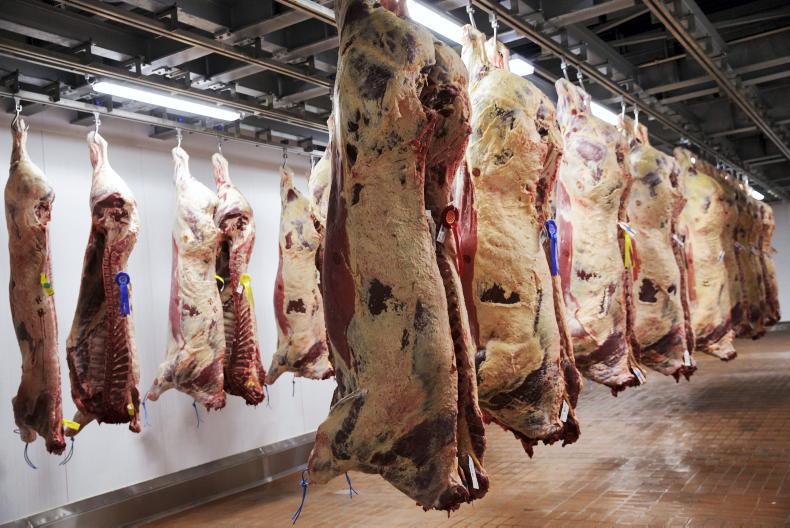
Factories continue to apply pressure to the beef trade this week, with further downward movement in quotes.
This week’s pressure brings general bullock quotes back to €7.30/kg, with heifer quotes moving to €7.40/kg in most sites this week. A few factories are trying to buy heifers at €7.35/kg.
Factories are saying that beef cuts and especially the higher-priced cuts have become increasingly hard to shift in recent weeks, with the Irish price also creeping ahead of the English price cited as a problem in terms of selling beef to the UK.
The general consensus is that quotes will stabilise next week with the ploughing championships taking place.
Factories have always been slow to apply cuts in ploughing week and many are planning a similar kill next week, which demonstrates that they still need numbers.
Factories would have hoped for a bigger flush of cattle after last week’s price pull, but numbers have stayed steady.
Factory agents are still actively looking for cattle, but some are exercising a little more caution. Some are also advising farmers buying back in to have the sums down and to work off a beef price lower than the current price.
Cows
The cow trade is also back, with some factories down another 10c/kg for cows for Monday morning’s quotes.
R grading cows are generally trading at €7.20/kg to €7.30/kg, while O grading cows are coming in around €7.00/kg to €7.10/kg.
P grading cows are back to €6.80/kg in some locations, but €6.90/kg is still available, especially where numbers are involved.
Bulls
Up to €7.60/kg is still available at the top end for U grading bulls where numbers are involved, working back to €7.20/kg to €7.30/kg for O grades.
Last week’s kill came in at 27,549, up 936 head on the previous week’s kill of 26,613 head.
The increase came in the bullock category, with more bullocks becoming available for slaughter off grass over the last seven to 10 days.
The cow kill remains low at 5,180 head and with milk price good, there is expected to be no glut of cows in the next few weeks before housing begins ahead of winter 2025.
There is an increasing amount of South American beef coming on to the European market in the last number of months.
This is to fill gaps where European beef production has reduced, but is a worry for Ireland, which exports 50% of its exports to the EU market.
July and August 2025 Brazilian beef imports hit their highest level in the last 15 years, hitting almost 10,000t of frozen and chilled product.
Exports to Spain are up 26% in the period January to August 2025, compared with the same period in 2024. Exports to the Netherlands are up 18%, while Italy is up 28% to 9,299t for the first eight months of 2025.
The Food and Agriculture Organisation of the United Nations meat price index averaged 128 points in August, 0.7 points (0.6%) higher than in July and 5.9 points (4.9%) up compared with a year ago, reaching a new record all time high. The increase was driven by rising beef and sheepmeat prices.
International beef prices reached a record due to strong demand from the United States, which pushed quotations higher in Australia, and firm import demand from China, which kept Brazilian export prices stable despite reduced sales to the US after the imposition of additional tariffs
Meanwhile, in New Zealand, tight cattle numbers has meant the national kill is back 4.7% on 2024 numbers, with a resultant increase in price. Prime bullocks are currently trading at NZ$8.85/kg (€4.51/kg).
NI comment
Quotes in Northern Ireland are steady, with heifers up at £6.59/kg (€7.66/kg incl VAT) in the last week.



SHARING OPTIONS