



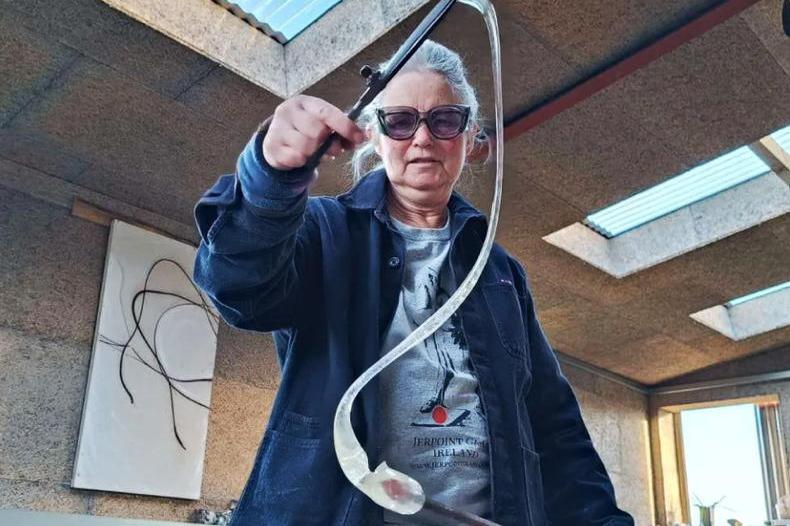
On The Glass Farm in Dromahair, Co Leitrim, artist and farmer Adrienne Diamond is bringing all her favourite things together – creative expression, sustainability, farming, the community, and above all, glass.
The 11ac organic farm is home to Adrienne, her husband Graham, a herd of sheep, several donkeys, and a glass-making studio and workshop. Adrienne also runs a Social Farm initiative, allowing her to share the joys of farming life and her creative passion with participants.
“I’ve always been an artist and a glassmaker,” says Adrienne, “but I let it sit for maybe 10 years because there was already glass-making facilities in Manorhamilton in the Sculpture Centre.When they closed, I thought it was an opportunity, and I was able to buy some of their equipment.”
The environmentally friendly craft facilities on the farm were built using eco-fibre board and sheep wool insulation with support from the ACORNS LEADER programme, which supports early-stage female entrepreneurs who are rurally based to accelerate their business.
Adrienne now offers classes in glass-making for people of all abilities – from curious beginners to artists who want to develop their practice.
She also rents the facility, which is designed uniquely to allow equipment to be moved to accommodate other makers, workshops, exhibitions and social farming activities.
“North Leitrim and Sligo is full of artists. The plan is that they will be taking classes and renting the workshop. I’ve had one renter so far and she had an exhibition in the Leitrim Sculpture Centre. Some of the work in that exhibition was made in my workshop.”
The Glass Farm had their first major event recently as part of August Craft Month, funded by the Design & Crafts Council Ireland (DCCI).
Rather than massively producing things, it’s about helping people find their own creativity, sharing skills around, and keeping the skills alive around the glass-making
“We had eight creative people up here from all sorts of different backgrounds, some of them glassmakers, but others not. For the two days, we just played with the glass, and it wasn’t about making a finished object, but it was about sharing our common ground and even things that were different about us and exploring the possibilities of the glass. It was amazing. Everybody brought their own tools and techniques and their secrets of the trade, and it took off. I facilitated it, but then it just took on an energy of its own.”
Sustainability is at the heart of everything Adrienne does. Traditional glass-making can be emissions-heavy, as gas is used in the heating, but at The Glass Farm, the process is all electrical.
“My dream was to do it all electric and smaller scale,” explains Adrienne. “With electric, it’s a smaller furnace, so you can turn it off and on.
“I keep it on for three days and then turn it off again, so it’s not on blasting away all the time.”
The studio has also run Ecoglass classes to create crafts using glass recycled from discarded double-glazing panes.
“Rather than massively producing things, it’s about helping people find their own creativity, sharing skills around, and keeping the skills alive around the glass-making.”
Adrienne describes the support she has received from ACORNS as “way more than I expected” and says the encouragement of her group has been invaluable. “There are seven others in the group and we’re sharing information all the time. I could go to them with anything. It’s a support group and I think that’s going to grow and grow,” she adds.
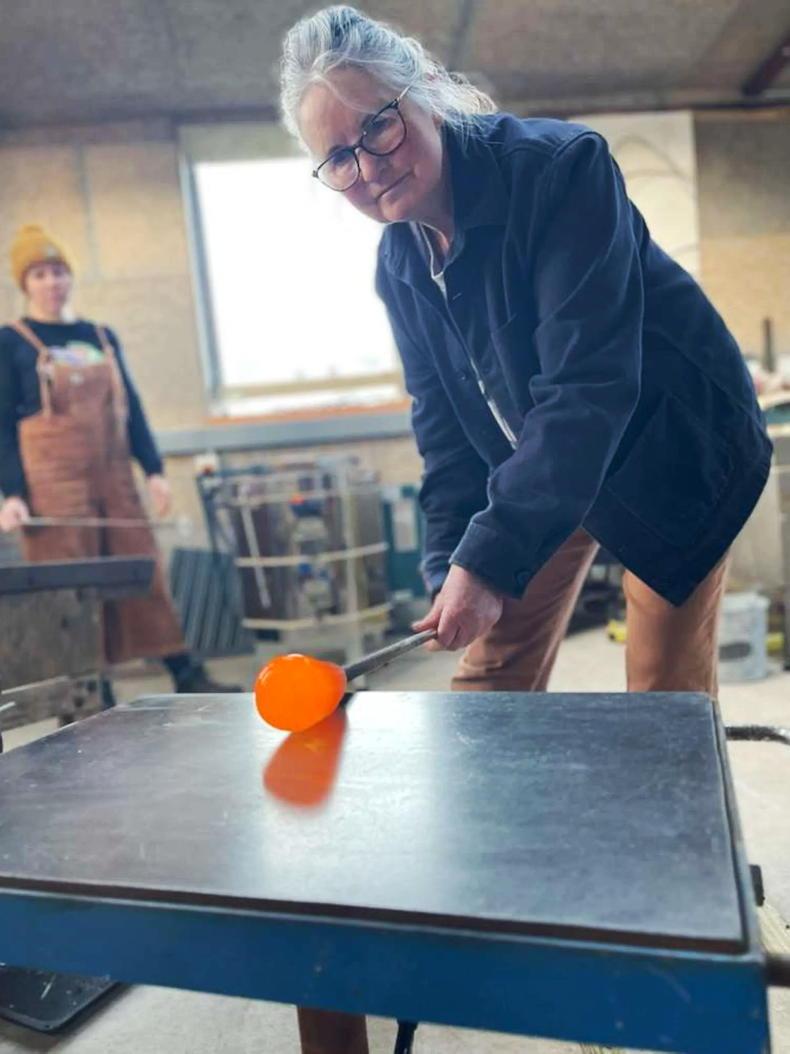
She is currently focused on acquiring a sustainable reheating chamber to use in her studio, something which will allow her to teach glass-blowing at the farm.
The equipment, which is also known as a glory hole, is normally powered by gas, and although there are electrical chambers available, they are only produced for commercially scaled factories.
Adrienne has travelled across Ireland and the UK in search of a company who will produce a smaller-scale electrical reheating chamber, but it seems it may need to be designed and developed from scratch.
In the meantime, The Glass Farm will continue to run alternative glass-making workshops and classes, as well as the regular social farming sessions, which Adrienne and Graham love.
“It’s two-sided. The participants gain from coming to a farm. We would have had a lot of older participants coming, and maybe they would have grown up on farms, but then went to live in the town.
“We sit around telling stories, and we learn from them as well, and it breaks the farmer’s isolation too. It’s really nice for my husband and myself, and it’s farm diversification.
“We also do arts and crafts with the participants, and woodwork. It’s early days yet, but some of the social farmers are interested in the glass as well, and I hope to help people explore their creativity that way too.”
See glassfarm.ie and acorns.ie for more details.
ACORNS is funded through the Rural Innovation and Development Fund by the Department of Agriculture, Food and the Marine (DAFM) and was launched earlier in the summer by the Minister for Agriculture, Food and the Marine Martin Haydon.
ACORNS 12 will run from October 2026 to April 2027. The programme is open to early-stage female entrepreneurs living in rural Ireland who have generated sales no earlier than the end of June 2023. There are up to 50 places available.
There is no charge for those selected to participate due to the continuing support of the Department of Agriculture, Food and the Marine and the voluntary contribution of time by the Lead Entrepreneurs. The window for applications will close at midnight on Friday 18 September. Those wishing to apply must first register their interest via the website (acorns.ie). They will then be sent a short application for by email.



SHARING OPTIONS