The longer it takes to form a government, the closer the prospect of the demise of the politician.
We are all in danger, both national and local politicos, if the people wake up to the fact that we’re surplus to requirements – the country is getting on fine without politicians in charge. Yes, we have an acting cabinet, but it’s clear they’d prefer to be doing anything else. And it’s hard to blame them; they’re like a bicycle without a chain, freewheeling around until they run out of road.
As for the rest of our newly elected parliamentarians, Pa Cantillon compares them to a shed full of bullocks; all the appearance of potency but when it comes to the job in hand they have neither the will nor the tackle to do what’s needed.
I haven’t heard as many politicians saying “no” since Maggie and Garrett signed the Anglo Irish Agreement in 1985. They’re all talking about Dáil reform and a new way of doing politics, but if they don’t get their act together soon, the people will suddenly discover that the new way of doing politics doesn’t involve politicians at all. This has serious implications for my pension plans.
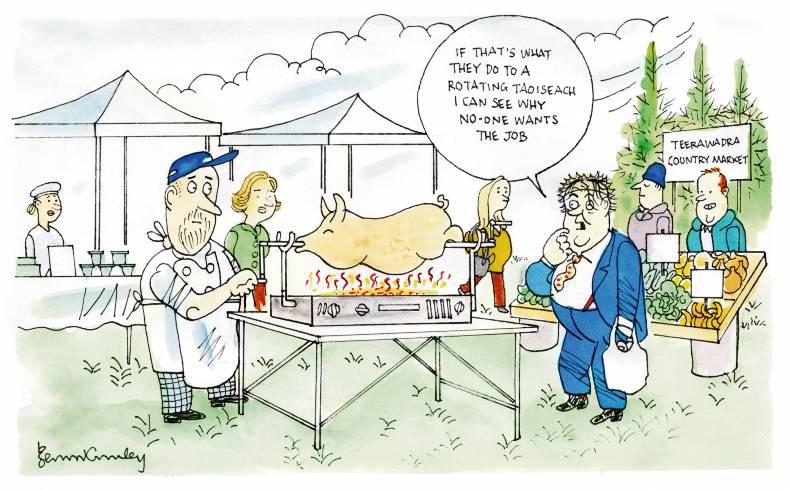
Now, instead of just giving out about this, I have decided to adopt a “solution oriented approach” and have been asking various people in my social circle what formation they would suggest for the next government. The Mother is in favour of an FG/FF coalition with a rotating Taoiseach.
“I suggest that when one of them is Taoiseach the other fella should be his driver,” she said, “they’ll learn to live with one another fairly lively when they have to put up with one another’s personal habits in such close quarters, day in and day out.”
I’m not so sure that’s a recipe for a stable government. The Mother and myself spend a lot of time in the car together and if the rows and arguments we have are anything to go by, I wouldn’t put much money on the Grand Coalition lasting too long if the rotating Taoisigh had to spend protracted periods of time in so confined a space.
Tom Cantwell believes that the idea of a rotating Taoiseach should involve all party leaders and the practice should apply to ministers as well.
“For example,” he says, “there should be a rotating Minister for Strokes, Favours and Shortcuts. Such a ministry would last about four months and every party would get a turn at it.”
To balance it out, he proposes the Minister for Strokes Favours and Shortcuts would serve the next four months as Minister for Health, going from the playing fields to the minefield. Furthermore, he suggested that every Minister for Health should spend his or her four months in that portfolio sleeping on a trolley in a hospital corridor.
Pa Quirke suggested that every party should have a turn as Minister for Foreign Affairs, or the Minister for GOF (Going out Foreign), as he called it. However, after four months of red carpets and Mercedes, the incumbent should then be transferred into the Ministry for Housing where he or she would live out the tenure of their ministerial responsibilities in a doorway in Dawson Street. I’d imagine the housing crisis would be sorted fairly lively after that dose of misery.
I must admit this task of designing a “new politics” made me realise I hang around with a very even-handed bunch – great believers in give and take. They suggested that the Ministry of Finance should be divided in two, between a minister for giving and a minister for taking, a taxer and a spender. As you probably guessed, the two ministers would swap jobs after four months, giving them a taste of sweetness and the bitter pill.
You might think all this is cracked but I reckon it makes a lot of sense. If there are 15 ministries to give out and if each minister is appointed for eight months during a five-year Dáil term, then about 120 TDs will have had their shoes under a ministerial desk. The remaining three dozen or so that didn’t get a chance at the top table could be given other jobs like mopping up after Irish Water, draining the Shannon or reviving the Irish language. At the next election, every TD in the house will have to face the people and account for his or her movements instead of blaming everybody else for the state we’re in.
We all thought our plan was the best solution on offer. However, Moll Gleeson, our local FG councillor, and her FF counterpart, Peter Treacy, were not impressed,
“That’s a recipe for chaos,” says Moll.
“And tell me,” says Tom Cantwell, “what word would you use to describe the situation we find ourselves in at the moment?