



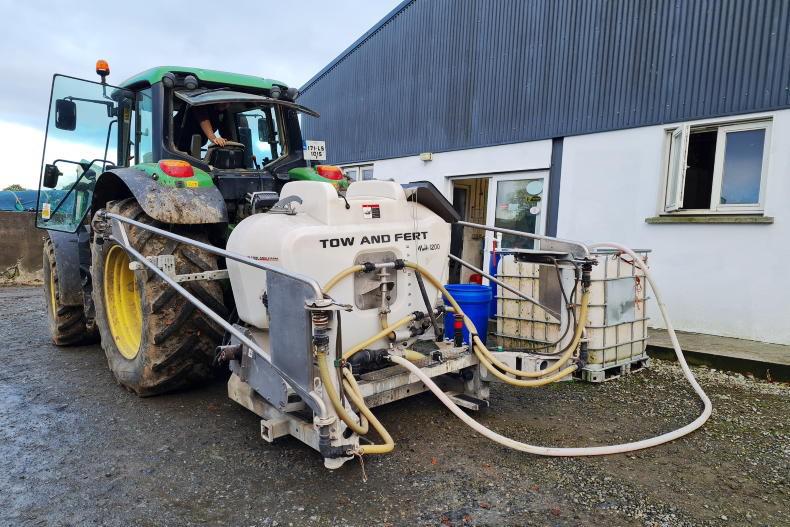
Foliar application of nitrogen is something that has come to the Irish market in recent years, with an aim of growing more grass, from less fertiliser.
While approximately 15% of fertiliser in New Zealand is spread through a foliar applicator, it is still a very new concept here in Ireland.
Tow and Fert is a New Zealand-built machine and has been on the market in Ireland since 2017. The best way to describe it, is a hybrid between a sprayer and a fertiliser spreader.
The theory is that liquid nitrogen is sprayed onto the leaf rather than the soil. It intends to maximise absorption through the leaf, which is faster and more efficient than through the soil.
From trials in New Zealand and Wales, savings in nitrogen can be up to 40% to grow the same amount of grass as granular fertiliser, due to less losses.
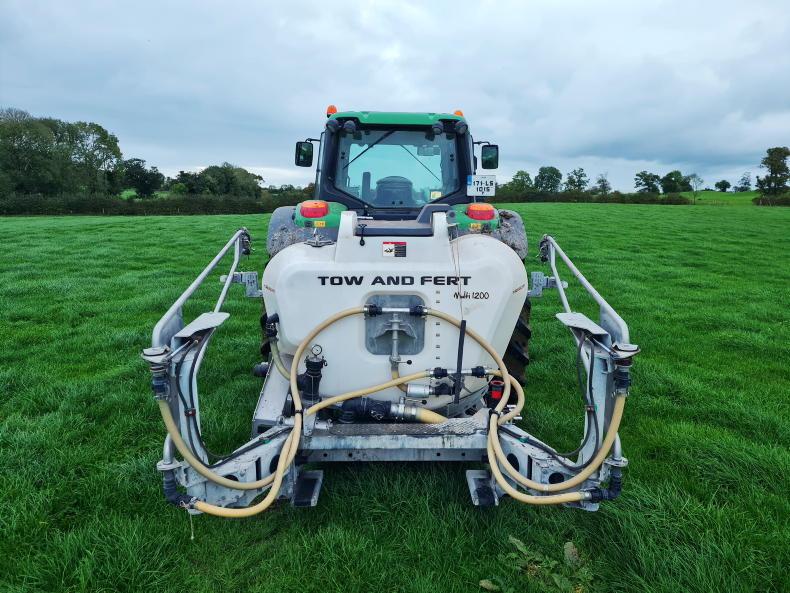
While it sounds simple to change over to foliar application, there is a lot more management involved. Timing is extremely important for better results. Farmers will have to spread more often than they typically would with granular nitrogen.
As the liquid nitrogen targets the leaf, ideally there should be a cover of between 300-700kg DM/ha in order to get the best uptake. Spraying with a cover of less than 300kg DM/ha would lead to losses.
Timing of application is also essential. As the nitrogen is absorbed through the leaves, stomata must be open.
Guard cells control the opening and closing of stomata and are influenced by sunlight, meaning the best time for absorption is during the day.
It takes about six hours for the nitrogen to get into the leaf, so the optimal time for spreading is either early in the morning or late in the evening. It is also recommended to not to spread in conditions above 20°C, unless there is good moisture content on the leaf.
One of the selling points of the Tow and Fert sprayer is the flexibility it allows farmers to create their own mix. The granular nitrogen must be dissolved down in cold water, which is done while the tank is filling and on transport to the field – usually made at a rate of 2:1 water to nitrogen.

While the main saving is nitrogen, Tow and Fert aims to also have a focus on soil fertility. Adding farm-specific products can focus on soil structure and nutrients locked in the soil.
Farmers can also add products such as finely ground limestone to maintain pH, gypsum for calcium and sulphur, trace elements, molasses and milk powder to feed soil biology and health, and also seaweed for root conditioners. Some farmers also add a carbon source, such as a soft powder rock coal, which is claimed to improve soil structure and drainage.
Once the mix is made, the only way in which application rate can be changed is by adjusting speed, as the nozzles let out the same amount. Rates are easily adjusted and it can spread at rates as low as one unit N/acre, which is especially beneficial when it comes to clover.
Farm visit
On the Reynold’s family farm in Navan, Co Meath, the. The mix they typically use on the grazing platform is a 4,000l fill for 23ha containing: three 375kg bags of urea, 190kg bag of sulphate of ammonia all of which is mixed in 2,300l of water. They also add in trace elements and humates, which is approximately the equivalent of 24kg N/ha plus 1kg S/ha.
From using Tow and Fert in 2021, where they would have traditionally spread 200kg N/ha, they have since been able to reduce this to 100kg N/ha in 2023, a saving of about 50%.
The Reynold’s farm opted for the biggest machine on the market, which is 4,000l, costing approximately €75,000 and with the saving on nitrogen, will have the machine paid for in two to three years on their 156ha milking platform.
The range of equipment makes Tow and Fert suitable for different scales of farmers. The smallest version is a 500l, with a 10m spray width, that can cover 4ha in 25 minutes and can be towed by an ATV. This machine has a starting price of around €13,000.
The largest sprayer is a 4,000l, costing €75,000, this machine can cover up to 40ha in one fill with a 24m spraying width. The PTO-driven machine weighs up to 10t full and would require a minimum of 120hp to pull.
Other ranges include 1,000l, 1,200l and 2,800l machines which can be towed or on the three-point linkage. They also come in a range of different spread widths.
As it stands, Tow and Fertsprayers don’t qualify for TAMS, and as of yet there is no Teagasc research on foliar application versus either liquid or granular application.



SHARING OPTIONS