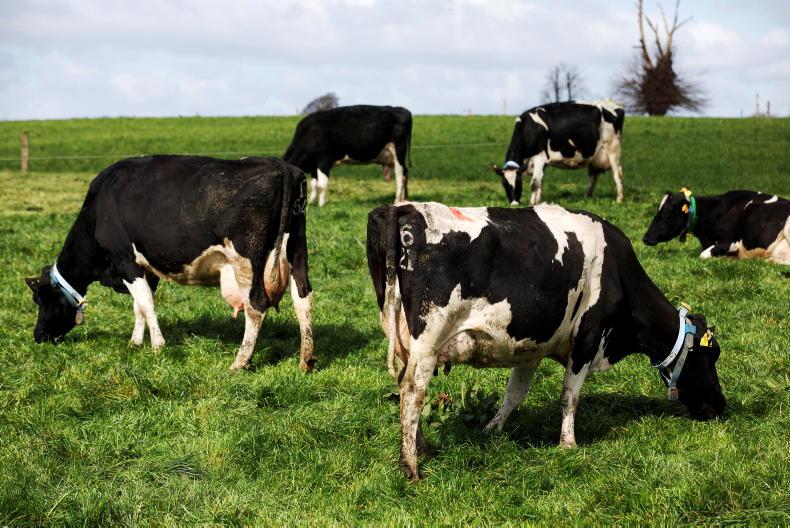
Grass: It’s a bit of a case of damned if you do and damned if you don’t when it comes to managing grass these days. If you didn’t skip over and cut heavy covers for silage you would be left with very poor-quality grass and if you did cut out a lot of the farm for silage you’re probably getting tight for grass now. High grass growth rates in June are always hard to manage as it coincides with grass going to seed.
The challenges were compounded last week when colder than expected weather caused a sharp dip in growth rates. A good chunk of farmers who were trying to do the right thing are now tight for grass, but it is probably a temporary deficit as growth rates should improve this week. For me, a grass deficit is when the average farm cover per cow drops below 140 to 150kg/cow. At this level, some extra supplement is needed to slow down the round and keep rotation length at 21 days or so.
To know what covers cows should be going into, multiply the stocking rate by the amount of grass each cow eats by the number of days in the rotation. For example, a herd stocked at four cows per hectare eating 18kg DM of grass per day in a 21 day round require a pre-grazing yield of over 1,500kg DM/ha (4 x 18 x 21 = 1,512kg DM/ha).
Nitrates: There was an increase in nitrate levels in rivers during 2025, according to the latest report from the Environmental Protection Agency (EPA). With so many variables involved, particularly the weather, it’s hard to definitively say what exactly caused the increase. What it does highlight is the fragility of the progress that has been made over the last few years. I don’t believe nitrate levels increased in 2025 because farmers cared less, but I do believe farmers need to double down and keep working on the actions to improve water quality. If the uptick in nitrates happened in 2024, would we have a derogation today? At the end of the day, it’s a collective effort to improve water quality but it starts at an individual level. Are there things farmers can do to reduce run-off from farm yards? Are there practices that should change? Big ticket items like slurry storage will help, but there are often smaller things that need to be done too.
Reseeds: Generally speaking reseeds are looking good, with good establishment in most cases without any major pest or weed problems. Fields that were sown early are due to be grazed now, after the post-emergence spray. For the vast majority of farmers, clover should have been sown with the grass seeds so a clover safe spray is necessary. Pro Clova is not suitable for red clover reseeds, so Clovermax or DB Plus is still available for red clover reseeds.
Timing is critical when it comes to spraying reseeds. Leave it too late and the dock seedlings will get established and will be harder to control. In terms of fertiliser, it’s true to say that there is usually a high level of mineralisation of soil nitrogen after reseeding, due to soil disturbance. However, reseeds have a high response to nitrogen and perennial ryegrass has a high demand for nitrogen, particularly in the establishment phase.