



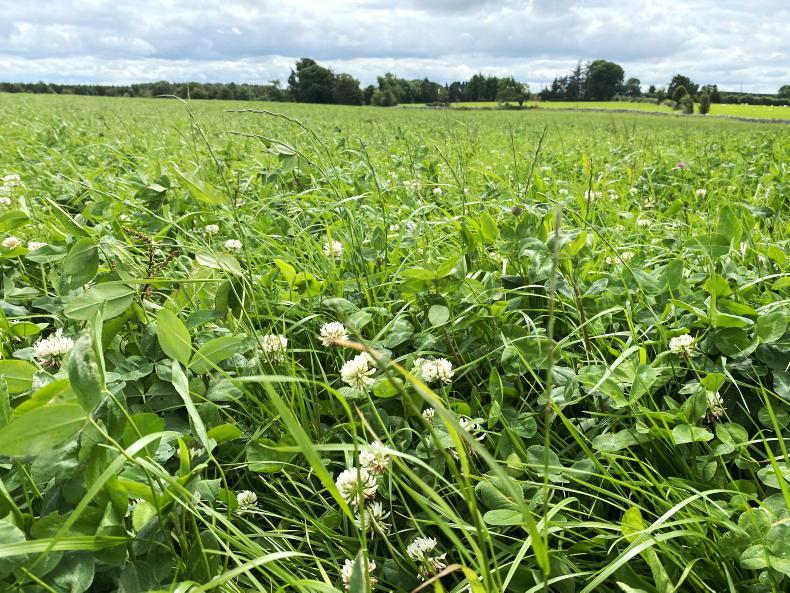
Performance of white clover varieties under intensive grazing
Since 2022, there has been an increase in white clover usage on farms, mainly in response to environmental and financial implications associated with applying chemical N. This renewed interest in white clover has led us to some new research questions: what level of clover content is expected in swards, are there differences between varieties, how persistent are varieties under intensive grazing?
The answers to these questions will eventually develop new insights into traits that will be incorporated into the Clover Profit Index.
The results below are from a two-year grazing experiment, which took place in Teagasc Moorepark (2024 and 2025) and is still ongoing, to assess white clover varieties under a protocol representative of commercial farm practice, ie under grazing with a N application rate of 150kg N ha.
The objective of this study was to evaluate white clover variety performance under intensive grazing as implemented on commercial farms, focusing on herbage production and sward clover content.
Seventeen white clover varieties were sown with perennial ryegrass (PRG; Lolium perenne, L.) and a PRG monoculture control (cv. Aberchoice). These plots were rotationally grazed at an average cover of 1,400kg DM/ha by dairy cows until an average post-grazing height of 4cm was reached.
The grass only sward yielded 8,471kg DM/ha, which was numerically inferior to all grass/clover swards and significantly lower than the highest yielding variety of clover, Crusader (10,162kg DM/ha).
Varietal and seasonal differences in clover content were observed. The varieties Galway, Iona, Buddy and Tasman all had lower sward clover content. Clover leaf size does not look like an indicator of agronomic performance and is more a classification category.
This demonstrated that under 150kg N/ha and grazing, clover inclusion was benefiting production and differentially so between varieties.
This study demonstrates that white clover varieties can enhance sward production and are able to express these differences under a rotational grazing management at a relatively moderate nitrogen level (150kg N/ha). The assumption that clover varieties will rank the same regardless of defoliation method or applied nitrogen level needs more investigation.
Clover persistence is an important trait, which is likely to identify elite varieties capable of optimising farm environmental and economic performance. This is a trait of consideration for this study in the years ahead, but already some clover varieties are showing lower levels of clover two years into the study.



SHARING OPTIONS