On leaving Auckland Airport and making the journey south to Hamilton, New Zealand’s fourth-largest city, you could be forgiven for wondering what all the fuss is about when it comes to the well-publicised intensity of New Zealand’s dairy industry.
For much of the hour-long drive, urban sprawl and rather unremarkable drystock farms dominate the landscape, providing very little indication that you are approaching the traditional heartland of one of the world’s largest dairy-exporting nations.
Once you arrive in Hamilton, however, the influence of agriculture becomes clear, and within five minutes of the city bounds, the scale of dairying in the region really becomes apparent.
Dairy farm follows dairy farm, stretching as far as the eye can see.
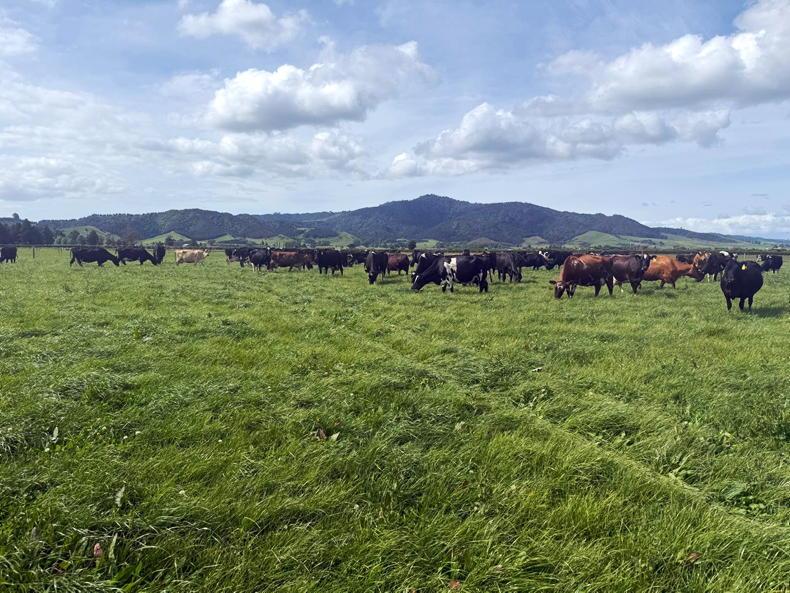
Herds of predominantly crossbred cows graze large blocks of land on either side of the road, with little more than basic milking parlours and small hay sheds to accompany them.
There are no big cubicle sheds, tractors, or fancy yards.
This is the Waikato, the traditional heartland of dairy farming in New Zealand.
Within roughly a 100km radius of the city of Hamilton, there are close to one million dairy cows milking, almost a quarter of the national herd.
The only reasonable comparison with Ireland would be the golden vale, but even this doesn’t do the area justice.
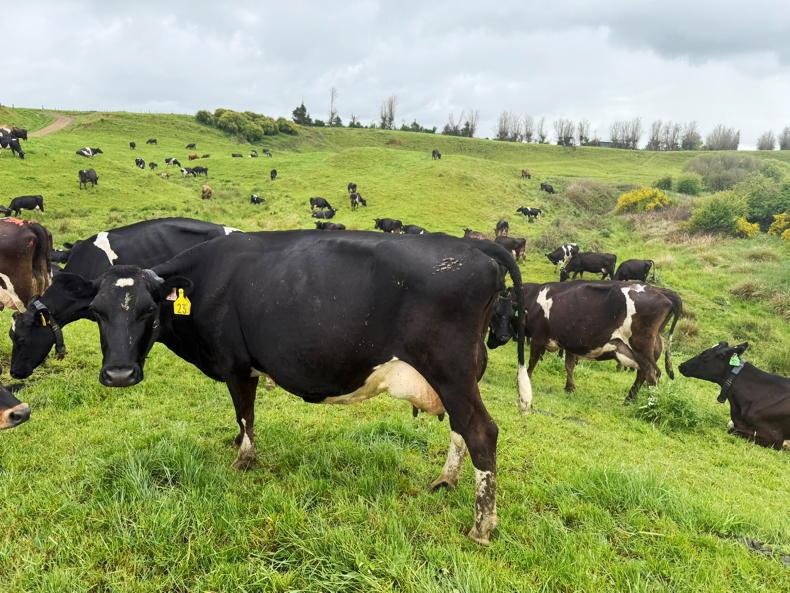
While there are flat tracks of land in parts of the Waikato, the area is well known for it’s rolling hills, with some farms operating on particularly steep terrain.
Cows are grazing wherever a blade of grass can grow, and this is no exaggeration. As part of the trip, the Irish Farmers Journal is visiting some of these dairy farming operations. The first of the visits was to Jacob and Sarah Brown.
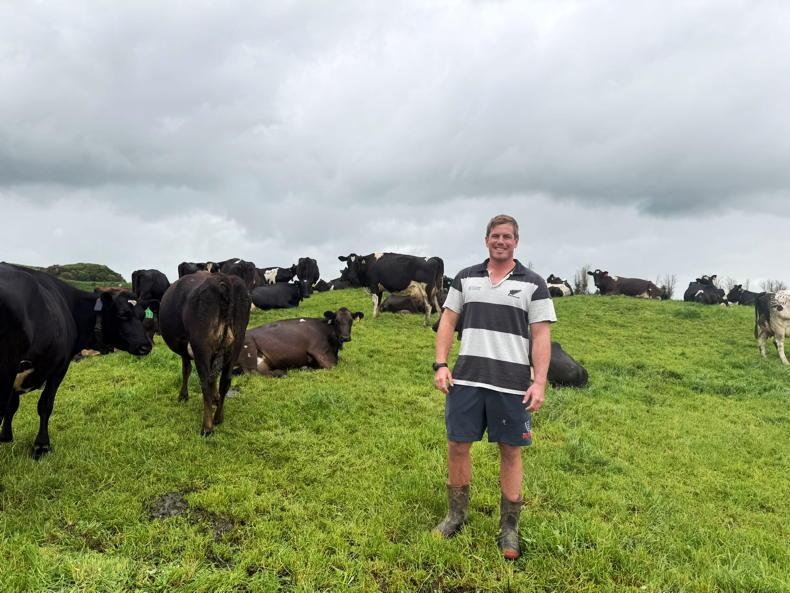
The Browns
Jacob and Sarah are 50-50 sharemilkers on a 239ha farm in Maihiihi, a small village near the town of Otorohanga, approximately 40 minutes south of Hamilton.
Jacob is not from a farming background, while Sarah grew up steeped in dairying. She comes from a Maori family, with her parents owning three dairy units through a Maori trust.
Jacob had been working in an environmental role after completing a Bachelor of Science degree but, after meeting Sarah, he decided he would like to go farming.
He started as a general farmhand on one of Sarah’s parents’ farms and worked his way up through the ranks. He followed the typical New Zealand pathway second in charge, farm manager and then contract milker before the couple entered their current sharemilking arrangement.
Sarah is also involved in the arrangement but works full-time with DairyNZ, the New Zealand equivalent of Teagasc, and wasn’t there at the time of the visit.
The setup
The couple milk 420 cows at peak across a 149ha milking platform. They also have a 90ha drystock block which is used for rearing 110 R1s (calves) and 110 R2s (heifers), as well as providing some silage for the cows.
The land is largely free-draining and cows are fully outwintered on the grazing block. Typical rainfall for the region is about 1,500mm/year.
Summers tend to get very dry in the Waikato, with severe droughts now a common occurrence. Despite this, there are practically no farms with irrigation, a major difference compared to farms on the South Island.
Winters are wet in the Waikato but milder than Irish winters, meaning farms can still grow grass at rates of 15 to 25kg DM/ha/day.
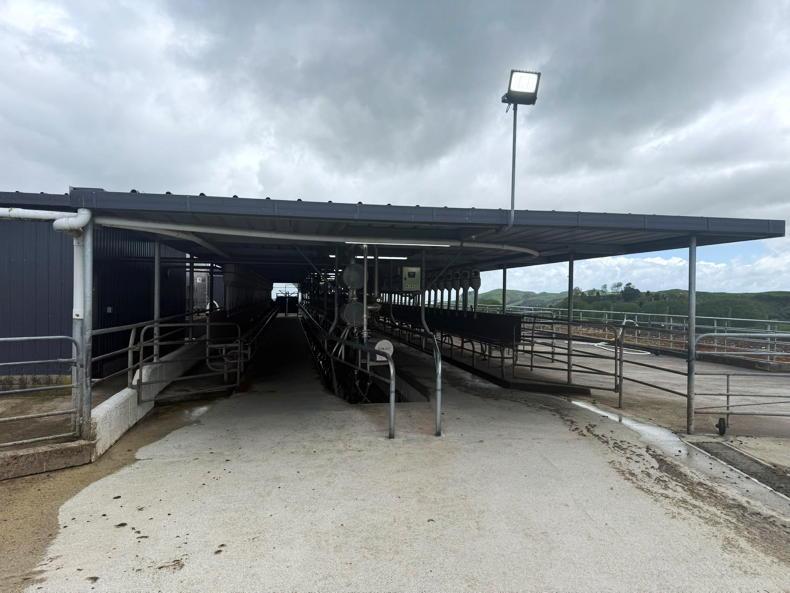
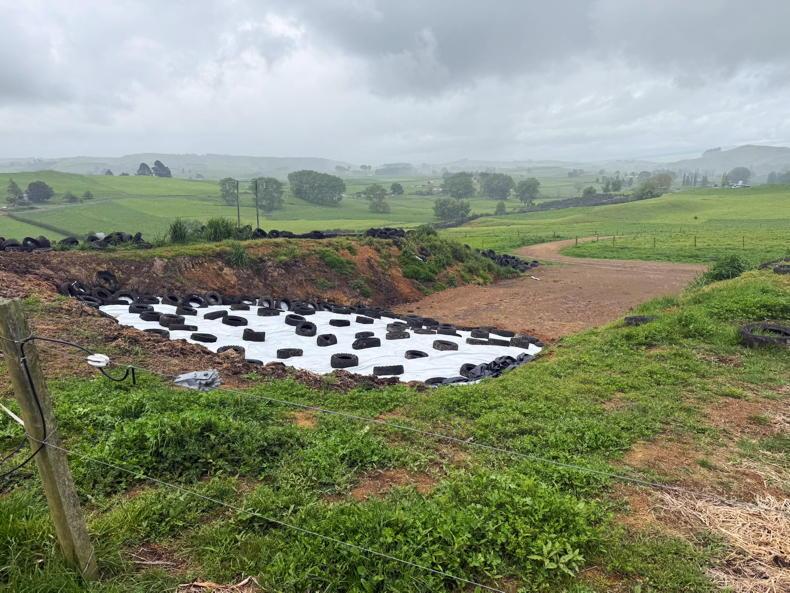
The only infrastructure on the farm is a milking parlour, an effluent pond (a small lagoon for dirty water as it would be known in Ireland) and a very small, low-cost calf shed.
Environmental regulation is still very relaxed in New Zealand when compared to the Irish system.
As 50-50 sharemilkers, Jacob and Sarah own all of the cows, which they have purchased over the last three years. The land and infrastructure are owned by the Maori trust.
There are two other staff working full-time on the farm alongside Jacob. All three are on an 11/3 roster, meaning they work 11 days on followed by three consecutive days off.
Cows are milked at 5am and 2.30pm through a 40-unit parlour.
The herd is split in two, with younger cows in their first and second lactation along with cows in poorer body condition making up the first herd.
The second herd consists of the mature cows, which Jacob describes as the engine of the business.
The herd is fully crossbred, with mature cow weights ranging from 450kg to 500kg.
Halter
Like many farms in the locality, the couple have recently invested in Halter. Halter is a technology capable of virtual fencing and pasture management which has been growing rapidly in New Zealand in recent years.
The technology is subscription-based and operates through a collar fitted to each cow. There are tiered subscription levels, with the more basic packages capable of virtual fencing, heat detection and estimating pre- and post-grazing covers.
As you move up through the tiers, the technology becomes more sophisticated, with the highest-cost subscription capable of measuring grass through satellite technology, outlining cows’ daily intakes, rumination time and more.
The cost of the collars ranges from about NZ$10 to NZ$13/cow/month, equivalent to approximately €5 to €6.50/cow/month.
Jacob and Sarah have a middle-tier subscription and find it very beneficial, particularly given the challenging topography of the land.
Halter allows them to set up smaller 12-hour breaks on land that would otherwise be difficult to fence. This is particularly beneficial during winter when cows are grazing but weather conditions can be challenging.
From the house, Jacob can move the virtual fence and shift cows to prevent them from poaching paddocks.
Halter also works like a Batt-Latch, opening the fence gap at a set time or through the press of a button on the phone app. This allows cows to start making their way towards the milking parlour. The fence can also close behind the cows, forcing stragglers to leave the paddock.
With the average walk from the paddock to the parlour being just over 1km and the longest walks closer to 2.5km, this saves Jacob and his staff close to an hour per milking compared to going out for cows and sitting behind them, as they had traditionally done.
With two separate herds, that could mean a saving of close to four hours per day.
While the technology also shows grass growth, pre-grazing yields and post-grazing residuals, Jacob says he still likes to carry out his own grass measuring and pasture management.
“Some of the farms with Halter have definitely become completely reliant on the technology and are now relying on it to do all of the pasture management.
“I can’t see us ever going that far as you definitely miss things and lose focus on some of the fundamentals,” he says.
Grass
Grass is very much at the core of the business, and while it’s not much more than the basics done really well, as Jacob says himself, it’s the level of consistency with which they are applied that makes the system so impressive.
Stocking rate on the milking platform is 2.8 cows/ha, based on the farm utilising 12t DM/ha across the year. That’s roughly 4.28t DM of grass per cow, including the winter grazing.
On top of that, cows receive 300kg DM of silage during the shoulders of the year, along with 400kg/cow of a palm kernel blend fed through the parlour.
The blend is made up of 90% palm kernel, with the remaining 10% being a dairy nut.
In total, the herd is eating just over 5t DM/cow across the year on average and producing 440kg MS/cow.
A total of 112kg N/ha was spread in 2025, with clover growing well on parts of the farm. The clover has all established naturally, with none introduced through reseeding.
The Browns are regrassing 20% of the milking platform each year, but all of this is done through oversowing, with no paddocks ploughed or rotavated.
Milk price
The Browns are Fonterra suppliers, like the majority of New Zealand dairy farmers, and the current milk price being received is NZ$10/kg MS. This equates to approximately €5/kg MS and is one of the highest milk prices ever received in New Zealand.
Costs are lower, however, with palm kernel costing the equivalent of €200/tonne and nitrogen fertiliser around €450/tonne.
The couple have fixed the price for around 30% of their milk for the next 18 months.
They have taken on significant borrowings in recent years between purchasing the herd and investing in Halter, and feel that fixing a proportion of their milk price gives them greater security when it comes to meeting repayments.