There is no doubt that each supplier should sit down and go through a one to one meeting with Dairygold. Dairygold management have committed to repaying the revolving fund money and have stated and clarified that the shareholding level or revolving fund contribution won’t change once a supplier signs up. While accepting the clarification, the Dairygold contract naysayers want this specifically written into the contract.
The Dairygold contract requires a minimum of 4,000 shares per 100,000 litres supplied and all suppliers must contribute to the revolving fund to help fund new investment. A deferred payment equal to 20% of the milk price on the volume increase over your base line supply (2010-2012) will be taken from milk cheques from May to September and returned the following March to fund extra working capital for the co-op.
Case Study 1
Dairygold supplier, growing output, well shared up now but will have to buy more shares as output grows.
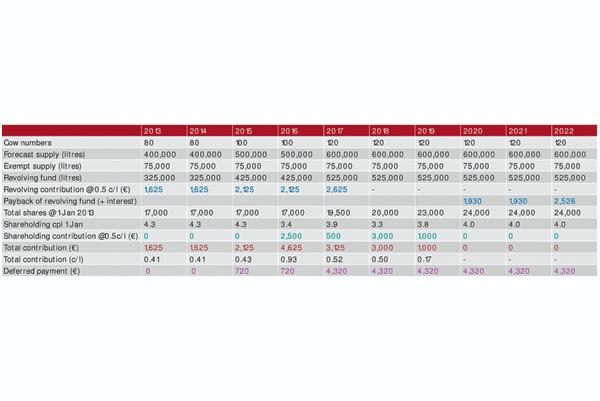
This farmer is milking 80 cows and is planning to milk close to 100 cows when quotas are removed post-2015. The supplier is currently selling 400,000 litres (88,000 gallons in 2012) and is planning to grow output to 500,000 litres (110,000 gallons) by 2015 and then supply 600,000 litres from 2017 onwards. The supplier has 17,000 shares in the co-op in Jan 2013 (4,300/100,000 litres). What will be the annual financial impact on this business?
Results: Dairygold say this is close to representing the average milk supplier that is planning to grow production.
The blue text shows the money that the farmer will have to spend on the revolving fund but will receive back with interest seven years later.
||PIC2||
No deductions will be taken if milk price is less than 27c/litre and at and above 27c/litre a fee of 0.5c/litre will apply.
A maximum of 60 monthly deductions will be taken (five years).
The green text shows the shareholding contribution that the farmer must pay to align his shareholding with supply.
The red text is the sum of the revolving fund and the shareholding investment.
We can see for the next three years the cost is approx 0.4c/litre or €20 per cow, rising to 0.9 c/litre (€45/cow) for 2016. The purple text in the last row shows the deferred payment (assuming 30c/l milk price) that will be taken out of the milk cheques from May to September each year and will be returned without interest the following March.
Case Study 2
Dairygold supplier, growing output but not well shared up now but buys shares.
||PIC3||
The very same as Case Study 1, this farmer is milking 80 cows and is planning to milk close to 100 cows when quotas are removed post 2015.
The farmer is currently selling 400,000 litres (88,000 gallons) and is planning to grow output to 500,000 litres (110,000 gallons) by 2015 and then supply 600,000 litres from 2017 onwards.
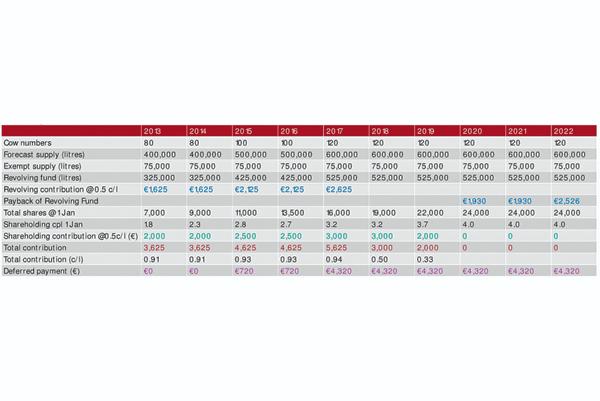
However, this supplier only has 7,000 shares in the co-op in 2013 (1,750/100,000 litres).
What will be the annual financial impact on his business – see table for answers.
Results: The blue text shows the money that the farmer will have to spend on the revolving fund but will receive back with interest seven years later.
The green text shows the shareholding contribution that the farmer must pay to align his shareholding with supply.
||PIC4||
In this example, the farmer has to pay out €2,000 for shares starting in 2014.
The red text is the sum of the revolving fund and the shareholding investment.
The cost is approx 0.9 c/litre (€45/cow) for five years. A supplier may receive a transfer of shares from family members. The current CGT tax exemption threshold is €1,270 per annum and may provide the opportunity to transfer 1,270 shares tax free, but as each transferor’s tax circumstances are different any transfer should only be done on the basis of having received tax advice.
Case Study 3
Dairygold supplier. NOT growing output and well shared up now.
This farmer is milking 80 cows and is planning to milk close to 80 cows when quotas are removed post-2015.
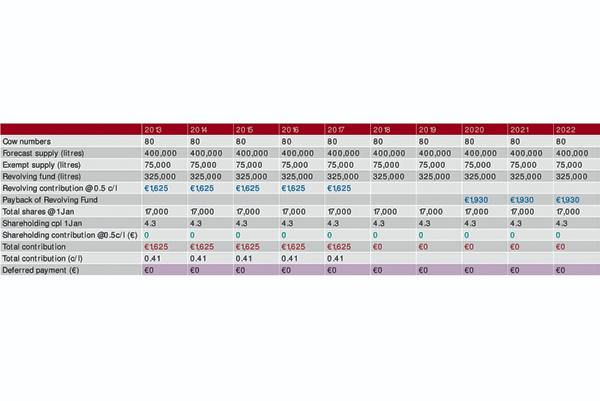
The farmer is currently selling 400,000 litres (88,000 gallons) and is planning to remain supplying this volume.
He has 17,000 shares in his co-op in 2013 (4,250/100,000 litres).
What will be the annual financial impact on his business – see table for answers.
Results: The blue text shows the money that the farmer will have to spend on the revolving fund but will receive back with interest seven years later.
It will cost this farmer €1,625 annually, which will be repaid with interest seven years later. There is no extra shareholding required so the cost is approx 0.4c/litre or €20 per cow. There is no deferred payment required as no volume increase is planned.
Case Study 4
Dairygold supplier
NEW ENTRANT in 2015, NOT well shared up now and will have to buy shares as output grows.
This farmer is NOT milking cows yet but is planning to milk close to 60 cows post 2015 growing to 120 cows by 2022.
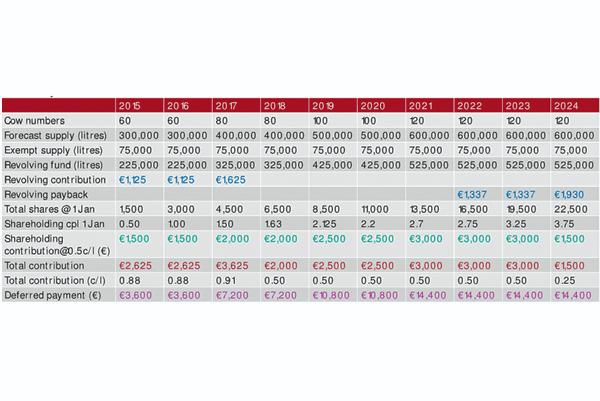
In 2015, the farmer forecasts a supply of 300,000 litres growing to 600,000 litres by 2022 from 120 cows. The farmer has 1,500 shares in his co-op in January 2015 (500 shares /100,000 projected litres).
What will be the annual financial impact on his business – see table for answers.
Results: The blue text shows the money that the farmer will have to spend on the revolving fund but will receive back with interest seven years later.
The green text shows the shareholding contribution that the farmer must pay to align his shareholding with supply.
Effectively, this new entrant is looking at spending €1,500 per year starting off in shares and this doubles to €3,000 per year when supply doubles.
By the end of 2022, he still only has 3,250 shares/100,000 litres so he must continue for another two years (to 2024) before he has 4,000 shares/100,000 litres – the minimum shareholding.
Bottom line, this new entrant needs to plan for a cost of €45 per cow for the first three years (0.9c/l) and 0.5c/l for another six years until he has the minimum shareholding.
The deferred payment is substantial at €3,600 in 2015 & 2016 and rising to €14,400 as his supply increases further.
A new entrant in Dairygold is issued with a 200,000 litre annual baseline (120,000 litres between May and September) and so his deferred payment increases as he moves substantially above this volume.
This has cash flow implications for the ‘new entrant’ but ultimately the same annual amount is paid out for the milk with the 13th payment coming in March of the following year.
In total terms for this new entrant over the first six years of business, including his initial shareholding cost, he will have invested a total of €14,875 in shares and revolving funds assuming the Dairygold revolving fund finishes in 2017 after five years in existence.
KEY POINTS
Total cost summary
Case study 1 – Milk supplier going from 80 to 120 cows post 2015 who needs to purchase shares for new supply – cost 0.5c/l for six years and 0.9c/l for one year (2016). Case study 2 – Milk supplier going from 80 to 120 cows post 2015 who is not well shared up for current or future supply – cost 0.9 c/l for five years and 0.5 c/l for two years. Case study 3 – Milk supplier milking 80 cows, shared up and staying at 80 cows post 2015 – cost 0.5 c/l for five years.Case study 4 – New entrant to milk in 2015 starting with 60 cows and growing to 120 cows – minimum shareholding at start – cost 0.9 c/l for first three years and then 0.5 c/l for six years.TAX?
It is important to make the point that investments in revolving fund and shareholding must come from after tax income so the earnings required to invest this amount of money are double the actual cost if paying the high tax rate. On top of this it is important to note the transfer of shares between family members is subject to 1% stamp duty and 33% capital acquisitions tax.
There is no doubt that each supplier should sit down and go through a one to one meeting with Dairygold. Dairygold management have committed to repaying the revolving fund money and have stated and clarified that the shareholding level or revolving fund contribution won’t change once a supplier signs up. While accepting the clarification, the Dairygold contract naysayers want this specifically written into the contract.
The Dairygold contract requires a minimum of 4,000 shares per 100,000 litres supplied and all suppliers must contribute to the revolving fund to help fund new investment. A deferred payment equal to 20% of the milk price on the volume increase over your base line supply (2010-2012) will be taken from milk cheques from May to September and returned the following March to fund extra working capital for the co-op.
Case Study 1
Dairygold supplier, growing output, well shared up now but will have to buy more shares as output grows.
This farmer is milking 80 cows and is planning to milk close to 100 cows when quotas are removed post-2015. The supplier is currently selling 400,000 litres (88,000 gallons in 2012) and is planning to grow output to 500,000 litres (110,000 gallons) by 2015 and then supply 600,000 litres from 2017 onwards. The supplier has 17,000 shares in the co-op in Jan 2013 (4,300/100,000 litres). What will be the annual financial impact on this business?
Results: Dairygold say this is close to representing the average milk supplier that is planning to grow production.
The blue text shows the money that the farmer will have to spend on the revolving fund but will receive back with interest seven years later.
||PIC2||
No deductions will be taken if milk price is less than 27c/litre and at and above 27c/litre a fee of 0.5c/litre will apply.
A maximum of 60 monthly deductions will be taken (five years).
The green text shows the shareholding contribution that the farmer must pay to align his shareholding with supply.
The red text is the sum of the revolving fund and the shareholding investment.
We can see for the next three years the cost is approx 0.4c/litre or €20 per cow, rising to 0.9 c/litre (€45/cow) for 2016. The purple text in the last row shows the deferred payment (assuming 30c/l milk price) that will be taken out of the milk cheques from May to September each year and will be returned without interest the following March.
Case Study 2
Dairygold supplier, growing output but not well shared up now but buys shares.
||PIC3||
The very same as Case Study 1, this farmer is milking 80 cows and is planning to milk close to 100 cows when quotas are removed post 2015.
The farmer is currently selling 400,000 litres (88,000 gallons) and is planning to grow output to 500,000 litres (110,000 gallons) by 2015 and then supply 600,000 litres from 2017 onwards.
However, this supplier only has 7,000 shares in the co-op in 2013 (1,750/100,000 litres).
What will be the annual financial impact on his business – see table for answers.
Results: The blue text shows the money that the farmer will have to spend on the revolving fund but will receive back with interest seven years later.
The green text shows the shareholding contribution that the farmer must pay to align his shareholding with supply.
||PIC4||
In this example, the farmer has to pay out €2,000 for shares starting in 2014.
The red text is the sum of the revolving fund and the shareholding investment.
The cost is approx 0.9 c/litre (€45/cow) for five years. A supplier may receive a transfer of shares from family members. The current CGT tax exemption threshold is €1,270 per annum and may provide the opportunity to transfer 1,270 shares tax free, but as each transferor’s tax circumstances are different any transfer should only be done on the basis of having received tax advice.
Case Study 3
Dairygold supplier. NOT growing output and well shared up now.
This farmer is milking 80 cows and is planning to milk close to 80 cows when quotas are removed post-2015.
The farmer is currently selling 400,000 litres (88,000 gallons) and is planning to remain supplying this volume.
He has 17,000 shares in his co-op in 2013 (4,250/100,000 litres).
What will be the annual financial impact on his business – see table for answers.
Results: The blue text shows the money that the farmer will have to spend on the revolving fund but will receive back with interest seven years later.
It will cost this farmer €1,625 annually, which will be repaid with interest seven years later. There is no extra shareholding required so the cost is approx 0.4c/litre or €20 per cow. There is no deferred payment required as no volume increase is planned.
Case Study 4
Dairygold supplier
NEW ENTRANT in 2015, NOT well shared up now and will have to buy shares as output grows.
This farmer is NOT milking cows yet but is planning to milk close to 60 cows post 2015 growing to 120 cows by 2022.
In 2015, the farmer forecasts a supply of 300,000 litres growing to 600,000 litres by 2022 from 120 cows. The farmer has 1,500 shares in his co-op in January 2015 (500 shares /100,000 projected litres).
What will be the annual financial impact on his business – see table for answers.
Results: The blue text shows the money that the farmer will have to spend on the revolving fund but will receive back with interest seven years later.
The green text shows the shareholding contribution that the farmer must pay to align his shareholding with supply.
Effectively, this new entrant is looking at spending €1,500 per year starting off in shares and this doubles to €3,000 per year when supply doubles.
By the end of 2022, he still only has 3,250 shares/100,000 litres so he must continue for another two years (to 2024) before he has 4,000 shares/100,000 litres – the minimum shareholding.
Bottom line, this new entrant needs to plan for a cost of €45 per cow for the first three years (0.9c/l) and 0.5c/l for another six years until he has the minimum shareholding.
The deferred payment is substantial at €3,600 in 2015 & 2016 and rising to €14,400 as his supply increases further.
A new entrant in Dairygold is issued with a 200,000 litre annual baseline (120,000 litres between May and September) and so his deferred payment increases as he moves substantially above this volume.
This has cash flow implications for the ‘new entrant’ but ultimately the same annual amount is paid out for the milk with the 13th payment coming in March of the following year.
In total terms for this new entrant over the first six years of business, including his initial shareholding cost, he will have invested a total of €14,875 in shares and revolving funds assuming the Dairygold revolving fund finishes in 2017 after five years in existence.
KEY POINTS
Total cost summary
Case study 1 – Milk supplier going from 80 to 120 cows post 2015 who needs to purchase shares for new supply – cost 0.5c/l for six years and 0.9c/l for one year (2016). Case study 2 – Milk supplier going from 80 to 120 cows post 2015 who is not well shared up for current or future supply – cost 0.9 c/l for five years and 0.5 c/l for two years. Case study 3 – Milk supplier milking 80 cows, shared up and staying at 80 cows post 2015 – cost 0.5 c/l for five years.Case study 4 – New entrant to milk in 2015 starting with 60 cows and growing to 120 cows – minimum shareholding at start – cost 0.9 c/l for first three years and then 0.5 c/l for six years.TAX?
It is important to make the point that investments in revolving fund and shareholding must come from after tax income so the earnings required to invest this amount of money are double the actual cost if paying the high tax rate. On top of this it is important to note the transfer of shares between family members is subject to 1% stamp duty and 33% capital acquisitions tax.






SHARING OPTIONS