


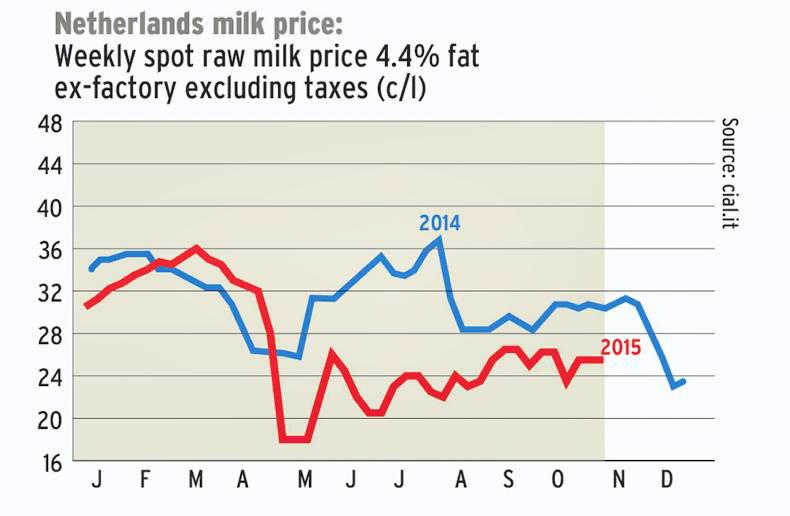
This week’s Global Dairy Trade (GDT) auction result saw prices drop on average by 7.4%, the second consecutive drop after a brief period of price rises. The average price across all products was $2,569/t, down $166 on the last result.
Global commentators are split on where the market is going over the coming months.
Everyone is watching the New Zealand fall in supply as farmers cut back production. Remember, September volumes delivered were down 6% to 7%.
October figures have not been released yet, but analysts suggest the supply fall relative to last year will be in the region of 3% to 4%. October is when New Zealand hit peak milk, so effectively it is sliding down off peak at this stage.
Auckland Savings Bank suggests that the lost New Zealand exports are too big to cover and the price will rise.
A statement said: “New Zealand production has not fallen this hard since 1999. Moreover, NZ is the largest dairy exporter, and in particular exports the lion’s share of WMP. The EU and others cannot fill the NZ hole.”
Rabobank analyst Emma Higgins said the GDT was a largely unsurprising result. She expected next quarter prices would be US$2,500, the following US$3,000 and by this time next year prices for whole milk powder would sit at about US$3200/t.
Speaking from New Zealand, she said: “One positive thing for New Zealand farmers now is that European cows are rolling off pastures and into barns, so their input costs will rise.”
Coming back to the GDT results for this week, Rennet Casein saw the biggest drop of 11.2%, followed by butter milk powder, which dropped by 9.4%. Whole milk powder and skim milk powder both fell by 8%, with anhydrous milk fat experiencing a fall of 5.7%.
The volume of product sold was slightly down on the previous GDT at 33,997t and there were 151 participating bidders. Again, this is a much reduced volume of product traded compared with previous years when prices were at a much higher level.



SHARING OPTIONS