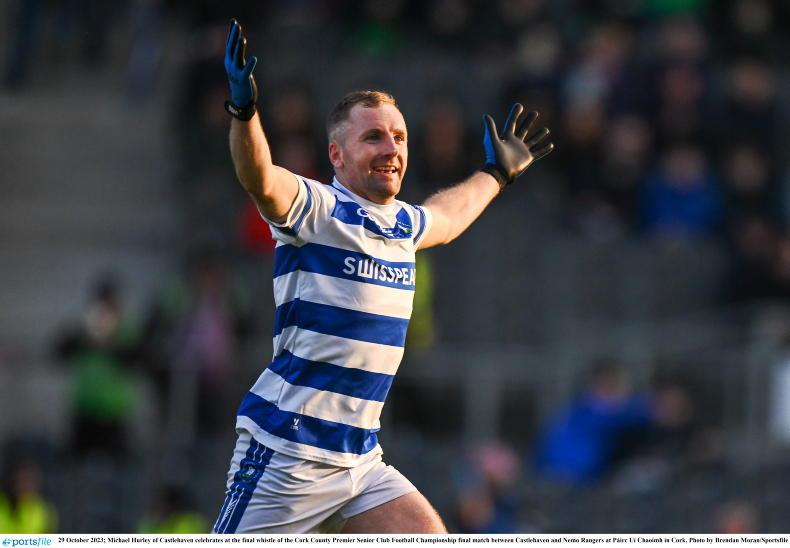
On Sunday, I was at Páirc Uí Chaoimh for the Bon Secours Hospital Cork Premier Senior Football Championship final.
Castlehaven ended a ten-year wait for the Andy Scannell Cup as they defeated Nemo Rangers by 0-11 to 0-9. It was, shall we say, a very modern game of football, lit up by five points from play by the Haven’s Michael Hurley.
Now 27, Michael was a greenhorn on the team when they won in 2013, with his older brothers Shane, Stephen and Brian all in the squad then too.
Going back further again, Shane had been part of the successful 2003 team, which was managed by James McCarthy.
McCarthy is still the man in the bainisteoir’s bib, having also guided the club to glory in 2012.
Castlehaven’s first breakthrough came in 1989 and Sunday marked their sixth title. Since they reached senior level at the end of the 1970s, their teams have been backboned by the same families. Although economic realities and other factors have led to Haven people migrating to other parts of the county, their children return to don the blue and white. There is a strong pull there.
Named Success
It’s the case in many GAA clubs that the same names appear more than once throughout history. And Sunday’s game featured an example the naming phenomenon that has been prevalent in Cork GAA for more than half a century.
In the full-back line for Nemo was Bríain Murphy, the latest example of a rule that is seemingly immutable on Leeside. The last time the Rebels won the All-Ireland hurling title, in 2004 and 2005, another Brian Murphy played a starring role at corner-back and the Bride Rovers man would remain a key member of the team until his final retirement in 2016 (two previous departures, in 2009 and 2014, were reversed). That he ended up with just one All-Star was definitely a failing on the judges’ parts.
In the 1990s, the Cork football squad featured a Brian Murphy from Clonakilty, who captained the side in 1997 after his club had won the county championship. He played in the full-back line, too.
The three mentioned above – a Nemo Rangers player, a Cork hurler and a Cork footballer – could all be said to be following in the footsteps of the ‘real’ Brian Murphy. He was there for Nemo’s emergence with their first county title in 1972 and won four All-Ireland senior medals (three hurling and one football) as well as two All-Stars in each code. For all of them, he was selected at – and you may be spotting a pattern here – corner-back.
He was not the first Brian Murphy either. In the mid-1960s, Brian Murphy from Crosshaven played football for Cork, as a goalkeeper. The emergence of Billy Morgan saw him take over the number 1 jersey but, rather than simply become the reserve keeper, Murphy was re-purposed – and you can guess in which position.
Established
There have been exceptions, it should be noted. In the late 1980s, Bryan Murphy from Bishopstown was on the fringes of the Cork hurling panel but, perhaps because of the different spelling of his name, he did not become established at corner-back and instead transferred to Kildare, with whom he won Leinster football medals in 1998 and 2000.
The spooky thing is, this isn’t simply just limited to Cork’s Brian Murphys. In Kerry’s last three All-Ireland football final appearances – the 2019 and 2023 losses to Dublin and the 2022 win over Galway – the number 4 shirt has been worn by Tom O’Sullivan. The Dingle man’s reliability can be seen in the picking up of All-Star Awards in 2019 and 2021.
It was the third time that the All-Star left corner-back was Kerry’s Tom O’Sullivan, as the Rathmore version was picked there in 2009. That was his second All-Star – the first was at right corner-back.
While the first of his five All-Irelands was at left half-back, the other four were in the last line of defence.
Tipping point: How much of a good thing can you have?

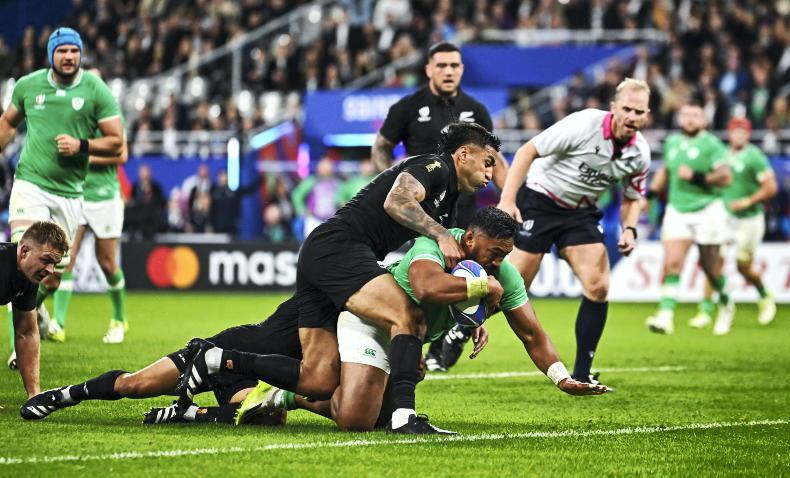
Bundee Aki of Ireland scores his side's first try, in the 27th minute, despite the tackle of New Zealand's Rieko Ioane, during the 2023 Rugby World Cup quarter-final match between Ireland and New Zealand at the Stade de France in Paris, France. \ Harry Murphy/Sportsfile
An article, written by Mikey Stafford on the RTÉ Sport website caught my eye last weekend.
Essentially, it was pointing out how there is far more sport on nowadays than 20 or 30 years ago and wondering where the tipping point is – how much of a good thing can you have before it becomes saturation?
Obviously, last week’s Rugby World Cup final lived up to its billing as South Africa just edged New Zealand in an absorbing battle. It’s not controversial to say that the game was in the minority in terms of quality, though.
Group stages
The long group stages produced far too many mismatches but World Rugby’s solution is to increase the number of teams to 24 for the 2027 edition in Australia.
While they say it will improve the scheduling as teams don’t have two-week lay-offs, there is a chance that the addition of four more sides will further demonstrate the drop-off between the top ten or so and the rest.
For those who were at the World Cup, there is little or no chance of a rest. The United Rugby Championship started a fortnight ago and the European Rugby Champions Cup kicks off on December 8. When you consider that Leinster and Munster were each involved in finals last season, going up to the end of May, before the shortest of breaks and then into the World Cup preparations, it’s asking a lot to keep levels high.
These are well-paid, highly-conditioned professionals and sports science has become very advanced, but the relentless onslaught of matches can take its toll in physical and mental burnout.
On Sunday, I was at Páirc Uí Chaoimh for the Bon Secours Hospital Cork Premier Senior Football Championship final.
Castlehaven ended a ten-year wait for the Andy Scannell Cup as they defeated Nemo Rangers by 0-11 to 0-9. It was, shall we say, a very modern game of football, lit up by five points from play by the Haven’s Michael Hurley.
Now 27, Michael was a greenhorn on the team when they won in 2013, with his older brothers Shane, Stephen and Brian all in the squad then too.
Going back further again, Shane had been part of the successful 2003 team, which was managed by James McCarthy.
McCarthy is still the man in the bainisteoir’s bib, having also guided the club to glory in 2012.
Castlehaven’s first breakthrough came in 1989 and Sunday marked their sixth title. Since they reached senior level at the end of the 1970s, their teams have been backboned by the same families. Although economic realities and other factors have led to Haven people migrating to other parts of the county, their children return to don the blue and white. There is a strong pull there.
Named Success
It’s the case in many GAA clubs that the same names appear more than once throughout history. And Sunday’s game featured an example the naming phenomenon that has been prevalent in Cork GAA for more than half a century.
In the full-back line for Nemo was Bríain Murphy, the latest example of a rule that is seemingly immutable on Leeside. The last time the Rebels won the All-Ireland hurling title, in 2004 and 2005, another Brian Murphy played a starring role at corner-back and the Bride Rovers man would remain a key member of the team until his final retirement in 2016 (two previous departures, in 2009 and 2014, were reversed). That he ended up with just one All-Star was definitely a failing on the judges’ parts.
In the 1990s, the Cork football squad featured a Brian Murphy from Clonakilty, who captained the side in 1997 after his club had won the county championship. He played in the full-back line, too.
The three mentioned above – a Nemo Rangers player, a Cork hurler and a Cork footballer – could all be said to be following in the footsteps of the ‘real’ Brian Murphy. He was there for Nemo’s emergence with their first county title in 1972 and won four All-Ireland senior medals (three hurling and one football) as well as two All-Stars in each code. For all of them, he was selected at – and you may be spotting a pattern here – corner-back.
He was not the first Brian Murphy either. In the mid-1960s, Brian Murphy from Crosshaven played football for Cork, as a goalkeeper. The emergence of Billy Morgan saw him take over the number 1 jersey but, rather than simply become the reserve keeper, Murphy was re-purposed – and you can guess in which position.
Established
There have been exceptions, it should be noted. In the late 1980s, Bryan Murphy from Bishopstown was on the fringes of the Cork hurling panel but, perhaps because of the different spelling of his name, he did not become established at corner-back and instead transferred to Kildare, with whom he won Leinster football medals in 1998 and 2000.
The spooky thing is, this isn’t simply just limited to Cork’s Brian Murphys. In Kerry’s last three All-Ireland football final appearances – the 2019 and 2023 losses to Dublin and the 2022 win over Galway – the number 4 shirt has been worn by Tom O’Sullivan. The Dingle man’s reliability can be seen in the picking up of All-Star Awards in 2019 and 2021.
It was the third time that the All-Star left corner-back was Kerry’s Tom O’Sullivan, as the Rathmore version was picked there in 2009. That was his second All-Star – the first was at right corner-back.
While the first of his five All-Irelands was at left half-back, the other four were in the last line of defence.
Tipping point: How much of a good thing can you have?

Bundee Aki of Ireland scores his side's first try, in the 27th minute, despite the tackle of New Zealand's Rieko Ioane, during the 2023 Rugby World Cup quarter-final match between Ireland and New Zealand at the Stade de France in Paris, France. \ Harry Murphy/Sportsfile
An article, written by Mikey Stafford on the RTÉ Sport website caught my eye last weekend.
Essentially, it was pointing out how there is far more sport on nowadays than 20 or 30 years ago and wondering where the tipping point is – how much of a good thing can you have before it becomes saturation?
Obviously, last week’s Rugby World Cup final lived up to its billing as South Africa just edged New Zealand in an absorbing battle. It’s not controversial to say that the game was in the minority in terms of quality, though.
Group stages
The long group stages produced far too many mismatches but World Rugby’s solution is to increase the number of teams to 24 for the 2027 edition in Australia.
While they say it will improve the scheduling as teams don’t have two-week lay-offs, there is a chance that the addition of four more sides will further demonstrate the drop-off between the top ten or so and the rest.
For those who were at the World Cup, there is little or no chance of a rest. The United Rugby Championship started a fortnight ago and the European Rugby Champions Cup kicks off on December 8. When you consider that Leinster and Munster were each involved in finals last season, going up to the end of May, before the shortest of breaks and then into the World Cup preparations, it’s asking a lot to keep levels high.
These are well-paid, highly-conditioned professionals and sports science has become very advanced, but the relentless onslaught of matches can take its toll in physical and mental burnout.
SHARING OPTIONS