



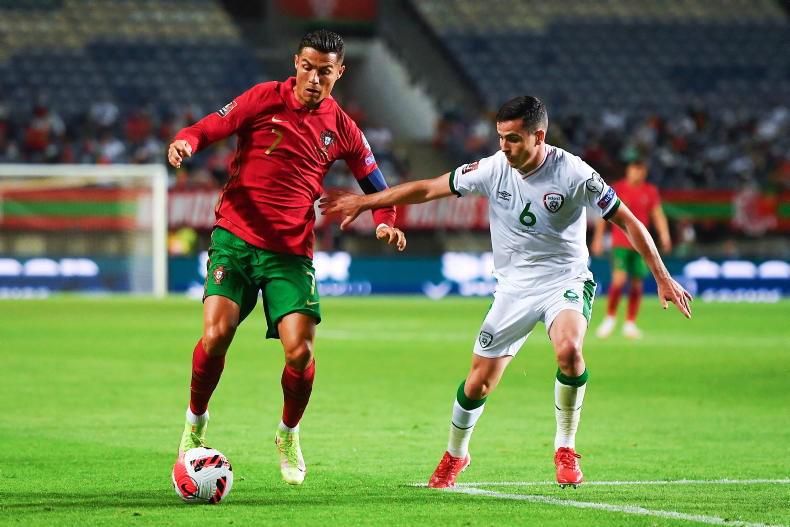
Way back at the start of the year – that seems like a lifetime ago now – editor Ciara Leahy, asked for a steer on which issues would sync up with sporting events on which to base columns around.
Some things, like the All-Ireland finals, Irish Open, Women’s World Cup and so on, fall into place fairly easily. Other things can then be worked around those ‘pillar’ events and so, in order to have some sporting balance, I suggested the issue of 11 October could focus on the Republic of Ireland’s World Cup qualifying campaign.
Cursed with the affliction of optimism, I had gambled on the opening two games, at home to Hungary and away to Armenia, yielding something tangible – like a win – meaning that Heimir Hallgrímsson’s side would be going to Portugal this weekend as huge underdogs but still in the fight for qualification.
Of course, as is so often the case when it comes to Irish football, the reality is somewhat different. The home game against Hungary – the chance to get things off on a strong footing – was almost a disaster due to the concession of two early goals.
A goal back in the second half and a red card for the visitors – of the kind that would have calls to Liveline on RTÉ radio if it were given to an Ireland player – paved the way for Adam Idah’s equaliser.
This one was a good draw for Ireland given the circumstances. There was also the feelgood factor for those leaving Aviva Stadium – an ideal bounce to take to Yerevan, one would think.
Alas, the best-laid plans of mice and men go oft awry. A defeat to Armenia reset the dial, sparking the usual endless debates – the manager is useless; but we don’t have the players; this is decades in the making thanks to the FAI.
As is often the case, there’s probably a kernel of truth in everything. Hallgrímsson might have beaten England as Iceland manager but didn’t pull up any trees with Jamaica; Caoimhín Kelleher’s Premier League medal from last year was the first for an Irishman since John O’Shea and Darron Gibson with Manchester United in 2011; the now-regular appearances of FAI personnel before Oireachtas committees lay bare more and more mismanagement.
Problems can be sorted given time but, such is the modern international football calendar, there is rarely an opportunity to catch breath.

Multi-faceted malaise
The UEFA Nations League campaign was meant to give Hallgrímsson a chance to settle before targeting a place at the expanded World Cup in Canada, Mexico and the USA – instead, there have been calls to terminate his contract early and give the next man breathing space.
And, let’s honest, if that were to happen, it’s not hard to envisage a situation 12 or 18 months down the line where that next manager – Damien Duff, John O’Shea or someone else – is getting the brunt of the criticism when they may only be part of a wider, multi-faceted malaise.
Being Ireland manager at the moment is a bit like the job of Garda Commissioner – the task in itself is huge but you end up carrying the can for issues outside of your remit and the media never need encouragement to call for your head.
Hallgrímsson might have done some things differently but the world rankings do not lie: Ireland are the 61st-best team in the world and it’s five years since we were in the top 30.
The problem is the general perception of how sports teams ‘should’ be doing is always out of date. Rugby fans, both serious and casual, within Munster and without, still feel that the province should be making a better fist of European performances, for instance.
Prior to this year’s All-Ireland semi-final appearance, Meath football had been in the doldrums – they even dropped to the Tailteann Cup – but legacy perception meant we still expected them to challenge the Dublin juggernaut.
By contrast, the fact that ‘plucky little Bournemouth’ keep enjoying good results against ‘bigger’ clubs in the Premier League seems to surprise people.
The loss to Armenia was the second one there in just over three years and a crop of elite youngsters have not just appeared out of nowhere in the interim.
In the last World Cup qualification cycle, Ireland led early against Portugal but conceded two late goals, sadly another for the ‘moral victory’ pile.
Like Ireland, Portugal have played Armenia and Hungary. Where Ireland have failed to win either, Portugal won both, scoring eight goals. Most Ireland fans would probably take a narrow defeat if offered it beforehand, rather than experience what could be a heavy loss.
If that were to happen, then the Armenia game in Dublin on Tuesday night would make for quite the funeral atmosphere.


SHARING OPTIONS