



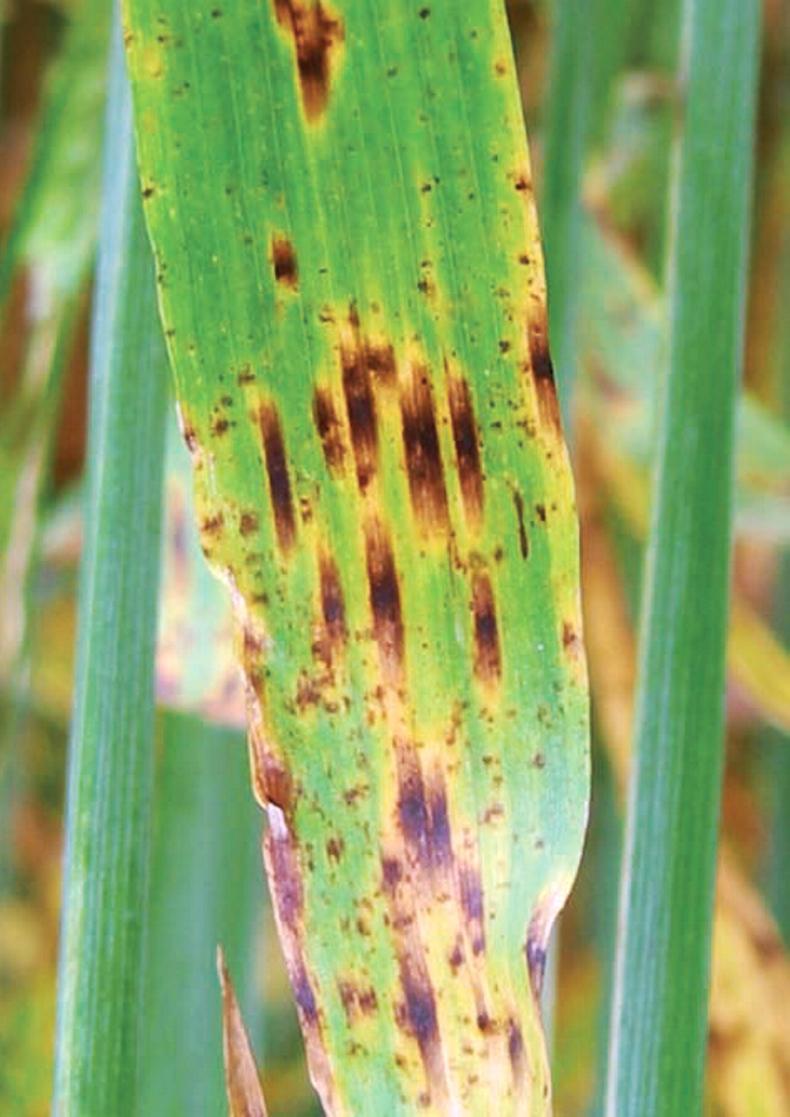

Due to the mild and humid weather that often prevails in Ireland, foliar diseases such as septoria in winter wheat and ramularia in barley, both spring and winter, are endemic in Irish crops. If left untreated, they have the potential to significantly reduce yields.
While varietal resistance represents the most effective means of controlling foliar cereal diseases, in both of the above cases difficulties exist in the ability to bring effective and durable resistance to a commercial scale. As such, fungicides have been relied upon for control of both diseases for over two decades. Unfortunately, this reliance on fungicides has placed immense pressure upon both diseases to adapt.
The result has been the development and spread of fungicide resistance in both diseases to all major fungicides currently used for control, the exception being the multi-site fungicides.
As they are regarded as being at a low risk of resistance development, the multi-sites have played an integral role in fungicide anti-resistance strategies on both wheat and barley.
As chlorothalonil is the most effective of the multi-sites available, it has become the backbone of fungicide programmes in both wheat and barley.
Following the spread of azole and SDHI resistance in both the Irish septoria and ramularia populations, while continuing to play a crucial role from the perspective of fungicide resistance management, chlorothalonil has become increasingly important in maintaining control and protecting potential yields.

This has become most apparent in wheat since 2014, where yield responses from the addition of chlorothalonil to typical fungicide programmes have retained disease control at approximately 80%, delivering 0.4t/ha to 1.0 t/ha.
Chlorothalonil in Europe
Unfortunately, within the European Union the use of chlorothalonil will no longer be approved beyond 20 May 2020. This will present significant challenges to Irish growers. To counter these, it is necessary to design strategies to mitigate the potential development of both diseases and, equally importantly, provide the required anti-resistance to those other fungicide chemistries that will continue to be used.
In the broadest terms, growers must utilise the concept of integrated pest management in their approach to disease control, utilising all available control measures. The simplest strategy that can be implemented will be the use of alternative multi-sites. Currently, this is restricted to folpet, mancozeb and potentially sulphur. However, the availability and reliability of each of these in terms of efficacy and from an anti-resistance perspective needs to be investigated.
Previous trials have confirmed that within fungicide programmes these actives can provide comparable levels of disease control to chlorothalonil. However, some of these studies were conducted in seasons of low disease pressure or when both diseases remained sensitive to at least either the azoles or SDHIs. In response, specific trials have been established on winter wheat and winter and spring barley to investigate this further through 2019, with the results being utilised to provide guidance on future recommendations.
New actives
However, it is widely accepted that none of the above alternatives provide comparable levels of efficacy to chlorothalonil. Fortunately and timely, new actives including a new azole fungicide (Revysol from BASF) and a QiI fungicide (Inatreq from Corteva), which is a new mode of action, are expected to be commercialised for use on wheat and barley in the coming seasons.
Factors that place the barley crop under stress, most notably water logging or drought, should be avoided where possible
Currently, these provide levels of efficacy previously achieved by past azoles and the SDHIs prior to the emergence of resistance and undoubtedly they will be widely used on Irish crops. However, as both fungicides are at risk of resistance development, fungicide anti-resistance strategies using the multi-sites described above must be utilised.

To further assist these strategies all available cultural control measures must be employed. For wheat, these must include varietal resistance and agronomic practises.
While the availability of varieties with high levels of resistance is limited, farmers must utilise those that are available. This is of particular importance in systems where early sowing maybe used. However, where possible, winter wheat planting should be as late as is feasibly possible, taking into account the planting system used and soils, etc.
Although availability of barley varieties with ramularia resistance is currently limited, factors that place the barley crop under stress, most notably water logging or drought, should be avoided where possible. Additionally, it is important to realise that all treatments barley crops receive, even if for disease control, are likely to place the crop under additional stress.



SHARING OPTIONS