Farmers who believe they can rely on the non-contributory pension as an income are being warned that unless their holdings are less than 12ac, they may be left without any State support after they retire.
This was raised at a Galway IFA meeting in Athenry last week, where new pension arrangements taking effect with the Government’s Auto Enrolment Scheme launching in January, were outlined.
A presentation was also given on the night on the requirements surrounding the Nursing Home Support Scheme, known as the Fair Deal. IFA Family Farm chairperson Teresa Roche and
Galway IFA Family Farm representative Anne Mitchell shared valuable information on the scheme as it applies to farmers.
Martin Clarke of Ifac gave a presentation on how the new Auto Enrolment programme would affect farmers who employ staff, with significant add-on costs and extra administrative requirements adding to workloads.
Anne Kinsella, senior research economist in Teagasc’s Rural Economy and Development Programme told a crowd of almost 100 farmers that with 33% of the country’s farmers aged 65 and over, the issue of pension provision was a big concern.
“Farmers face unique challenges regarding pension provision due to lower and variable incomes, the intergenerational nature of farm ownership and cultural attitudes towards retirement. In Ireland, a significant portion of farmers have limited pension coverage, with many not planning to retire formally,” she said.
Financial welfare
“Self-employed farmers have the lowest pension cover, with many not planning ever to retire, which has huge implications for generational renewal, so pension provision is something we need to tackle as a matter of urgency.”
Anne’s research, which was referenced in the Government’s Commission on Generational Renewal Report in recent months, recommends reforming the basic state pension to make it available to all engaged in farming.
“This is not currently the case as some farmers may not qualify for either the contributory or non-contributory pension due to gaps in their PRSI contributions, or their holdings being considered too large under the means test,” she added.
“The current limit under the means test is 12ac, which rules an awful lot of farmers out of the non-contributory pension, and if these low-income farmers were unable to keep their PRSI contributions up to date, then they are left without any state pension at all.
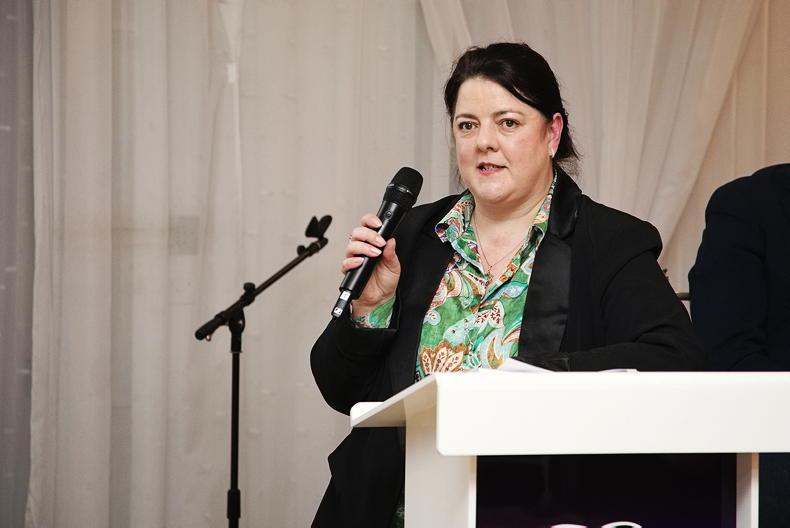
Anne Kinsella, senior research economist wtih Teagasc's Rural Economy and Development Programme addresses an IFA pensions and Fair Deal Meeting in Raheen Woods Hotel, Athenry, Co Galway. Photo Sean Lydon
“We need a system where all engaged in farming are in receipt of a basic state pension to protect not only their own financial welfare but the financial welfare of their spouses/partners in retirement.”
The issue of pensions formed a section of the most recent National Farm Survey that fed into Anne’s research.
“When we asked farmers about their income in retirement, the responses we got varied from state pension to family support with others relying on savings and assets. But a significant number said they would continue to work into their old age,” explains Anne.
“Our research has found that 24% of all farms in the country are vulnerable, with 33% sustainable and only 43% considered viable.
Private pension
“A significant number of farmers do not have sufficient PRSI contributions paid by the time they reach the age of 66, the age of retirement. Farmers on low incomes, particularly those in cattle rearing earn an average of €14,000 per annum and when you consider a person has to make a minimum of 520 PRSI contribution, that’s a considerable amount of a farmer’s income, which in some cases can be as low as €7,000.
“We are trying to get the Department of Agriculture to look at the issue of facilitating full retirement rather than partial or never being able to retire at all.
“The three pillars of pensions are: contributory, occupational and private but people don’t understand the differences. This isn’t just for those approaching retirement age either. Successors in waiting need to understand how important it is to ensure their PRSI contributions are up to date so that they don’t face difficulties when their time comes to retire.
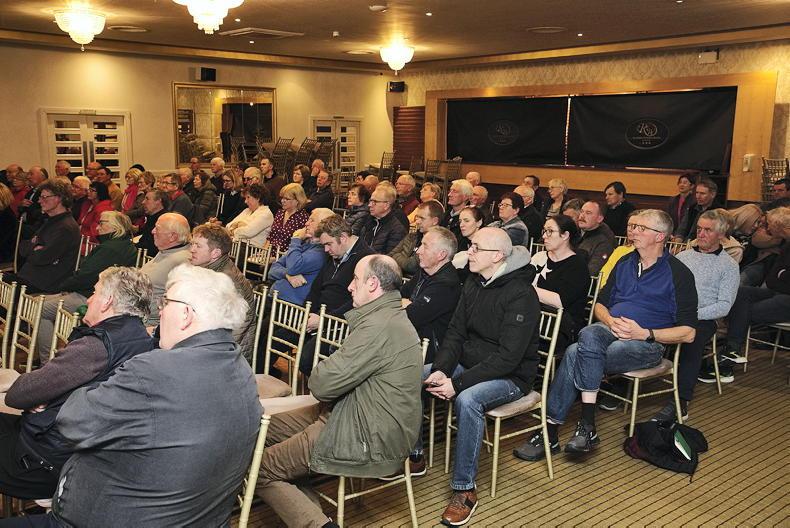
Crowd at the an IFA pensions and Fair Deal Meeting in Raheen Woods Hotel, Athenry, Co Galway. \ Sean Lydon
“A study funded by the Department of Agriculture, Food and the Marine revealed that only 50% of Irish farmers have private pension coverage. This breaks down further to around 70% of dairy and tillage farmers having private pensions, yet only 40% of sheep and cattle farmers have this level of financial protection.
“We found from the responses to the survey that the main barriers to uptake include affordability, procrastination, distrust in private providers, and reliance on savings or assets instead,” continues Anne.
“More worryingly many farmers expect to rely on the state pension, family support, continued farming, or personal savings once they reach retirement age.”
Statistics issued by the Central Statistics Office (CSO) last year showed that approximately 45% of those working in the agriculture, forestry, and fishing sector had supplementary pension coverage, compared to 88% in the financial services sector.
Anne has also been involved in a research project, undertaken in conjunction with Maynooth University, looking at pension provision in five EU countries, comparative to what is available to Irish farmers.
“Our study looked at statutory pension provision in Austria, Finland, France, Germany and Poland, all of which are members of the European Network of Agricultural Social Protection Systems (ENASP), and all of which offer tailored social welfare schemes for farmers.
“The low level of private pension coverage among farmers isn’t unique to Ireland, it’s a key challenge facing the European agricultural sector.
“EU countries take two broad approaches: either farmers are included in the general self-employed social insurance system, or they benefit from a dedicated preferential system.
“Given that agriculture is a high-risk, low-profit sector, higher pension contributions are not necessarily viable without support and in the countries, we looked at, all of the pension schemes are heavily subsidised, reducing the contributions farmers make. In the case of Poland, the scheme is 85% subsidised while in France, it’s 75%.
“These five countries recognise the unique needs of rural populations, including economic vulnerability, demographic challenges and the central role of family farms. The benefits of dedicated systems also go beyond pensions in that they can help prevent rural depopulation, encouraging timely retirement and promoting regional equality.”
Anne added that a big problem with current pension provision is the lack of understanding among the farming community and public in general.
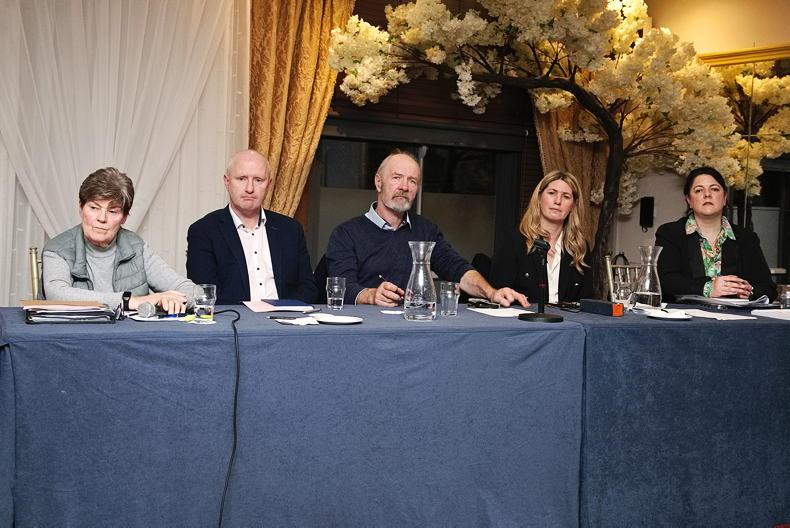
Anne Mitchell, Galway IFA; Martin Clarke, Ifac; Stephen Canavan, chairperson Galway IFA; Teresa Roche, chairperson IFA National Farm Families and Social Affairs Committee and Anne Kinsella, Teagasc.
“The pension process needs simplification, along with how people are informed about it. There is a lack of understanding and engagement with the current model, it’s confusing,” she said.
The objective of the state pension is to provide basic and effective protection against pensioner poverty. It was never designed or intended to secure a high level of pension adequacy so to maintain a reasonable standard of living after retirement, people need to have savings to support the state payment.”
Anne said that while changes to pension provision in the form of the new Auto Enrolment Scheme were to be welcomed, it would not be of any huge benefit to the majority of farmers farming their own land.
“Auto enrolment will go some way to addressing the low private pension uptake in the employed workforce, but it doesn’t yet extend to the self-employed, so it will not make any difference for a lot of farmers, in terms of their own pension provision,” she added.
“Any new policy in this area needs to have a dual focus whereby it facilitates entrance rates into the agriculture industry for successors and new entrants while also facilitating exit strategies that include a framework of supports for adequate retirement income provisioning, so that retiring farmers and their dependants have financial stability.”
Farmers who believe they can rely on the non-contributory pension as an income are being warned that unless their holdings are less than 12ac, they may be left without any State support after they retire.
This was raised at a Galway IFA meeting in Athenry last week, where new pension arrangements taking effect with the Government’s Auto Enrolment Scheme launching in January, were outlined.
A presentation was also given on the night on the requirements surrounding the Nursing Home Support Scheme, known as the Fair Deal. IFA Family Farm chairperson Teresa Roche and
Galway IFA Family Farm representative Anne Mitchell shared valuable information on the scheme as it applies to farmers.
Martin Clarke of Ifac gave a presentation on how the new Auto Enrolment programme would affect farmers who employ staff, with significant add-on costs and extra administrative requirements adding to workloads.
Anne Kinsella, senior research economist in Teagasc’s Rural Economy and Development Programme told a crowd of almost 100 farmers that with 33% of the country’s farmers aged 65 and over, the issue of pension provision was a big concern.
“Farmers face unique challenges regarding pension provision due to lower and variable incomes, the intergenerational nature of farm ownership and cultural attitudes towards retirement. In Ireland, a significant portion of farmers have limited pension coverage, with many not planning to retire formally,” she said.
Financial welfare
“Self-employed farmers have the lowest pension cover, with many not planning ever to retire, which has huge implications for generational renewal, so pension provision is something we need to tackle as a matter of urgency.”
Anne’s research, which was referenced in the Government’s Commission on Generational Renewal Report in recent months, recommends reforming the basic state pension to make it available to all engaged in farming.
“This is not currently the case as some farmers may not qualify for either the contributory or non-contributory pension due to gaps in their PRSI contributions, or their holdings being considered too large under the means test,” she added.
“The current limit under the means test is 12ac, which rules an awful lot of farmers out of the non-contributory pension, and if these low-income farmers were unable to keep their PRSI contributions up to date, then they are left without any state pension at all.
Anne Kinsella, senior research economist wtih Teagasc's Rural Economy and Development Programme addresses an IFA pensions and Fair Deal Meeting in Raheen Woods Hotel, Athenry, Co Galway. Photo Sean Lydon
“We need a system where all engaged in farming are in receipt of a basic state pension to protect not only their own financial welfare but the financial welfare of their spouses/partners in retirement.”
The issue of pensions formed a section of the most recent National Farm Survey that fed into Anne’s research.
“When we asked farmers about their income in retirement, the responses we got varied from state pension to family support with others relying on savings and assets. But a significant number said they would continue to work into their old age,” explains Anne.
“Our research has found that 24% of all farms in the country are vulnerable, with 33% sustainable and only 43% considered viable.
Private pension
“A significant number of farmers do not have sufficient PRSI contributions paid by the time they reach the age of 66, the age of retirement. Farmers on low incomes, particularly those in cattle rearing earn an average of €14,000 per annum and when you consider a person has to make a minimum of 520 PRSI contribution, that’s a considerable amount of a farmer’s income, which in some cases can be as low as €7,000.
“We are trying to get the Department of Agriculture to look at the issue of facilitating full retirement rather than partial or never being able to retire at all.
“The three pillars of pensions are: contributory, occupational and private but people don’t understand the differences. This isn’t just for those approaching retirement age either. Successors in waiting need to understand how important it is to ensure their PRSI contributions are up to date so that they don’t face difficulties when their time comes to retire.
Crowd at the an IFA pensions and Fair Deal Meeting in Raheen Woods Hotel, Athenry, Co Galway. \ Sean Lydon
“A study funded by the Department of Agriculture, Food and the Marine revealed that only 50% of Irish farmers have private pension coverage. This breaks down further to around 70% of dairy and tillage farmers having private pensions, yet only 40% of sheep and cattle farmers have this level of financial protection.
“We found from the responses to the survey that the main barriers to uptake include affordability, procrastination, distrust in private providers, and reliance on savings or assets instead,” continues Anne.
“More worryingly many farmers expect to rely on the state pension, family support, continued farming, or personal savings once they reach retirement age.”
Statistics issued by the Central Statistics Office (CSO) last year showed that approximately 45% of those working in the agriculture, forestry, and fishing sector had supplementary pension coverage, compared to 88% in the financial services sector.
Anne has also been involved in a research project, undertaken in conjunction with Maynooth University, looking at pension provision in five EU countries, comparative to what is available to Irish farmers.
“Our study looked at statutory pension provision in Austria, Finland, France, Germany and Poland, all of which are members of the European Network of Agricultural Social Protection Systems (ENASP), and all of which offer tailored social welfare schemes for farmers.
“The low level of private pension coverage among farmers isn’t unique to Ireland, it’s a key challenge facing the European agricultural sector.
“EU countries take two broad approaches: either farmers are included in the general self-employed social insurance system, or they benefit from a dedicated preferential system.
“Given that agriculture is a high-risk, low-profit sector, higher pension contributions are not necessarily viable without support and in the countries, we looked at, all of the pension schemes are heavily subsidised, reducing the contributions farmers make. In the case of Poland, the scheme is 85% subsidised while in France, it’s 75%.
“These five countries recognise the unique needs of rural populations, including economic vulnerability, demographic challenges and the central role of family farms. The benefits of dedicated systems also go beyond pensions in that they can help prevent rural depopulation, encouraging timely retirement and promoting regional equality.”
Anne added that a big problem with current pension provision is the lack of understanding among the farming community and public in general.
Anne Mitchell, Galway IFA; Martin Clarke, Ifac; Stephen Canavan, chairperson Galway IFA; Teresa Roche, chairperson IFA National Farm Families and Social Affairs Committee and Anne Kinsella, Teagasc.
“The pension process needs simplification, along with how people are informed about it. There is a lack of understanding and engagement with the current model, it’s confusing,” she said.
The objective of the state pension is to provide basic and effective protection against pensioner poverty. It was never designed or intended to secure a high level of pension adequacy so to maintain a reasonable standard of living after retirement, people need to have savings to support the state payment.”
Anne said that while changes to pension provision in the form of the new Auto Enrolment Scheme were to be welcomed, it would not be of any huge benefit to the majority of farmers farming their own land.
“Auto enrolment will go some way to addressing the low private pension uptake in the employed workforce, but it doesn’t yet extend to the self-employed, so it will not make any difference for a lot of farmers, in terms of their own pension provision,” she added.
“Any new policy in this area needs to have a dual focus whereby it facilitates entrance rates into the agriculture industry for successors and new entrants while also facilitating exit strategies that include a framework of supports for adequate retirement income provisioning, so that retiring farmers and their dependants have financial stability.”








SHARING OPTIONS