


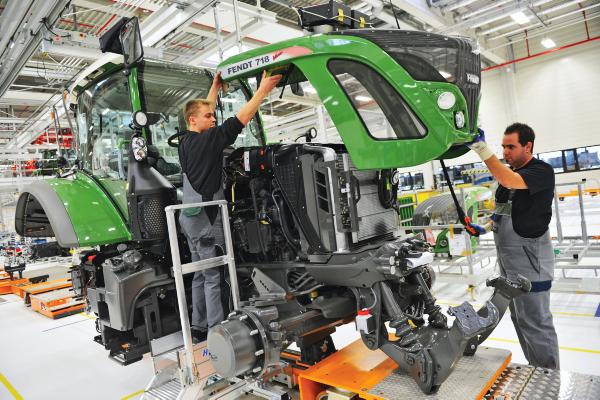
The AGCO-owned tractor company claims that the new factory is the world’s most modern, efficient and flexible factory network for tractor manufacturing.
Fendt claims that it did not only erect new buildings to house modern production and assembly operations, but it has also re-assessed and optimised all the manufacturing and IT processes associated with building tractors in what it has called the Fendt Ahead2 project. The focus for the new factory was on lean production principles and achieving the greatest possible flexibility.
The new factory has a single assembly line where all tractor series are produced. The system gives Fendt the flexibility to produce a wide range of tractor sizes, from the smallest specialty tractor for vineyards to high horsepowered tractors up to 390hp, all on the one line.
Every tractor is made with an average of 10,000 components and Fendt claims that the new factory process will ensure that almost every component arrives straight to the production area in the new final assembly. It can then be installed according to each customer’s individual order.
Fendt said that flowing production is also an important factor in ensuring quality.
‘Just-in-time’ and ‘just-in-sequence’ concepts ensure perfectly timed delivery of important components, such as engines and cabs, in the correct order. Fendt used the opportunity of a new factory to install the latest environmental technology, both for reducing emissions and for increasing energy efficiency.
This new final assembly for tractors was constructed in only 13 months on the site of the newly expanded factory premises in Marktoberdorf. The construction work started in March 2011. In September, the first tractor left the assembly line.
Fendt builds the cabs for the full tractor range at a separate site in Asbach-Bäumenheim. Here the cabs are now assembled in-line with the tractor sequence in Marktoberdorf, according to customer order, and delivered directly to Marktoberdorf in sequence.
A new hall for welding the new cabs was constructed in Asbach-Bäumenheim in 2010. Here the VisioPlus cabs for the 500 and 700 Varios, as well as the large Fendt cabs for the 800 and 939 Vario series, are welded by 18 robots.
The total investment in the new factory and facilities, at both sites, is claimed to be in the region of $300 million. This is the biggest investment that Fendt has made in tractor production, according to its owners, the AGCO Group.
Fendt input recognised
The normally ebullient AGCO chief Martin Richenhagen was noticeably restrained at the opening of the new Fendt factory. He claimed that the AGCO investment in the new Fendt factories was the largest in the farm machinery industry.
He said that he was reasonably optimistic for the farm machinery market in 2012 and 2013 and he expected the markets to show significant worldwide growth in 2015. He claimed that Fendt was a world market leader in tractor technology and that the brand would continue to lead the AGCO group in that respect.
Fendt boss Peter-Josef Paffen was in a more open and optimistic mood. He said that Fendt aims to produce 20,000 tractors per year. This compares with a current figure of 17,500 tractors.
It appears that the negotiations to build the new factory involved a commitment to ensure higher productivity from the 2,800 staff. This is part of the target to build more tractors and up to 30,000 Vario transmissions, some of which will go into other AGCO tractors such as Massey Ferguson.
The official opening of the new factory was performed by the prime minister for the Bavarian region, with prayer support from four religious denominations. There were some lighter moments to the ceremony when the parish priest of Marktoberdorf prepared to bless the factory but there was no water. To the amusement of the crowd present, he was heard to add: “We don’t appear to have water here to bless a factory that is surrounded by such high technology.”
Every local and regional interest was involved in the opening ceremony. It was an investment in the future of tractor production in the region, something everybody was proud of. AGCO’s decision to re-invest in the factory was well recognised, as was the part that AGCO chief Martin Richenhagen, himself a German native, had played in ensuring that the investment was in place.
That decision has ensured that tractor production has a future in a high-cost economy such as Bavaria, through the use of technology backed by manufacturing efficiency.
tractor sales are up
Fendt claims that its tractor sales figures are up by about 18% in 2011 over the previous year. The company is predicting that it will sell approximately 17,500 tractors in 2012.
Fendt reported that it had sold 35 tractors in Ireland in 2011, up from 25 the previous year, while sales in Britain and Northern Ireland jumped from 600 to 676 tractors in the same period.
Fendt launched a new 500 Vario Series range of tractors at the opening of the new factory. These are four-cylinder turbo-powered tractors that span the power range from 125hp to 1675hp. We will have a full and detailed report on these tractors in next week’s Irish Farmers Journal.
Katana could come harvesting to Ireland
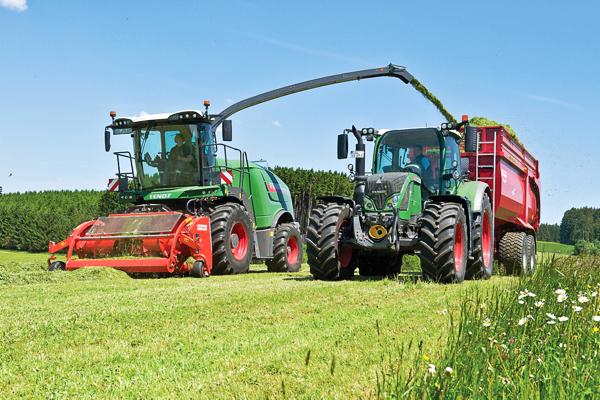
Fendt is putting new effort into developing the market for the Fendt Katana self-propelled silage harvester. There are 25 machines currently working in Germany. The Fendt team is considering bringing the Katana to Ireland for tests in 2013.
The Katana is powered by a 16 litre V8 Mercedes-Benz engine, featuring the fuel-saving SCR technology. With a 720mm diameter, the cutter head on the Fendt Katana 65 is the largest currently available on the market.
Fendt claims that its v-cracker for harvesting maize has been copied by others. The system uses individual v-shaped meshing discs on two parallel-running rollers, giving a cracking length that Fendt claims is more than twice as long as conventional rollers.
The discs mesh, allowing the speeds on the inside and outside of the disc to be different. Fendt claims that this results in highly efficient and thorough cracking of the maize kernels.
The v-cracker can be quickly rotated back behind the discharge blower electro-hydraulically by pressing a button in the maintenance area.
Fendt claims that the Katana excels with low fuel consumption, thanks to the drive train with ECO/Power modes. It claims that when full engine power is not always required for light work, such as in grass, the ECO mode is activated.
This allows the engine speed to be lowered from 2,000 to a fuel-saving 1,600 rpm. The speed of the components remains constant.


SHARING OPTIONS