In order to be financially smart, farmers need to focus on their own Smart BPS plan (budgeting, planning and spending), while also making better use of their resources and skills. The first steps to achieve this are:
• Protect your farm income and Basic Payment Scheme.• Improve your long-term financial situation.• Improve your quality of life.What is Smart budgeting?
Smart budgeting encompasses your earning, spending, saving and investing. It is all about managing your short-term cashflow – understanding how you handle money.
Keeping a daily/weekly diary of income/expenses will reflect the reality – keep it simple. If you try to write down from memory, the picture you paint will be inaccurate.
“No one was ever meant to remember or invent what he did with every cent.” – Robert Frost, US poet.
Smart planning
A plan is needed in order to budget correctly. Again, keep it simple, that way you will be more likely to stick to the plan – whatever works for you is best. Proper planning prevents poor performance, yet setbacks are inevitable. This applies to everyday life and farm plans. Leave some space for the unexpected as the farm and its finances are in a constant state of flux.
Some tIps to be BPS Smart
• Have a dedicated place/office space if possible.• Put a system of filing invoices/receipts in place.• Plan your spending in advance.• Monitor your spending – check actual v planned spend. Are there differences, reasons for being the same. Let there be no surprises.• Modify plan as necessary – it’s not set in stone and should reflect your changing financial needs.• Smooth cashflow. Is there a more efficient way to manage your short-term cashflow?• Cost of credit card versus overdraft?• Would a short- or medium-term loan be better?• Match loan term to your cash requirements.Smart Spending
Smart spending is essential. Loyalty does not always pay. Remember every €1 saved is another €1 in income.
• How much do you need to run the household on a monthly basis?• Could you reduce non-productive farm costs?• Farm costs/insurance/utilities – spread your bills over the course of the year, switch providers, bundle or save by paying online (switch and save).• Reduce energy costs – avail of recently increased SEAI grants.• Bundle your debt – shop around for best rates. Meet with bank/financial institution.• Smart use of resources – use your resources effectively and efficiently, tapping into as many as possible to make your finances flourish.By minding your money and getting the best from it you will also mind yourself, giving you a sense of control and consequently more peace of mind.
In the longer term, Smart BPS will assist in achieving your goals. Getting the family involved in the process will ensure you are all aware of how much it costs to run the household, while also providing children with valuable life skills.
It is all about building good habits that stand the test of time:
• Commit to a plan.• Stick to it.• Review and modify as necessary.• Build on it gradually.If you apply these principles, you will be well on track to farm financial fitness and sound household budgeting. Make the most of your resources – think, plan and be smarter.
In brief
• Getting BPS smart is all about building good habits that stand the test of time.• Smart budgeting – managing short-term cashflow and understanding your finances.• Smart planning – have a simple plan that allows for ups and downs on the farm.• Smart spending – cut out unnecessary costs and make sure you’re getting the best service from providers, eg energy bundles.Is cashflow the real
issue for farmers?
I recently read a quote from psychologist Dr Wayne Dryer that “if you change the way you look at things, the things you look at change”.
The situation on farms is unusual, in that there are seasonal peaks and troughs in income. Most farm income occurs in the last quarter of the year. However, farm costs are a continuous outlay throughout each month of the year. Consequently, farmers need to have some money remaining in their farm bank account at the beginning of the year to cover the ongoing farm costs.
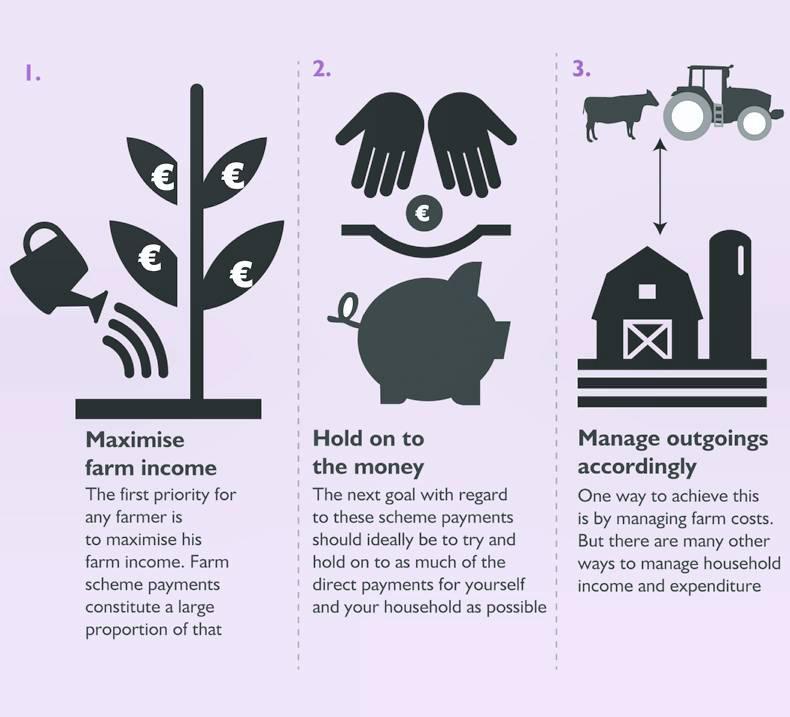
Cashflow is, therefore, the real issue for many farmers. The challenge on the farm is twofold – managing cashflow, while also dealing with volatile income and prices. What is important is how farmers can deal with income volatility and plan around it, while retaining some of their Basic Payment Scheme payment. There is the added challenge of balancing the needs of the farm household with the financial requirements of the farm. Farm households need to budget monthly rather than annually. Ideally, the Basic Payment Scheme should not be used to cover the costs of production, but mainly be used for the household.
For many farmers this is not always possible, but taking a more long-term perspective and planning ahead may assist in achieving this goal.
Finally, farmers, like all other members of society, need to make the most of their tax and social welfare benefits. Farms with an income insufficient to sustain the household may indeed fall below the threshold to qualify for Farm Assist.
In order to be financially smart, farmers need to focus on their own Smart BPS plan (budgeting, planning and spending), while also making better use of their resources and skills. The first steps to achieve this are:
• Protect your farm income and Basic Payment Scheme.• Improve your long-term financial situation.• Improve your quality of life.What is Smart budgeting?
Smart budgeting encompasses your earning, spending, saving and investing. It is all about managing your short-term cashflow – understanding how you handle money.
Keeping a daily/weekly diary of income/expenses will reflect the reality – keep it simple. If you try to write down from memory, the picture you paint will be inaccurate.
“No one was ever meant to remember or invent what he did with every cent.” – Robert Frost, US poet.
Smart planning
A plan is needed in order to budget correctly. Again, keep it simple, that way you will be more likely to stick to the plan – whatever works for you is best. Proper planning prevents poor performance, yet setbacks are inevitable. This applies to everyday life and farm plans. Leave some space for the unexpected as the farm and its finances are in a constant state of flux.
Some tIps to be BPS Smart
• Have a dedicated place/office space if possible.• Put a system of filing invoices/receipts in place.• Plan your spending in advance.• Monitor your spending – check actual v planned spend. Are there differences, reasons for being the same. Let there be no surprises.• Modify plan as necessary – it’s not set in stone and should reflect your changing financial needs.• Smooth cashflow. Is there a more efficient way to manage your short-term cashflow?• Cost of credit card versus overdraft?• Would a short- or medium-term loan be better?• Match loan term to your cash requirements.Smart Spending
Smart spending is essential. Loyalty does not always pay. Remember every €1 saved is another €1 in income.
• How much do you need to run the household on a monthly basis?• Could you reduce non-productive farm costs?• Farm costs/insurance/utilities – spread your bills over the course of the year, switch providers, bundle or save by paying online (switch and save).• Reduce energy costs – avail of recently increased SEAI grants.• Bundle your debt – shop around for best rates. Meet with bank/financial institution.• Smart use of resources – use your resources effectively and efficiently, tapping into as many as possible to make your finances flourish.By minding your money and getting the best from it you will also mind yourself, giving you a sense of control and consequently more peace of mind.
In the longer term, Smart BPS will assist in achieving your goals. Getting the family involved in the process will ensure you are all aware of how much it costs to run the household, while also providing children with valuable life skills.
It is all about building good habits that stand the test of time:
• Commit to a plan.• Stick to it.• Review and modify as necessary.• Build on it gradually.If you apply these principles, you will be well on track to farm financial fitness and sound household budgeting. Make the most of your resources – think, plan and be smarter.
In brief
• Getting BPS smart is all about building good habits that stand the test of time.• Smart budgeting – managing short-term cashflow and understanding your finances.• Smart planning – have a simple plan that allows for ups and downs on the farm.• Smart spending – cut out unnecessary costs and make sure you’re getting the best service from providers, eg energy bundles.Is cashflow the real
issue for farmers?
I recently read a quote from psychologist Dr Wayne Dryer that “if you change the way you look at things, the things you look at change”.
The situation on farms is unusual, in that there are seasonal peaks and troughs in income. Most farm income occurs in the last quarter of the year. However, farm costs are a continuous outlay throughout each month of the year. Consequently, farmers need to have some money remaining in their farm bank account at the beginning of the year to cover the ongoing farm costs.
Cashflow is, therefore, the real issue for many farmers. The challenge on the farm is twofold – managing cashflow, while also dealing with volatile income and prices. What is important is how farmers can deal with income volatility and plan around it, while retaining some of their Basic Payment Scheme payment. There is the added challenge of balancing the needs of the farm household with the financial requirements of the farm. Farm households need to budget monthly rather than annually. Ideally, the Basic Payment Scheme should not be used to cover the costs of production, but mainly be used for the household.
For many farmers this is not always possible, but taking a more long-term perspective and planning ahead may assist in achieving this goal.
Finally, farmers, like all other members of society, need to make the most of their tax and social welfare benefits. Farms with an income insufficient to sustain the household may indeed fall below the threshold to qualify for Farm Assist.





SHARING OPTIONS