


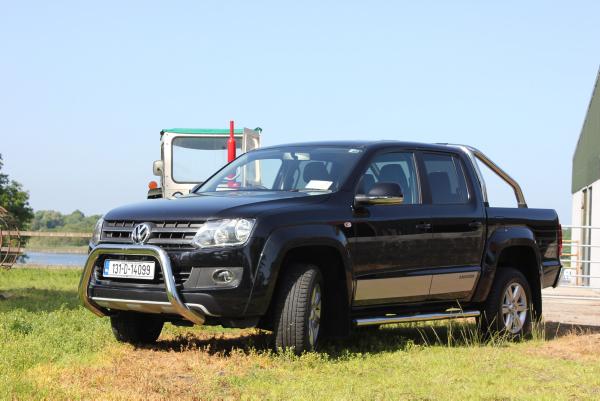
There’s more power to the Amarok as Volkswagen worked some magic and got an extra 17bhp from the 2.0 litre diesel engine of this giant, 4x4 pick-up. I felt the difference after driving the Amarok for a week, a few months ago, and the impression lasted long after the test drive.
Everything looks the same, in terms of size and features, but some subtle distinctive marking let you know it’s different. Experts will spot the red ‘I’ on the rear tailgate, but the side markings are more defined.
I had the comfort of driving the automatic version which was easy to use. It took to the off-road field trials with ease, but as my drive went without a hitch I missed the opportunity to give it a towing trial. The towing rating was also boosted, along with the engine power, and it’s now rated at 3200kg, up 400kg from the lower power model.
The appearance and size of the Amarok has always impressed me. The interior feels a lot more spacious in comparison with the competition.
The width of the Amarok can be daunting for first time drivers, but you get used to it, even if the people that you meet on smaller roads don’t.
The automatic gearbox was easy to use. The extra power from the twin turbo 180bhp engine meant a real smoothness in gear change. Would I opt for it relative to the manual gearbox?
There are obvious advantages for both, but for me the driving comfort is great with the auto unit, even if there is a slight penalty in terms of fuel economy.
The fact that the test Amarok came with the permanent 4x4 system meant that it was always going to be a bit heavier on diesel. It could be even heavier with a trailer attached, but I didn’t get the chance to put that to the test.
Overall, I found that the 80 litre fuel tank lasted longer than I would have expected. Although I didn’t achieve the rated fuel economy figures of 13.1 km/litre (7.6 l/100km or 37.2mpg) as I was operating at about 20% less. Given the range of driving conditions, including a fully loaded pick-up area for one session, this was overall an impressive economy level.
There is some competition at this end of the pick-up market as both the 2.5 litre Nissan Navara and the 3.2 litre Ford Ranger offer more engine power. And the bigger engine Ford Ranger is marginally ahead of the Amarok when it comes to the pulling power ratings.
They are all similar in terms of the acceleration pace and with little to separate them when it comes to economy on the road, this is where the Amarok does shine. It brings comfort, large loading and passenger space to a new level.
These are top end 4x4 pick-ups and so they come with lots of additional features that push the prices up. The entry level 180bhp Amarok comes at the price of €41,225 or £22,495 in Northern Ireland and that’s getting expensive. These are commercial vehicles and there is scope to get VAT refunded if you have a VAT number. That significantly changes the price number.
I’m still a fan of the 4x4 pick-up because it’s so much more versatile than the commercial, covered 4x4. They have a five-seat capacity plus a decent load area that can be covered and locked.
The 4x4 pick-ups can now deliver decent power and comfort, along with towing ability. They look well and drive well, and the new more powerful Amarok proves all three.
That said, I was happy with the performance of the lower power unit that I drove last year, so I expect you’ll think twice about paying almost €4,000 more for the power privilege of the 180bhp version, even with a Volkswagen badge up in front. CL


SHARING OPTIONS