


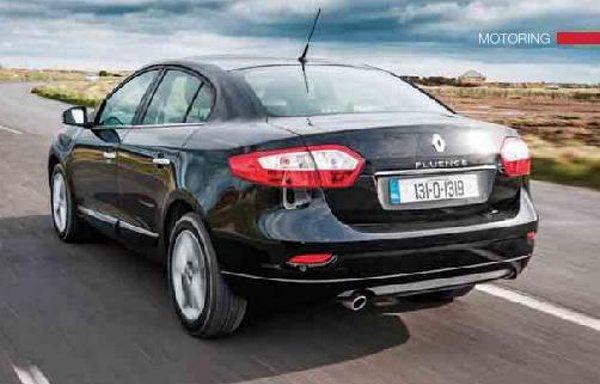
Renault has upgraded the Fluence model with a new front-end design and some additional styling features. The car excels in terms of boot space with huge capacity, even more than you expect.
But is there more to the Fluence and can it compete with the likes of the Ford Focus or the new Toyota Corolla that's on the way? On first impressions the car is a standard three box design; there's a front-engine section, a passenger cabin and that large boot. What more do you want.
Even though the styling has changed, I'm not sure if it's enough - it's more a gentle evolution. The styling is in line with the new look of the entire Renault fleet where the badge in strong silver chrome takes priority on the front of the bonnet.
On the inside, the car is spacious, there's reasonable legroom in the back and good side by side space at the front. There's reasonable ceiling height for an average guy like me who likes to sit with a high seating position.
The dash area to the front is basic in feel and touch. There's a push-button start system that does not need the Renault fob to be inserted.
The colours are somewhat dull with little in terms of styling to brighten it up - apart from the side air vents that have a chrome surround which, like a recent Toyota I drove recently, caused a light reflection I found quite irritating.
This Renault was fitted with the entry-level 1.5 litre turbo-diesel engine, which produces 90bhp. There's a more powerful version of the same size engine, with a bit more acceleration life and not much in terms of extra fuel usage.
The engine was lively enough, but in reality the 0 to 100km/hr figure of 13 seconds tells all. I found the pedal very light and, even after a few days, I tended to accelerate the car more than I wanted to.
This Fluence has a five-speed gearbox and the more powerful version comes with a six-speed one. The five-speed one was a bit noisy on the road. It also meant that I needed to rev to close to 2,800rpm to achieve the 120km/hr top speed on the motorway.
And at that engine speed, the car seemed noisy as if it was working too hard. The other aspect of this is that the economy levels take a nosedive as you increase engine speed.
Perhaps that was why my economy figures were about 25% poorer than the Renault quoted figures. In reality, what I achieved over a long test drive of almost 700km is probably closer to a true driving experience where you meet a range of conditions.
In terms of safety, the Fluence has all the current-day basics. There is no Euro NCAP test for the car on offer in Ireland, but the electric version of the Fluence has been tested in 2011 and came away with a four-star rating.
At the outset I mentioned the big boot, but with all that space there was no spare wheel. This is a significant drawback for me as it would not have encroached on the load-carrying area.
The Renault range has been competitively priced in recent years. Some owners might actually think it's been too competitively priced, which has had an impact on resale values.
The list price of the Fluence, which is not available in Northern Ireland except as an electric car, is €20,595 for the diesel-powered version I drove. That's competitive relative to the Ford Focus 1.6 TDCi and the Toyota Corolla with a similar 1.6-litre turbo-diesel engine. There is little between them in terms of economy, but resale prices put the Fluence further down in value terms.
From a driving point of view and overall space, the Fluence seems to make sense. This was a car I found difficult to be attracted to, but at the same time logic dictates that it makes family driving sense. However there are still niggly issues about reliability in my mind and - oh - those falling resale values.


SHARING OPTIONS