


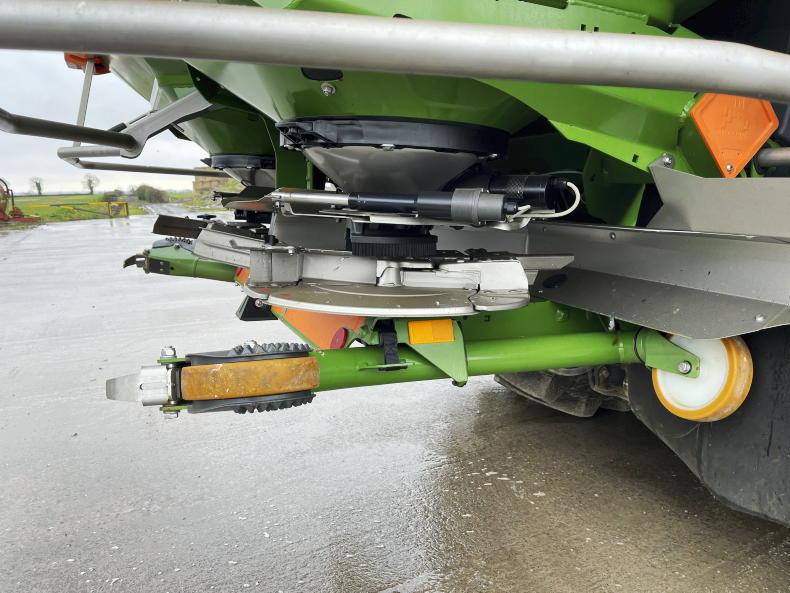
With fertiliser prices at an all-time high, it is more important than ever to make sure that your fertiliser spreader is in top condition this season.
What you can do to ensure your spreader is spreading evenly and accurately.
There are a few simple items that you should look at first. Check the spreader condition, look for any signs of rust or cracking in the frame and hopper itself.
Any issues need to be fixed to ensure the spreader doesn’t break when being filled or if you hit a bump on the road/field.
Make sure that the spreader is mounted correctly on the tractor.
You need to make sure that the machine is level both left to right, and front to back
This should be checked with the machine at the working height. This is normally a disc height of around 70cm over the crop. However, check the operator’s manual for your machine.
You need to make sure that the machine is level both left to right, and front to back. If not, you should check and adjust the tractor tyre pressure, lower the link arms and the toplink to make it level.
Inspect the spreader vanes. Wear on the vanes will have a big impact on the spreader’s performance. These are a wearing part so need to be replaced regularly.
Any issue here will have a big effect on the spreader’s performance
Signs of wear are usually seen as waves or holes worn into the vanes. Any issue here will have a big effect on the spreader’s performance.
It is very important to check the angle of the vanes. They will need to be adjusted to suit the fertiliser type that is being spread.
Most manufacturers have smartphone apps which make this process much more user-friendly than it used to be with the calibration booklets.
Also, while you are doing this, check for any wobble in the discs as the bearings will wear out over time and need replacing.
It is important to check the agitator in the bottom of the hopper. This has a very important role – it maintains a constant and even flow of fertiliser on to the disks.
Check the shutters on both sides of the hopper. They need to open evenly
If the agitator is broken or worn then the fertiliser will flow in stops and starts and result in very uneven spreading.
Check the shutters on both sides of the hopper. They need to open evenly.
If there is wear in the linkages or on the shutter itself then the openings in the hopper may be different. This will result in more fertiliser being released on to one of the discs and the spread pattern will be wrong as a result.
Check the flow rate of fertiliser. This is done by calibrating the spreader. Different fertilisers will flow at different rates, so the shutter position for 125kg/ha of urea will be different to the shutter position for 125kg/ha of CAN. This is done by removing one of the discs and placing a bucket under the shutter outlet.
Run the tractor PTO, then open the shutter for 30 seconds and collect the fertiliser in the bucket.
Check the amount collected against the fertiliser spreader app for your spreader.
Check the tractor forward speed and the PTO speed
If there is no app for your spreader, then you can use the Teagasc online calculator to work out how much fertiliser should have been collected. Adjust the shutter position until the correct amount is reached.
Check the tractor forward speed and the PTO speed. These settings are critical to getting the application correct. If you are not sure how to do this, then ask the garage to calibrate the speed sensors when you get the tractor serviced.
If you have access to a set of trays, carry out a field tray test. This will tell you how even the fertiliser application is across the full bout width.
Basic GPS
A basic GPS guidance system is a very good investment for anyone spreading their own fertiliser.
The GPS unit will not only make sure you are driving at the correct working width. It will also give you an accurate forward speed reading.
If you have a headland or boundary spreading unit on the spreader, check to make sure that it is working correctly and that the vanes are adjusted to suit the working width used.
It is important that the deflector is dropping to the correct level so that it diverts the fertiliser, but equally as important is that it retracts fully out of the way once the headland run is complete.
It is also important to check that lights and covers are all functioning correctly.
Check hydraulic hoses for leaks and make sure that all of the safety guards are in place. Aftercare of the spreader will ensure a much longer more accurate life of the machine.
Wash it down completely after use and lubricate all of the grease points. When storing for a prolonged period, apply a protective coating to reduce the chance of rust and corrosion.





SHARING OPTIONS