


Travel across Europe and you will more often than not see perfectly symmetrical fields. That means no gearogs or short shot to contend with. Here, on the other hand, perfectly symmetrical fields are few and far between.
For most farmers, tilling or mowing requires operating on the straightest and hopefully longest ditch. That often still leaves gearogs on one or both sides of a field.
Mowing grass for silage is one of those tasks that you need a really good eye for. Gearogs at either end are bad enough, but adding in more gearogs in the middle will not be appreciated by anyone.
However, there is a technological solution that doesn’t cost a fortune. Entry level GPS systems no longer cost the earth and even the most basic system can add a new level of efficiency and productivity.
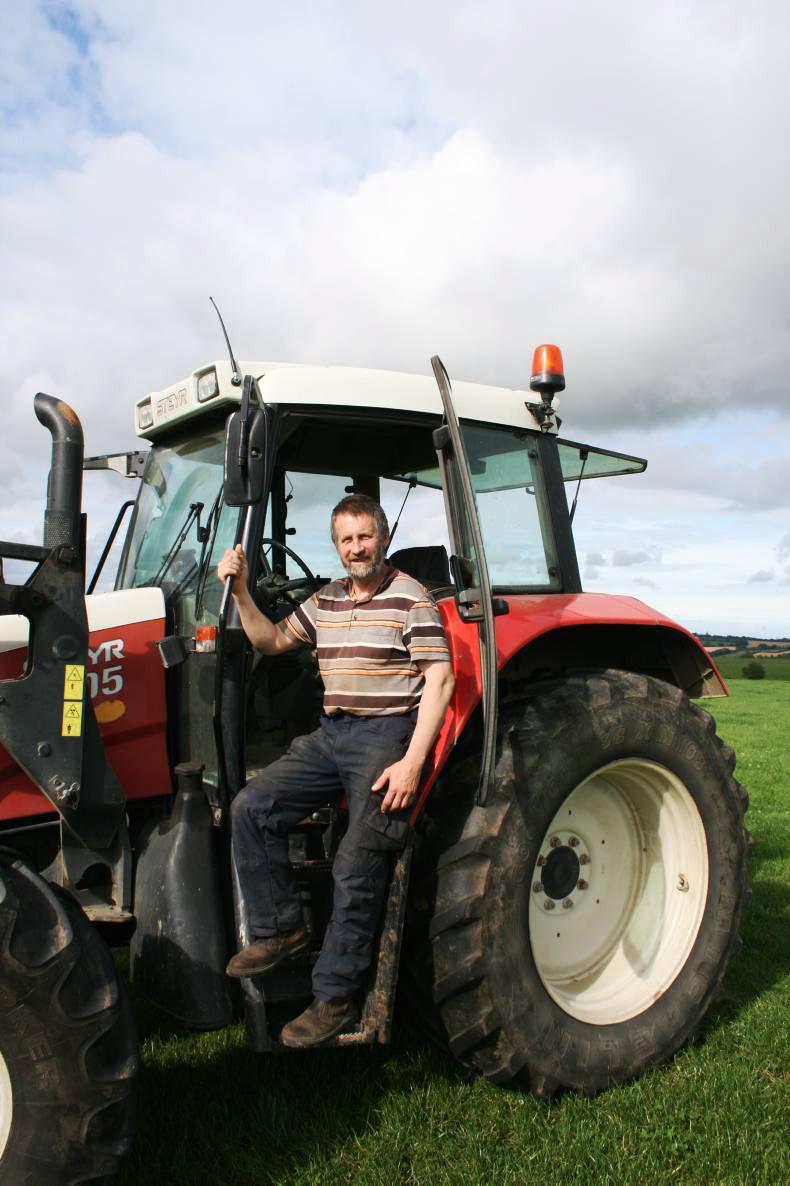
Back in 2011, Wexford dairy farmer Aidan Murphy saw how competitively priced GPS systems had become and decided to invest. He purchased the CaseIH branded version of the Trimble EZ-Guide 250 from Springmount Tractors Ltd. “I work with a neighbour to make our own silage, picking it up with a silage wagon. I do the mowing and the grass is picked up by a silage wagon after mowing. It’s important to be able to mow off gearogs properly and have the least possible amount of them,” explained Aidan.
The ability to go from spreading fertilizer at 12 metres to spreading at his fertilizer spreader’s capacity of 18 metres was also a deciding factor in purchasing a GPS system. “It suits me to spread the paddocks at 12 metres around the outside and up the middle – it just works out. On the silage ground I spread at 18 metres, which is far more efficient both fuel and time wise,” said Aidan.
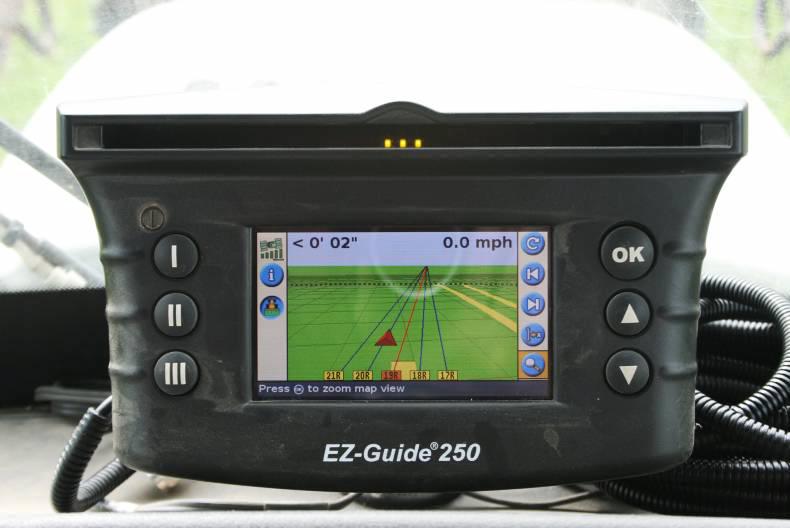
The EZ-Guide 250 which Aidan purchased is an entry level GPS system equipped with a light bar and 11cm screen. He mounted it on the dash of his Steyr 9105 (CaseIH CS110) where he could easily see both the screen and light bar, plus enter or change settings as required.
The EZ-Guide250 comes with its own small magnetic antenna but Aidan also purchased the AG-15 antenna which the firm claims improves accuracy down to between 6in and 8in. Like so many others who purchased the AG-15 antenna, Aidan still hasn’t yet mounted it because there are lots of trees where he farms and works, capable of sweeping it off the cab roof.
In the field
Aidan explains that when you go to field first, you drive around the boundary with whatever implement is attached and record the boundary position. This also records the acres or hectares in the field and, of this, Aidan said: “Recording acres is another thing it is brilliant at because you never knew what acres you were actually mowing, either for yourself or other people. I find a lot of fields are lower in acres than what people actually thought.”
Next you would usually set up an A-B line which is a line that the GPS will generate all its guidance lines parallel to. This is similar to working off the straightest or longest headland pre-GPS. All of this data is stored on the Trimble unit and can be used again on the same job in the future. “Once a field is stored on the unit, it is very easy to go back,” Aidan said.
You do have to be careful setting it up, Aidan warned: “Most lads would leave the ditch headland to last in case there are any stones, so leave the boundary recording to last so as to record the true acreage of the field.”
You should be careful when setting up an implement on the Trimble unit also, he advised. “Measure how far back the mower bed is from the antenna and how far it is offset to the centre of the mowing bed from the antenna.” If there measurements are incorrect then the lightbar on the GPS unit will precisely guide you to this incorrect position for the implement. Not helpful when mowing.
In total, Aidan mows over 200 acres of grass for silage with a 10ft trailed Kuhn FC302G mower. The vast majority of this is picked up still in the mowed rows by a silage wagon. “I tend to mow in the afternoon to about 7pm. Under sunshine the crop is at its driest and the sugars are well up in the grass,” Aidan explained.
Entering the field to be mown, Aidan will mow off seven rounds of the headland. On the eighth he will mark his A-B line, usually the longest headland. Once this is recorded, the GPS unit will divide the field into numbered guidelines. “Now I can see how many shots there are in the field and how many of these are gearogs. If there are 100 shots and 20 of these are gearogs then I would generally mow off the gearogs first. With the GPS units I can then go to line 40 and work from the middle out. This generally leaves me with two blocks at either end to mow off, and no gearogs.”
Accurate
Aidan’s entry level system is accurate enough to manage mowing and fertilizer spreading in his dairy operation. “If it is a little off coming to the end of a field, you will see it and compensate accordingly,” said Aidan.
“It’s brilliant for mowing, especially if you are mowing anywhere close to the road. It mows out perfect,” Aidan said. “Every row is parallel, you’d often be a couple of inches out but it’s never that much off. I’ve mowed for years but I could never mow gearogs off right, you always tend to go off line toward the end on one side. With the GPS I mow them off first, perfectly every time.”
While Aidan doesn’t mow grass at night, he often spreads fertilizer. “Without GPS at night or on freshly mown fields it would be impossible to spread fertilizer. I can see how it would be a great help at night time for mowing.”
Obstacles such as ESB poles or rock, for example, can also be marked on field maps stored in the Trimble unit. This is particularly important where a rock or feature may be protruding from the ground, but not high enough to be seen in tall grass.
Aidan pointed out that field data can be downloaded from the Trimble unit to a USB stick and saved or printed off from any computer with Microsoft Word installed. This, he says, is a useful feature for farm records or in the case of a contractor, could be part of the information provided at invoicing. Also, you can copy and paste the field latitude/longitude from the field data into Google Maps and find the field.
Now in his fourth year using GPS, has Aidan any plans to upgrade? “I don’t think I need to. For mowing or spreading fertilizer it’s great. You can even divide fields up to make paddocks. When you get used to using GPS you couldn’t go back, you wouldn’t be able!”
In 2011, Aidan would have bought his unit for around €1,500 including VAT so it was definitely value for money and no doubt saved him on both diesel and fertilizer over the years.




SHARING OPTIONS