Citroën’s new Cactus
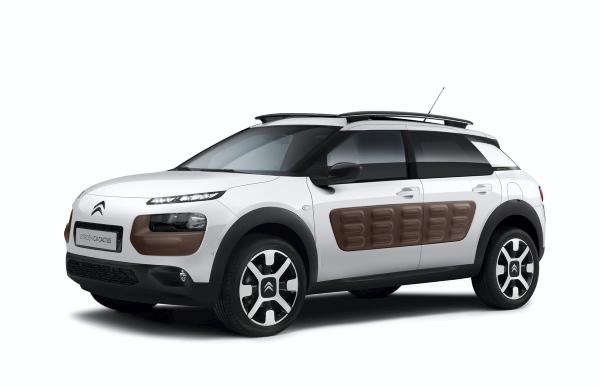
Citroën claims that its new C4 Cactus offers more in terms of simple design and smart functionality and, more importantly, it claims that running costs are almost 20% less than the benchmark in the compact hatchback segment.
The new model is 200kg lighter than the Citroën C4, on which it is based. It is powered by latest-generation Euro 6 engines, with fuel consumption figures of just 33km/litre (3.1 litres/100km) and a low CO2 rating ranging from 82g/km.
The car comes with Airbump technology. This is a thermoplastic polyurethane (TPU) skin that uses air capsules to absorb impacts.
Airbump requires no specific maintenance and helps to cut vehicle repair costs, according to the company. Daytime-running LED lights and headlights are built into the front of the car.
SsangYong’s new Rexton W
The Korean car company SsangYong has launched the new Rexton 4x4 this week, with entry prices starting at €34,119.
The Rexton comes with a selectable 4x4 system and uses a body-on-frame type construction for strength. It uses a double wishbone and coil spring suspension to the front and a five-link rigid axle with coil springs at the rear.
The Rexton is powered by a 2.0-litre turbo-diesel engine and has a 2.6t towing rating. It is available in three versions, passenger seven-seat, commercial and utility (five-seat commercial).
The standard equipment includes heated front and rear seats, cruise control, air conditioning, electrically operated and heated folding door mirrors, CD and RDS radio with USB and Bluetooth connectivity. It comes with a five-year unlimited warranty for the passenger versions and there’s a 150,000km limit for the commercial versions.
Jeep to offer new, small SUV
Jeep announced a new, smaller SUV called the Jeep Renegade at the Geneva Motor Show last week, which will be on sale in 2015.
The company claims that the Renegade will deliver a unique combination of off-road capability, open-air freedom and convenience, a nine-speed automatic transmission to give outstanding on-road and off-road driving dynamics, fuel-efficient engines, and a host of new safety and technology offerings.
The company also claims that its new full-time 4x4 system can provide up to 100% of the engine’s available torque to the ground, through any wheel, for optimal grip. The Renegade is the first small SUV to feature a disconnecting rear axle and power take-off unit (PTU) to provide Jeep Renegade 4x4 models with enhanced fuel economy.
The system instantly engages when 4x4 traction is needed.
It will have a hill-descent control system with high ground clearance and ability to wade in 480mm (19in) of water.
The engine power options will include four Fiat MultiAir petrol engines or two MultiJet II diesel engine offerings.
The new Renegade will be built by Fiat in Italy.
Mazda6 with limited offer
Mazda is offering a new Mazda6 Executive SKYACTIV-D 150PS model for a limited time only.
The Executive grade model, priced at €29,495, is claimed to offer a high level of specification with 17” alloy wheels, a multimedia system featuring a 5.8” touchscreen display, Bluetooth with voice control, cruise control, fog lights and start/stop functionality, to name just some of the features.
The company claims that the Mazda6 is one of the most powerful yet efficient cars, with CO2 emissions from just 104g/km and combined fuel consumption from 3.9 litres/100km.
The car is available on the Mazda Choices PCP finance package, for as little as €365 a month, based on terms and conditions.
Hybrid cars sales up 40%
European sales of hybrid vehicles increased by more than 40% in 2013 to 214,237 units as more people decided to reduce their fuel consumption by driving electrically assisted cars.
Motor industry analysts say that the market niche continues to struggle against diesel-powered cars that are often even more economical than hybrids.
The market growth in 2013 was fuelled by demand for updated versions of the petrol electric Toyota Auris and Yaris models, which combined to account for 47% of Europe’s total hybrid sales in 2013.
Toyota’s strong track record in hybrids in Europe and relatively weaker diesel engine offerings are supporting the hybrid car sales for the brand. It seems that many buyers who want a car with better fuel economy than a petrol car are opting for Volkswagen Golf diesel, while if you buy a Toyota it’s more likely that you’ll opt for a hybrid.
Toyota’s refinement of its hybrid system has paid off on the latest generation of the Auris Hybrid, which emits 84g of CO2 per kilometre, compared with 109g/km for the much lower powered 1.4-litre diesel version of the compact. The Yaris Hybrid’s CO2 output is just 79g/km, making it one of Europe’s cleanest vehicles.
Honda, on the other hand, announced that it will stop selling its Insight and CR-Z petrol electric hybrids in Europe because of weak demand. It is a blow to Honda, which was the first car brand to sell a mass-production hybrid in Europe back in 1999.
This will leave Honda with just one hybrid in Europe, the Jazz, and that car’s future is unclear. Honda said no decision has been made on whether Europe will get the hybrid version of the new Jazz that is due in 2015.
Diesel hybrids
Europe’s diesel-hybrid market is led by PSA/Peugeot-Citroen. The Peugeot 508 HYbrid4 was the top-selling diesel hybrid in Europe with a 2013 volume of 9,792, ahead of the Peugeot 3008 HYbrid4 and the Citroen DS5 HYbrid4.
Europe’s premium makers fared poorly in the niche market. There was little demand for cars such as the Mercedes-Benz S-class BlueHybrid and BMW’s Active Hybrid versions of 3 series, 5 series and 7 series. This is not surprising as these cars provide little, if any, improvement in fuel economy compared with diesel equivalents.
Plug-in hybrids
The one growth area is expected to be plug-in hybrids. The Mitsubishi Outlander PHEV gasoline plug-in was Europe’s number seven selling hybrid in 2013, its first year on the market. The car is currently being launched in Ireland.
Volvo’s V60 plug-in diesel hybrid was ninth on the market. Many have CO2 figures below 75g/km and are eligible for grants. Current plug-in hybrids, such as the V60, emit 48g/km of CO2.
Higher penalty points for phone use and
not wearing seat belt
Penalty points for using a mobile phone have risen from two to three following the enactment of the latest Road Traffic Bill. The Road Traffic No.2 Act 2013 allows for roadside impairment tests for drug driving, higher penalty points for speeding, mobile phone use and not wearing seatbelts, and allows unconscious drivers to be tested. The details of the new regulations are as follows:
Roadside impairment testing, where gardaí can carry out cognitive tests to establish if a driver is under the influence of an intoxicant. The result of the test can be used if a prosecution proceeds. A new road traffic offence of tampering with an odometer (clocking) with a penalty of €2,500 and/or three months in prison.Tougher penalties
Tougher penalties for involvement in a hit and run accident as follows:
When a person flees the scene, with intent to escape liability, and does not offer assistance, knowing injury has been caused, €10,000 and/or seven years.Where death results, €20,000 and/or 10 years.Increases
The act changes the level of penalty points for several offences. These changes will come into effect when the Garda Pulse system is next updated.
There will be increases for offences such as:
Speeding will now attract three points on payment of fixed charge and five on conviction (previously two and four).Mobile phone use will now attract three points on payment of fixed charge and five on conviction (previously two and four).Non-wearing of seatbelts will now attract three points on payment of fixed charge and five on conviction (previously two and four). Other offences such as non-display of an NCT certificate, which at present involve a court appearance, will attract two points on payment of fixed charge.Taking a blood specimen in hospital from a driver incapacitated following a road traffic collision. The permission of the treating doctor will be required before the specimen can be taken and the results of the analysis will be revealed only when the driver can, subsequently, give permission.
Citroën’s new Cactus
Citroën claims that its new C4 Cactus offers more in terms of simple design and smart functionality and, more importantly, it claims that running costs are almost 20% less than the benchmark in the compact hatchback segment.
The new model is 200kg lighter than the Citroën C4, on which it is based. It is powered by latest-generation Euro 6 engines, with fuel consumption figures of just 33km/litre (3.1 litres/100km) and a low CO2 rating ranging from 82g/km.
The car comes with Airbump technology. This is a thermoplastic polyurethane (TPU) skin that uses air capsules to absorb impacts.
Airbump requires no specific maintenance and helps to cut vehicle repair costs, according to the company. Daytime-running LED lights and headlights are built into the front of the car.
SsangYong’s new Rexton W
The Korean car company SsangYong has launched the new Rexton 4x4 this week, with entry prices starting at €34,119.
The Rexton comes with a selectable 4x4 system and uses a body-on-frame type construction for strength. It uses a double wishbone and coil spring suspension to the front and a five-link rigid axle with coil springs at the rear.
The Rexton is powered by a 2.0-litre turbo-diesel engine and has a 2.6t towing rating. It is available in three versions, passenger seven-seat, commercial and utility (five-seat commercial).
The standard equipment includes heated front and rear seats, cruise control, air conditioning, electrically operated and heated folding door mirrors, CD and RDS radio with USB and Bluetooth connectivity. It comes with a five-year unlimited warranty for the passenger versions and there’s a 150,000km limit for the commercial versions.
Jeep to offer new, small SUV
Jeep announced a new, smaller SUV called the Jeep Renegade at the Geneva Motor Show last week, which will be on sale in 2015.
The company claims that the Renegade will deliver a unique combination of off-road capability, open-air freedom and convenience, a nine-speed automatic transmission to give outstanding on-road and off-road driving dynamics, fuel-efficient engines, and a host of new safety and technology offerings.
The company also claims that its new full-time 4x4 system can provide up to 100% of the engine’s available torque to the ground, through any wheel, for optimal grip. The Renegade is the first small SUV to feature a disconnecting rear axle and power take-off unit (PTU) to provide Jeep Renegade 4x4 models with enhanced fuel economy.
The system instantly engages when 4x4 traction is needed.
It will have a hill-descent control system with high ground clearance and ability to wade in 480mm (19in) of water.
The engine power options will include four Fiat MultiAir petrol engines or two MultiJet II diesel engine offerings.
The new Renegade will be built by Fiat in Italy.
Mazda6 with limited offer
Mazda is offering a new Mazda6 Executive SKYACTIV-D 150PS model for a limited time only.
The Executive grade model, priced at €29,495, is claimed to offer a high level of specification with 17” alloy wheels, a multimedia system featuring a 5.8” touchscreen display, Bluetooth with voice control, cruise control, fog lights and start/stop functionality, to name just some of the features.
The company claims that the Mazda6 is one of the most powerful yet efficient cars, with CO2 emissions from just 104g/km and combined fuel consumption from 3.9 litres/100km.
The car is available on the Mazda Choices PCP finance package, for as little as €365 a month, based on terms and conditions.
Hybrid cars sales up 40%
European sales of hybrid vehicles increased by more than 40% in 2013 to 214,237 units as more people decided to reduce their fuel consumption by driving electrically assisted cars.
Motor industry analysts say that the market niche continues to struggle against diesel-powered cars that are often even more economical than hybrids.
The market growth in 2013 was fuelled by demand for updated versions of the petrol electric Toyota Auris and Yaris models, which combined to account for 47% of Europe’s total hybrid sales in 2013.
Toyota’s strong track record in hybrids in Europe and relatively weaker diesel engine offerings are supporting the hybrid car sales for the brand. It seems that many buyers who want a car with better fuel economy than a petrol car are opting for Volkswagen Golf diesel, while if you buy a Toyota it’s more likely that you’ll opt for a hybrid.
Toyota’s refinement of its hybrid system has paid off on the latest generation of the Auris Hybrid, which emits 84g of CO2 per kilometre, compared with 109g/km for the much lower powered 1.4-litre diesel version of the compact. The Yaris Hybrid’s CO2 output is just 79g/km, making it one of Europe’s cleanest vehicles.
Honda, on the other hand, announced that it will stop selling its Insight and CR-Z petrol electric hybrids in Europe because of weak demand. It is a blow to Honda, which was the first car brand to sell a mass-production hybrid in Europe back in 1999.
This will leave Honda with just one hybrid in Europe, the Jazz, and that car’s future is unclear. Honda said no decision has been made on whether Europe will get the hybrid version of the new Jazz that is due in 2015.
Diesel hybrids
Europe’s diesel-hybrid market is led by PSA/Peugeot-Citroen. The Peugeot 508 HYbrid4 was the top-selling diesel hybrid in Europe with a 2013 volume of 9,792, ahead of the Peugeot 3008 HYbrid4 and the Citroen DS5 HYbrid4.
Europe’s premium makers fared poorly in the niche market. There was little demand for cars such as the Mercedes-Benz S-class BlueHybrid and BMW’s Active Hybrid versions of 3 series, 5 series and 7 series. This is not surprising as these cars provide little, if any, improvement in fuel economy compared with diesel equivalents.
Plug-in hybrids
The one growth area is expected to be plug-in hybrids. The Mitsubishi Outlander PHEV gasoline plug-in was Europe’s number seven selling hybrid in 2013, its first year on the market. The car is currently being launched in Ireland.
Volvo’s V60 plug-in diesel hybrid was ninth on the market. Many have CO2 figures below 75g/km and are eligible for grants. Current plug-in hybrids, such as the V60, emit 48g/km of CO2.
Higher penalty points for phone use and
not wearing seat belt
Penalty points for using a mobile phone have risen from two to three following the enactment of the latest Road Traffic Bill. The Road Traffic No.2 Act 2013 allows for roadside impairment tests for drug driving, higher penalty points for speeding, mobile phone use and not wearing seatbelts, and allows unconscious drivers to be tested. The details of the new regulations are as follows:
Roadside impairment testing, where gardaí can carry out cognitive tests to establish if a driver is under the influence of an intoxicant. The result of the test can be used if a prosecution proceeds. A new road traffic offence of tampering with an odometer (clocking) with a penalty of €2,500 and/or three months in prison.Tougher penalties
Tougher penalties for involvement in a hit and run accident as follows:
When a person flees the scene, with intent to escape liability, and does not offer assistance, knowing injury has been caused, €10,000 and/or seven years.Where death results, €20,000 and/or 10 years.Increases
The act changes the level of penalty points for several offences. These changes will come into effect when the Garda Pulse system is next updated.
There will be increases for offences such as:
Speeding will now attract three points on payment of fixed charge and five on conviction (previously two and four).Mobile phone use will now attract three points on payment of fixed charge and five on conviction (previously two and four).Non-wearing of seatbelts will now attract three points on payment of fixed charge and five on conviction (previously two and four). Other offences such as non-display of an NCT certificate, which at present involve a court appearance, will attract two points on payment of fixed charge.Taking a blood specimen in hospital from a driver incapacitated following a road traffic collision. The permission of the treating doctor will be required before the specimen can be taken and the results of the analysis will be revealed only when the driver can, subsequently, give permission. 





SHARING OPTIONS