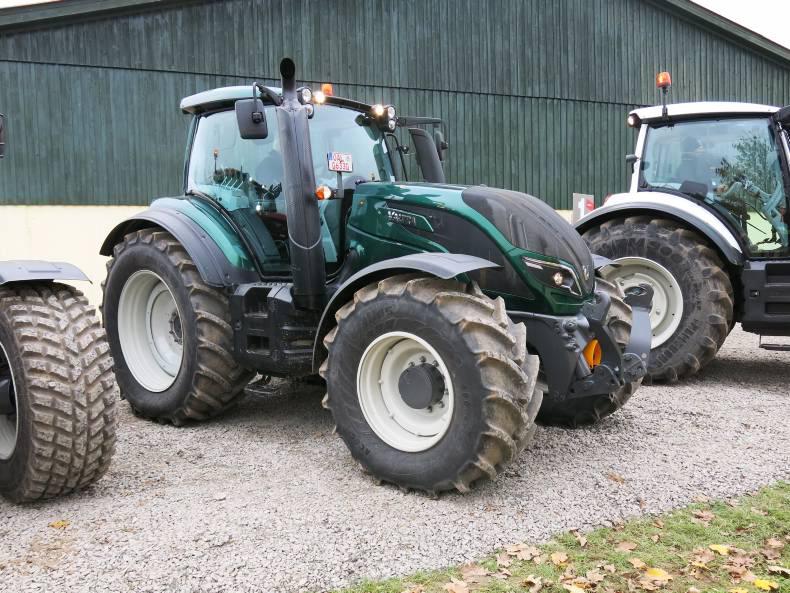
Valtra’s new T4 will be one of the star attractions on the Valtra stand for the ploughing.
The development of this new tractor started in 2008. The project involved huge market research and over 40,000 hours of testing all over the world. Valtra claims to have used one million litres of fuel in testing.
“Your working machine” is the message that Valtra pushed as their new brand identity to the customer.
The launch of the new T4 is the first completely new product from Valtra in 25 years. The company is quite proud of the styling and improvements. The T4 has been designed to give it a more universal appeal, yet it has maintained some of the traditional Valtra values that are favourites with existing customers. This tractor has the looks and the muscle to become a serious challenger on the market.
The existing T series models have outlived most other manufacturers’ models, but the need for modernisation was evident. Valtra, through its customer-focused research, designed the tractor prioritising the most important points raised.
Over 99% of those surveyed gave reliability, performance and durability as their key demands from a tractor. Valtra claims this tractor will have no problems delivering on these demands.
The new T4 is available in four model specifications – Direct, Versu, Active, and Hi-Tech. The Direct models are top of the range, with a continuously variable transmission and electrically operated hydraulics. While Versu and Active models share the same powershift transmission, the Versu tractors have electrically operated hydraulics, and an integrated display terminal in the armrest. The lower-spec Active gets mechanically operated hydraulics and no display terminal. The HiTech model is not available until next year.
New Cab
Valtra claims that the T4’s cabin is now the biggest in this tractor class. It offers 6.2m2 of glass and 2.6m3 of interior space. The front wiper can travel 270 degrees to keep all that glass clean. The impression when in the driving seat is that the cab has a bright airy feel. The cabin is 20cm wider at the hip area than the previous cab on the older T series.
The extra width provided by the curved pillars in the cab allow for a decent passenger seat to be fitted. The cab is a five-post design, with one fully functioning door. Valtra claims this design is better because the door is easier to close and less cumbersome than larger doors.
The controls in the cab are still familiar. The rally-like steering wheel and forward reverse selector remain the same. The dash itself has been upgraded, presenting clearer display dials. Depending on the model, the armrest option is matched with or without the integrated terminal. The controls on the righthand side armrest remain similar to previous versions except the throttle is back on top. An optional C3000 touch screen can be fitted for operators requiring guidance and telematics options on the tractor.
powershift revolution
According to Valtra, the customer wants a powershift transmission that drives like a CVT. Valtra has tried to deliver here with good results.
When driving the tractor in Germany at the launch with a Valtra engineer, the hill hold feature worked. Clever integration with the electronic parking brake allows this to happen. When you want to stop on a hill, keep your foot on the brakes and at the same time move the shuttle into its park position. Then move the shuttle back to the forward position. Take your foot off the brakes and the tractor will hold itself in position. Press the accelerator and the brake releases and the tractor moves on again.
Engine
Power comes from an Agco Power, 6.6-litre, six-cylinder engine for the two smallest models and a 7.4-litre version for the bigger models. Both engines comply with Stage 4 emissions legislation. Agco manufactures approximately 70,000 engines a year. The main components of this engine remain the same as 1990. Valtra claim that average lifespan of their engines is 25,000 engine hours.
Selective catalytic reduction only is used. While this takes care of the nitrous oxide, high pressure fuel injection reduces the amount of particles being produced. This eliminates the need for exhaust gas recirculation or a diesel particulate filter.
This design reduces the amount of service items and allows service intervals to be extended to 600 hours for the engine. The T174 model is also available with the firm’s Eco Power feature, allowing the nominal engine speed to be reduced to 1,800rpm and the torque increased at the push of a button, where jobs allow. In addition, the Sigma Power feature, which is standard or available on all models, increases engine output by 15hp when the PTO is under sufficient load or when the tractor is at either of the top two transmission ranges.
A three-piece bonnet allows convenient service access to the engine, with all serviceable items positioned down one side. Hydraulic and transmission oil levels can easily be checked via sight glasses.
Hydraulics and linkage
Rear linkage lift capacity has been uprated to 9.5t, while at the front the integrated linkage can handle 5.1t.
Whether it is fitted with a loader or front linkage, turning radius remains tight thanks to the repositioning of engine and front axle. This has seen the engine move backwards and the front axle move forwards, with the cooling packs placed directly over the top of the axle, allowing the front wheels to turn into recessed areas on the bonnet.
A longer wheelbase also means extra stability, taking the bounce out of the Valtra on the road and increasing traction in the field, claim the Finnish manufacturers. The company feels that farms are increasing in size and anticipate a tractor will have 15 % more road work use in the future. Three different PTO speeds in five modes can now be electrically selected; 1,000, 1,000E, 540, 540E and ground speed.
The rear of the tractor has been designed to be a lot friendlier, with spool valves repositioned down the lefthand side. The electric controls are placed lower on the mudguard.
Read more
All about Ploughing 2015
Valtra’s new T4 will be one of the star attractions on the Valtra stand for the ploughing.
The development of this new tractor started in 2008. The project involved huge market research and over 40,000 hours of testing all over the world. Valtra claims to have used one million litres of fuel in testing.
“Your working machine” is the message that Valtra pushed as their new brand identity to the customer.
The launch of the new T4 is the first completely new product from Valtra in 25 years. The company is quite proud of the styling and improvements. The T4 has been designed to give it a more universal appeal, yet it has maintained some of the traditional Valtra values that are favourites with existing customers. This tractor has the looks and the muscle to become a serious challenger on the market.
The existing T series models have outlived most other manufacturers’ models, but the need for modernisation was evident. Valtra, through its customer-focused research, designed the tractor prioritising the most important points raised.
Over 99% of those surveyed gave reliability, performance and durability as their key demands from a tractor. Valtra claims this tractor will have no problems delivering on these demands.
The new T4 is available in four model specifications – Direct, Versu, Active, and Hi-Tech. The Direct models are top of the range, with a continuously variable transmission and electrically operated hydraulics. While Versu and Active models share the same powershift transmission, the Versu tractors have electrically operated hydraulics, and an integrated display terminal in the armrest. The lower-spec Active gets mechanically operated hydraulics and no display terminal. The HiTech model is not available until next year.
New Cab
Valtra claims that the T4’s cabin is now the biggest in this tractor class. It offers 6.2m2 of glass and 2.6m3 of interior space. The front wiper can travel 270 degrees to keep all that glass clean. The impression when in the driving seat is that the cab has a bright airy feel. The cabin is 20cm wider at the hip area than the previous cab on the older T series.
The extra width provided by the curved pillars in the cab allow for a decent passenger seat to be fitted. The cab is a five-post design, with one fully functioning door. Valtra claims this design is better because the door is easier to close and less cumbersome than larger doors.
The controls in the cab are still familiar. The rally-like steering wheel and forward reverse selector remain the same. The dash itself has been upgraded, presenting clearer display dials. Depending on the model, the armrest option is matched with or without the integrated terminal. The controls on the righthand side armrest remain similar to previous versions except the throttle is back on top. An optional C3000 touch screen can be fitted for operators requiring guidance and telematics options on the tractor.
powershift revolution
According to Valtra, the customer wants a powershift transmission that drives like a CVT. Valtra has tried to deliver here with good results.
When driving the tractor in Germany at the launch with a Valtra engineer, the hill hold feature worked. Clever integration with the electronic parking brake allows this to happen. When you want to stop on a hill, keep your foot on the brakes and at the same time move the shuttle into its park position. Then move the shuttle back to the forward position. Take your foot off the brakes and the tractor will hold itself in position. Press the accelerator and the brake releases and the tractor moves on again.
Engine
Power comes from an Agco Power, 6.6-litre, six-cylinder engine for the two smallest models and a 7.4-litre version for the bigger models. Both engines comply with Stage 4 emissions legislation. Agco manufactures approximately 70,000 engines a year. The main components of this engine remain the same as 1990. Valtra claim that average lifespan of their engines is 25,000 engine hours.
Selective catalytic reduction only is used. While this takes care of the nitrous oxide, high pressure fuel injection reduces the amount of particles being produced. This eliminates the need for exhaust gas recirculation or a diesel particulate filter.
This design reduces the amount of service items and allows service intervals to be extended to 600 hours for the engine. The T174 model is also available with the firm’s Eco Power feature, allowing the nominal engine speed to be reduced to 1,800rpm and the torque increased at the push of a button, where jobs allow. In addition, the Sigma Power feature, which is standard or available on all models, increases engine output by 15hp when the PTO is under sufficient load or when the tractor is at either of the top two transmission ranges.
A three-piece bonnet allows convenient service access to the engine, with all serviceable items positioned down one side. Hydraulic and transmission oil levels can easily be checked via sight glasses.
Hydraulics and linkage
Rear linkage lift capacity has been uprated to 9.5t, while at the front the integrated linkage can handle 5.1t.
Whether it is fitted with a loader or front linkage, turning radius remains tight thanks to the repositioning of engine and front axle. This has seen the engine move backwards and the front axle move forwards, with the cooling packs placed directly over the top of the axle, allowing the front wheels to turn into recessed areas on the bonnet.
A longer wheelbase also means extra stability, taking the bounce out of the Valtra on the road and increasing traction in the field, claim the Finnish manufacturers. The company feels that farms are increasing in size and anticipate a tractor will have 15 % more road work use in the future. Three different PTO speeds in five modes can now be electrically selected; 1,000, 1,000E, 540, 540E and ground speed.
The rear of the tractor has been designed to be a lot friendlier, with spool valves repositioned down the lefthand side. The electric controls are placed lower on the mudguard.
Read more
All about Ploughing 2015






SHARING OPTIONS