


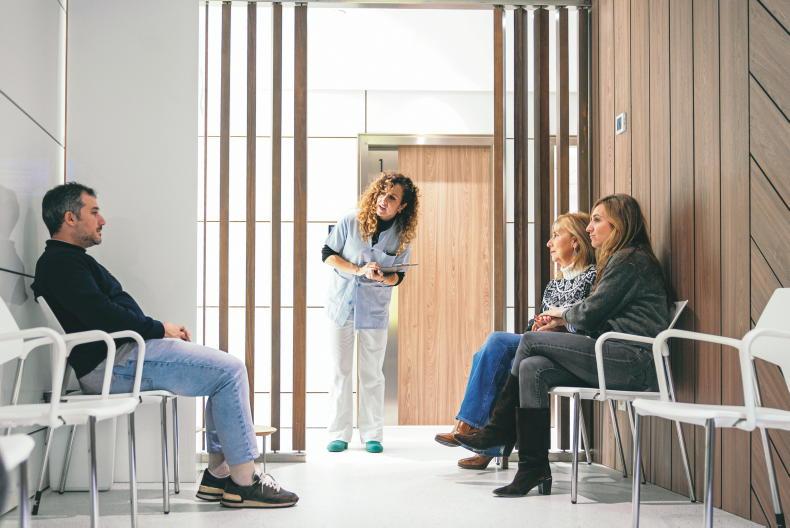
Last year, a total of 525,098 patients did not attend their outpatient hospital appointment in Ireland. That’s around 10,000 appointments missed each week, simply because patients did not turn up. The HSE has just released these figures to Irish Country Living through a Freedom of Information request.
A ‘Did Not Attend’ (DNA) patient refers to someone who unexpectedly does not attend an outpatient hospital appointment. The hospital staff have not been notified that they will not attend.
Examples of outpatient appointments are diagnostic tests, minor procedures, clinics or consultations. They do not involve the patient being admitted to hospital or staying overnight. A person is usually referred to an outpatient appointment by their GP.
Figures obtained by Irish Country Living also show a breakdown of the number of DNA patients at each hospital in the country last year. The problem of ‘no shows’ to outpatient appointments was greatest in Dublin – at Mater Misericordiae University Hospital (48,007) followed by St James’s Hospital (39,761) and Beaumont Hospital (39,398). This was not surprising given the specialist care provided in the capital.
Outside Dublin, Galway experienced the highest numbers of DNA patients, with 32,160 ‘no shows’ at Galway University Hospitals (University Hospital Galway and Merlin Park University Hospital).
The problem was also pronounced in University Hospital Limerick (24,659) and University Hospital Waterford (26,534).
Patients failing to show up for their outpatient appointment is a massive drain on HSE finances, resources and productivity. A report published last year by former Minister for Health Stephen Donnelly revealed that the 481,432 DNA patients in 2022 cost €91.5m in wasted funding.
Non-attendance is also frustrating for the thousands of patients on waiting lists up and down the country.
As of September, 541,316 adults and 73,154 children are on a national waiting list for an outpatient hospital appointment. This means the number of DNA patients last year is nearly equivalent to the number of patients on a waiting list.
Not black and white
The HSE told Irish Country Living that the “most common reasons for a patient not attending their appointment includes that the patient had forgotten or felt too unwell to attend, or the patient felt better or had trouble getting off work, or they may have felt the appointment was unnecessary”. But patients not respecting the system is only one part of this story.
According to consultant endocrinologist, Professor Francis Finucane, who works in Galway University Hospital, much more could be done at an organisational and infrastructural level to improve communication with patients about their appointments.
“Sometimes people receive a letter about an appointment maybe one year in advance, and they may not get a reminder closer to the appointment.
“I often meet patients who will tell me that they haven’t received a letter and that the first they knew about their appointment to see me was the text reminder that they received and they’ve had to drop everything at the last minute. That suggests it’s not merely patients not bothering to show up.”
Car parking is another key issue that Professor Finucane raises. “There’s also the patient who will say: ‘I got the letter, I drove to the hospital and I could not get parking, and I had to leave again. These are people who are highly motivated, have received the communication, but the facilities are not in place. There are definitely infrastructure requirements around parking.
“Anytime you come to Galway in working hours, you will see a queue for the car park that’s at least 45 minutes long. It’s a huge barrier to effective clinic management.” The issue of transport, in particular, presents an obvious problem for rural dwellers who cannot rely on public transport to get to their appointment.
“When I look at the systems that are in place to manage attendance of my clinic, I am very concerned that they are outdated, inefficient, expensive and unproductive,” Professor Finucane says.
“When I consider how straightforward it is to book a National Car Test (NCT) appointment, and yet it seems to be so much more difficult to introduce a system that would allow patients to choose a time that suits them within a defined time period. I would have thought that it would be worth the investment in such a system.”
Professor Finucane is not the only one advocating for system change. The HSE’s former director of digital transformation (serving from 2018-2023) told Irish Country Living that “we need to make radical changes like giving patients the ability to book an appointment when suits them”.
Non-attendance
Professor Martin Curley, now an academic in Maynooth University says there is an opportunity to utilise digital advancements more in the health sector.
“Rather than the patient having to go to the hospital for the appointment, that appointment could be done using something like Teams or WhatsApp, so they don’t have to travel. I think we need to leapfrog in our technologies, and we all need to work together, because it affects us all.” For years, the HSE has tried to minimise the number of appointments being missed by patients. Fundamental to this aim, they say, is complying with the protocol for the management of outpatient service. This states that if a patient fails to attend their appointment, their record is reviewed by a clinician to determine if they can be removed from the outpatient waiting list.
If the patient is not identified as having “urgent or high clinical needs”, they are removed from the list and a letter is issued to them and their GP.
There is also considerable administrative work for GPs to refer patients for outpatient appointments in the first place. This point was illustrated by Dr Monica Oikeh, a GP in Douglas, Cork, who posted a TikTok video about ‘no shows’ for her 71,000 followers at the end of August.
Speaking to Irish Country Living, she says, “For me, it does take time to do the referral. You have to attach files and scans.
“My whole point of that post was to encourage people to attend the appointment or cancel in advance, so that their slot can be given to somebody else.
“I think the problem is significant. Let’s say I was looking at 10 letters, there would be at least three about ‘no shows’.”
However, Dr Oikeh stresses it is not always the patient’s fault, citing long wait lists as a factor. “People are waiting over a year to be seen, so sometimes the issue has been resolved, or maybe they’ve gone private. I also know that some patients have trouble getting in touch with the hospitals to cancel the appointment as well and they can’t get through on the phone.”
The HSE told Irish Country Living that other measures they have taken include: sending a reminder letter to patients, sending SMS message reminders a few days before the appointment, and constantly reviewing waiting lists to make sure patients still require the appointment.
One measure that the Health and Social Care Trusts in Northern Ireland have taken is to include the cost of a missed appointment in their reminder letters and text messages. The Department of Health in Northern Ireland told Irish Country Living that this has been “standard practice” for some time. Including the cost of a missed appointment sends the message that there is a financial implication of non-attendance.
Large quantities of people failing to show up makes a bad week for business, whether you’re a hairdresser or a restaurant. The same is true for the HSE. Clearly, this is a leakage that needs addressed.
In 2024, the HSE delivered more than 3.9m outpatient appointments. More than 500,000 patients did not show up. That means 13% of patients last year did not turn up for their hospital appointment.
The HSE publishes the number of patients on waiting lists nationwide on the National Waiting List page on its website.
The HSE publishes a report on the average number of outpatient appointments seen. This is segmented by health region, hospital and specialty on the Outpatient Attendance Dashboard on its website.
If you cannot attend your appointment, contact the hospital to cancel by phoning the number at the bottom of your appointment letter.



SHARING OPTIONS