


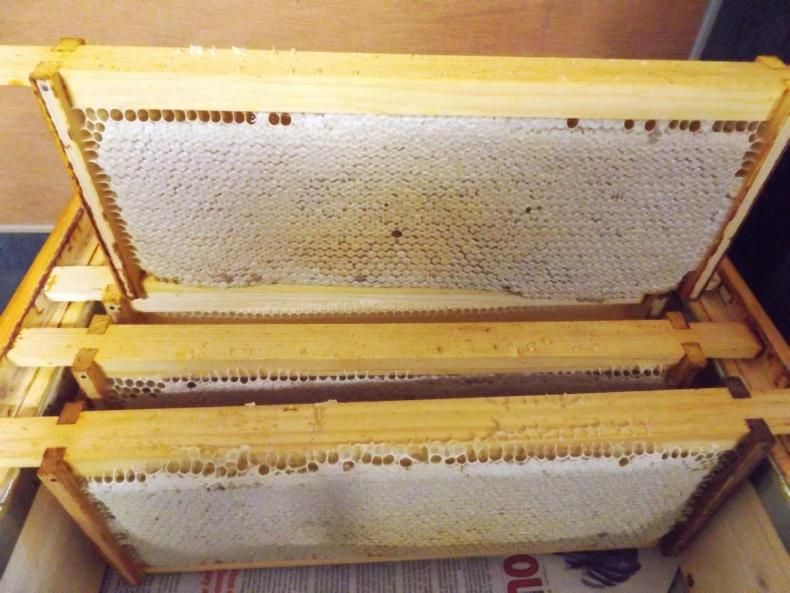
Mid-August has been a busy time for beekeepers as it marked the removal of the honey crop from their hives. This year, the nectar flow from the blackberry finished ahead of normal, resulting in beekeepers removing the honey crop a bit earlier.
Many of the nectar-producing crops were early. The quantity of honey produced appears to be good, but falling short of being excellent. Lack of rainfall left some nectar-producing plants struggling to yield quantities of nectar. The moisture content of nectar in blooms tends to be high, but this summer that problem seemed to be overcome. Bees would have had to do a lot less work to evaporate the nectar in the hive as a result.
Removing honey from the hive is done by using any one of a variety of non-return type devices. Once the bees pass through them, they cannot get back. Such units make it possible for the beekeeper to steal the honey without the bees being aware of what is happening.
The process of extracting honey from the honeycomb requires a centrifugal extractor. The honey in the comb must first be exposed by removing the wax cappings, which seal in the honey. Honeycomb is produced in wooden frames and it is these frames that are placed in the extractor and rotated to remove the honey.
Frames are placed in a cradle in the extractor, radiating from a central shaft. The honey is flung from the cells by centrifugal force as the cradle is rotated. It runs down the sidewall of the extractor, making its way through the outlet valve into a sieve, before pouring into a settling tank.
Course and fine sieves remove any particles of wax or other material from the honey. Once the settling tank is full, the contents are allowed settle for approximately 48 hours, so that any air bubbles may be released from the honey. These air bubbles form a froth on top of the honey in the tank. The froth is skimmed off and prevented from mixing into honey during bottling.
Honey is hygroscopic (it absorbs water from its surroundings), so it must be kept airtight in containers or jars. Before packaging, a refractometer can be used to verify that the moisture content of the honey is correct. High moisture levels in honey lead to yeast growth, causing fermentation.
Liquid honey is packed in a variety of jars and weights, or volume. Beekeepers producing honey in Ireland brand their honey as Irish, and produced in Ireland. Most Irish honey will be found in small, local shops. It is a seasonal product, produced in the main by beekeepers with a couple of hives.
Meanwhile, another beekeeping summer course recently took place at the Franciscan College Gormanston. It was a very successful week, with excellent attendance. The course was officially opened by the Minister of State for Agriculture, Andrew Doyle.
A variety of lectures and workshops were provided, suiting the beginner, improver and the professional beekeeper. The guest lecturer this year was Dr Ralph Büchler from the Bee Institute in Kirchhain, Germany. CL


SHARING OPTIONS