




Building or buying your dream home has become an unattainable goal for a whole generation of Irish people. But what if you already have your dream home and then discover it is structurally unsafe?
While Government figures estimate up to 10,000 homes throughout Donegal, Sligo, Mayo, Clare and Limerick are affected by defective concrete blocks, campaigners believe the real figure is close to 30,000. Wexford and Fingal are the latest parts of the country to be covered by the Government’s enhanced Defective Concrete Blocks Grant Scheme, with an application to include Tipperary also being progressed.
The crisis first emerged almost 15 years ago when homeowners in Donegal reported cracks in their properties in 2011. The presence of mica and pyrite in building materials used to build residential homes, commercial and public buildings led to a campaign that is still being waged across the country. Thousands of families are living in properties that in many cases are crumbling around them, and are impossible to heat or insure.
So far, 3,000 applications have been submitted to the scheme across the country, but only 300 homes have been remediated.
While the battle to secure sufficient compensation continues for those who have started the process, thousands more remain stuck, living in unsafe homes as they cannot afford to apply for their homes to be rebuilt.
Another battle also rages behind the scenes as those who have gone through the demolition and rebuild of their homes try to support those coming behind them in dealing with the considerable financial, emotional, psychological and practical struggles they are about to encounter.
Irish Country Living has spoken to homeowners and campaigners in both Donegal and Mayo, to determine the human cost of the crisis.
Nicola Baldrick and her husband have a beef and dairy farm in Ballynarry, near Burnfoot, Co Donegal. They built their dream four-bed dormer home, which overlooks the north Atlantic, in 2007. They discovered it was a victim of defective concrete blocks when they looked into replacing their conservatory in 2020.
“We had applied for planning permission to replace the conservatory with a two-bed extension as we needed more space for our growing family, but then COVID-19 struck and everything ground to a halt,” explains Nicola.
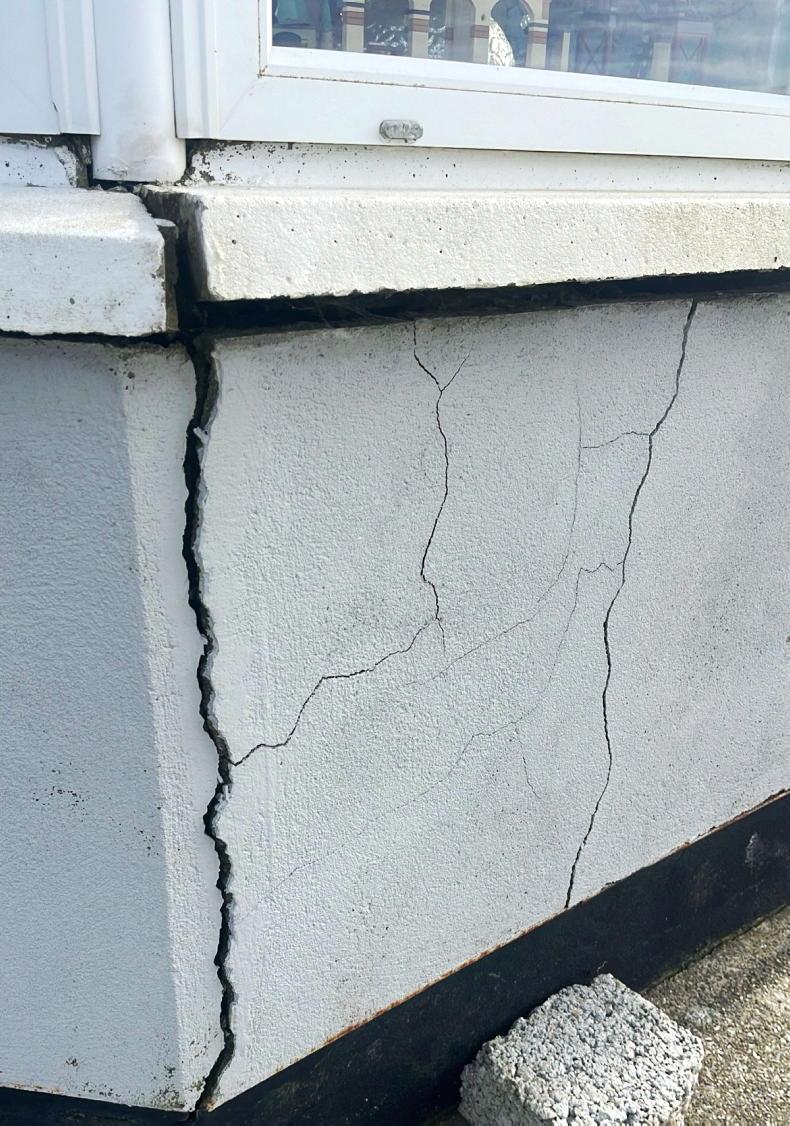
“When the restrictions lifted our architect came out and when he examined the walls of the conservatory, which we thought were falling apart because of age, he advised us to get it tested. We knew that part of the house had always been hard to heat and there were pretty bad cracks which we probably didn’t take much heed of until they were pointed out. But defective blocks are like a cancer, once you see one crack, they just seem to spread everywhere.”

Facing upfront costs
Nicola, who is a mother of six, says she considers her family among the lucky ones to have come through the demolition and rebuild process, despite the many obstacles and stresses they faced.
“To avail of the defective block grant you don’t have the option of remaining in the house and rebuilding adjacent, which we would have been lucky enough to do as we have the land. We had to rebuild on the exact site, so we had to move out. Trying to find a rental property was a nightmare and a mobile home was not an option with six kids.
"We got lucky with a holiday cottage that we were able to rent down the road so the kids were able to stay in their school and on the same bus route so the disruption wasn’t as bad as it could have been.”
Nicola says the family were also fortunate to have money saved for their original extension plan so didn’t end up in debt – which happens many families forced to rebuild their homes.
“The scheme needs to incorporate a central fund that homeowners can draw down from to cover the upfront costs of this scheme, which are significant,” says Nicola.
“The engineers report, which is the first step in this process was €7,000 alone and you can’t even apply for the scheme until you have that report confirming the presence of defective blocks. You need deposits for rent, then the cost of rent on top of your mortgage repayments which don’t magically stop just because you no longer have a house, and the cost of storage is considerable too.
"Some of this money is paid through the grant, but none of the money is released until the house is demolished. When the diggers did move in, our house just crumbled, it was as if it had been built with sand.”
Nicola says that as vital as financial support is, more needs to be done to support people through the emotional and practical side of demolishing a home and rehousing families in the short-term.
“We had huge support from family who were able to help us move us out of the house. So many families, single people, single parents and older people in particular don’t have that support. More needs to be done to help them. We were blessed with the network we had behind us but I still had so many dark days before we got back into our home.”
Public perception
Roisin Gallagher, a founder member of the Redress Focus Group based in Buncrana, says the perception that people are lucky to be getting brand new houses can be hard to swallow.
She has also moved back into her rebuilt home, which she bought in 2004. Her worst fears were confirmed when she discovered in 2020 that the house was built with defective blocks.
“I started this at the very beginning of the Government scheme and I thought I was being diligent. It still took five and a half years to get back into our home and we are still very badly affected financially with over €45,000 of debt outstanding,” she says.
“The engineer originally only recommended outer relief remediation for our semi-d, which meant the house wouldn’t be demolished. It took a two-and-a-half-year battle with Donegal County Council to get full demolition approved. The costs just kept coming and we didn’t have any savings to cover us. It was mayhem and caused serious stress for us as a family.
“The reality of having your house demolished is incredibly stressful. Apart from finding a house to rent for the duration of the rebuild, there’s the hassle of finding storage.
"It’s not a normal house move – you need to take everything out, from the sockets to the architraves and you’re trying to salvage as much as you can to keep costs down. So you can’t use cardboard boxes, you need the sturdy plastic ones with lids which are expensive and it all adds up.”
Roisin and her fellow focus group founders, Cllr Joy Beard and Brenda Tierney Joyce campaigned for a support hub to be established in Donegal to assist people going through the process.
“A hub would cost less than the funding for one house to set up, staff and run for three years, but the Government wouldn’t sanction it. They said there was no need for such a facility.
“We envisaged having a team of counsellors along with financial advisors to help people through every stage of what is a life-changing and extremely challenging journey.”
Roisin stepped back from the focus group earlier this year as the impact of the demolition and rebuild took its toll on her wellbeing.
“I got through my own house rebuild through grit and determination but I had to work very hard to protect my mental health throughout the process,” she adds.
“Through the focus group we provided a platform for experts and homeowners and professionals from various fields such as finance, engineering, law and health to come on board and work towards an overall solution.”

Focus Group
The work of the focus group has been taken over by the 100% Redress Party, which is represented in the Dáil by Charles Ward TD.
Speaking during a recent Dáil debate, Deputy Ward said he was very concerned by the lack of testing at quarries throughout Donegal to prevent more homes being built with defective blocks.
“The real number of homes involved in Donegal is, at a bare minimum, between 10,000 and 20,000, on foot of all the affected materials that came from a certain quarry,” he said.
“People are living in houses with plastered up walls that only contain sand. There are no blocks there anymore.
“The reality is that to this day there is no proper testing of quarries. We should have scientific laboratories taking samples from every quarry in Donegal and measuring them to make sure that this does not happen again, yet nothing is happening. The approach to this appears to be ‘close your eyes and let us hope things get better’.
“This is not the fault of the homeowners. They have done nothing wrong. Anybody in Ireland who is affected by defective concrete has gone through a journey that you would not wish on anybody.”
Next week, we visit Mayo to learn how homeowners are struggling to access the scheme and how campaigners are pushing for it to include home foundations.
What are defective blocks? These are concrete building blocks that contain excessive amounts of minerals like mica or pyrite. When these minerals are exposed to moisture, the concrete can weaken, crack, and crumble, impacting the structural safety of the building.
Applications to the Defective Concrete Blocks Grant Scheme are made through the local authorities in each of the affected counties.
Eligibility for the scheme is determined by the Housing Agency, which acts as an agent to the local authorities, and decides the best remediation option and grant amount.
The maximum grant available is €462,000 for detached properties, with lesser amounts awarded for semi-detached and smaller properties. It includes vouched ancillary grants to assist with alternative accommodation (up to €16,500), storage costs (up to €5,500) and immediate repairs up to €5,500.


SHARING OPTIONS