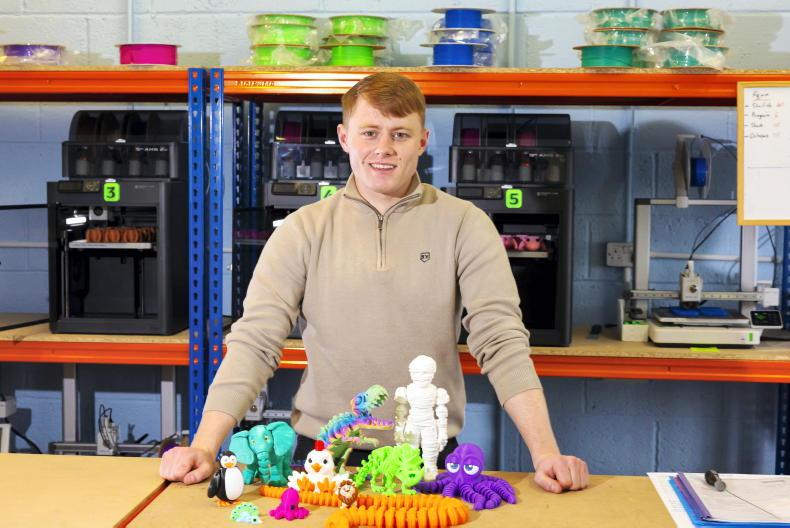
Sona means happy in Irish, and happiness is the feeling that Adam Brennan hopes that his Irish-made sensory toys will bestow to their users.
The Kilkenny man started his business, Sona Sensory, two years ago; and what was initially a few printers on the family farm in Castlecomer has now expanded to 25 printers in a local enterprise unit. Adam first operated the business as a 3D printing service – “I could see the potential in the machines” – but through his work in schools as a special education needs (SEN) teacher, he began to notice how neurodiverse students responded positively to sensory toys. And he wanted to make some himself.
“I was in classrooms with children with ADHD or autism and I would have seen a lot of them bringing in fidget toys or keyrings in their pencil cases, so that started the idea.
“I would see a lot of kids struggle. Even if you think back traditionally to students sitting in the classroom, you’d have people clicking their pens, they’re pulling their collar under jumpers, different things like that. It was something of interest to me, especially with teaching. I could see it happening in front of me.”
In March 2024, Adam started introducing fidget and sensory toys in SEN classes, and the feedback from both students and teachers was positive. He also set about researching the toy industry, and soon discovered that Ireland has very few manufacturers of sensory toys – most are imported. This became one of the motivations for Sona Sensory, and Adam’s academic background in graphics and engineering helped too.
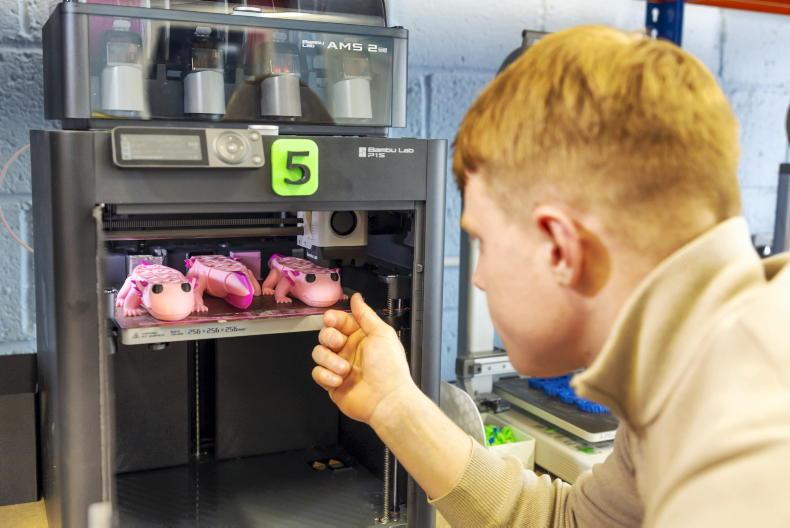
The toys are made with PLA (Polylactic Acid), a plant-based material derived from cornstarch and sugarcane. “It’s a renewable type of plastic,” Adam explains. “Traditionally plastic is derived from petroleum, so that wouldn’t be as sustainable.”
PLA is compostable and designed to break down more safely at the end of its life cycle. It is also safe for children to use and play with. There is a range of 3D animals for users to choose from, including an alligator, gecko, lion, peacock and rabbit, and Adam says the most popular design is the T Rex. “But the elephant and octopus are also favourites.”
Sensory toys can help children to regulate their emotions, and they can reduce stress and anxiety, similar to stress balls. They can also boost focus and concentration in the classroom, as well as improve students’ hand-eye coordination and motor skills.
“You can move it around and this causes your fingers to move, so you’re releasing energy through your fingers,” Adam explains, “and then there’s the feel of it because the 3D printing is built up by layers. You can actually feel something on the toy, so that’s good.”
Adam started stocking his toys in the National Reptile Zoo in Kilkenny, as well as Dublin Zoo and Dingle Aquarium. He works with gift shop managers and stockists on the designs, and they provide him with feedback on which toys are proving to be popular.
Running a business
Sona Sensory is now a full-time gig for Adam, but he still does some substitute SEN classes as well as the odd job on the dairy farm at home.
“I do have interest in, and stay involved in the farm, and I worked a lot on machinery when I was younger. My part-time job was fixing machinery, and I help my father with the silage.”
Adam adds that his farming background was what initially sparked his curiosity in 3D printing. He says that “a lot of farmers” approach him to print parts like fuse covers, gear knobs, replacement tractor parts, protective guards, or obsolete plastic parts.
Adam uses more durable types of plastic when he is tasked with printing parts for farmers.
“On the farm, lots of things are broken, but with 3D printers, there’s a fast turnaround in parts when you’re looking to design something on the computer and want to make something in a matter of minutes or hours, basically.”
When asked what it is like to run his own business, Adam says, “I couldn’t imagine my life without it. I always had in my head from a young age that I wanted to have my own business. I see my father getting up every morning and working late. I do have a similar work ethic to farming.”
One of Adam’s biggest career achievements to date was at the end of last year when he was asked to manufacture a bundle of different animal toys for the HSE. “That would have been the biggest partnership so far,” he says.
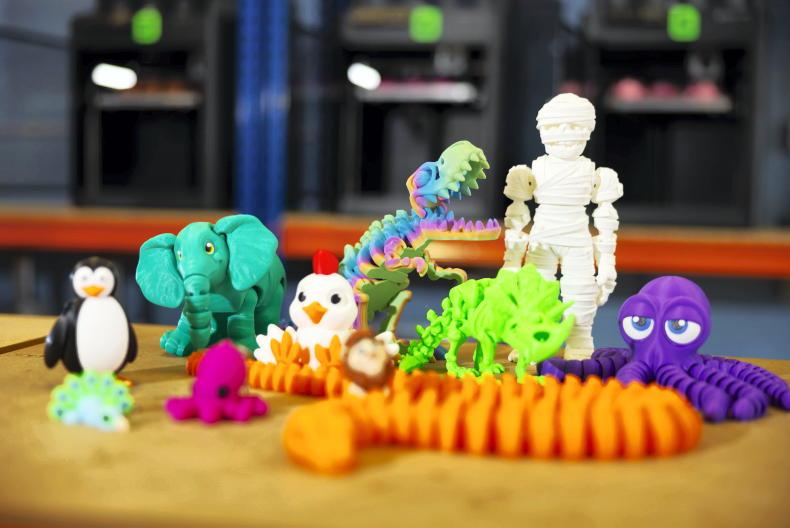
Adam and a few others delivered the bundles to all the Children Disability Network teams across 96 locations. “It was a highlight, definitely, driving around and delivering. I said we’d deliver them ourselves, and there was about four or five of us on the road that week. It was a good boost then as well for coming up to Christmas.”
Adam takes bespoke orders too, often receiving enquiries from customers with dementia. Fidget toys can reduce stress and agitation, and provide stimulation for people with the condition. “I’ve had people contacting me looking for fidget toys that were not childish – something for all ages.”
Adam is currently working on an order for 1,000 keyrings for a school in Barcelona. “The mascot for the school is a quokka, it’s supposed to be one of the happiest animals in the world,” he says. “It’s kind of like a hamster.”
Looking ahead, Adam says that his primary focus in the next few months is “to get more involved in the neurodivergent community and go to more events – to stay involved with everyone else, really.
“I’m trying to grow the other side of the business, 3D printing, as well. A lot of plastic parts that are bought are imported, so I’m just trying to reach out to companies at the minute [with the message] to be more sustainable and buy from an Irish manufacturer.”
See sonasensory.com