Life-changing work: “We’re still doing our job”
Caroline Corcoran works as a self-employed community midwife in Cork. After having two home births herself, she decided she wanted to return to education and pursue a career in midwifery. Following her degree, Caroline got involved in providing a home birth service.
Caroline’s passion and love for her profession is inherent.
“The women I look after come to me at 12 weeks and I work with them throughout their pregnancy,” she says.
“I look after them and their baby during labour and for two weeks after the baby is born. We become very close, and I think having a trusted relationship with your midwife is very powerful. Birth is such a special moment in somebody’s life and when you know them quite well, you can’t help but feel a little emotional too. It’s very special.”
The service is available for low-risk women who do not have any serious underlying medical conditions such as epilepsy or diabetes. The demand for home birth has seen a significant increase from the beginning of the pandemic.
“A lot of mums are feeling very anxious about going into hospital and potentially having to go in alone,” she explains. “It’s very scary for a first-time mum, in particular.”
Caroline explains that her work continues regardless of the pandemic.
“I’m still driving all over the county visiting my clients’ homes. The only real difference is the extra checkpoints! I’m checking blood pressure, monitoring the baby, making sure everything is okay and asking about birth plans. I provide postnatal support for new mums too,” she says.
“Every so often, I’ll get a phone call from a fellow midwife who might need assistance with a birth. Other times, it’s me getting the call from my own client. There’s the extra adrenaline rush when it’s your client in labour because you’ve built that trusted relationship with them.
“We are wearing PPE with the women, being careful and still doing the job we’re doing,” she continues. “The biggest difference is that if we had to transfer into hospital, we can’t go in with our patients because of risk of infection - which is completely understandable. It’s very hard to say goodbye to someone when they get out of the ambulance. For me, that’s probably been the hardest part.”
Christmas is always a busy time for Caroline; and especially this year.
“I actually have three women due on Christmas week alone!” she says. “I am on call 24/7, but my family and I are used to it. As long as there’s leftovers to eat on Christmas Day after work, I don’t care!
“I am passionate about my job and everything that comes with it. I think it is especially important for my daughter to see me as a strong woman who does an important job.”
Spiritual guidance: “If there was ever a year we needed Christmas, it’s this year”

Fr Chris O'Donnell, Limerick Diocesan Pastoral Centre. St Michael’s Courtyard, Denmark St, Co Limerick. \ Liam Burke Press 22
Fr Chris O’Donnell has been working throughout the COVID-19 pandemic in south Limerick. The Adare native works between the parishes of Kilmallock-Ballingaddy, Bulgaden-Martinstown and Effin-Garrienderk. His daily work has changed dramatically since March, but like many other workers during lockdown, he has adapted to the “new normal.”
Fr. Chris describes the pandemic as the “steepest learning curve” that he has ever been on.
“You couldn’t compare what we as a parish did before lockdown with what are doing now,” he says.
“Whether it be working in churches, schools or in parish settings, 90% of my work is being with people. It’s been a whole new world for us because the nature of our work is very much people-orientated.”
When lockdown commenced and churches closed, Fr Chris was met with the challenge of providing online services for local community members.
“Going online was a big change. For people whose faith is important to them, the church is a lifeline. I couldn’t have stood by and done nothing so we started live streaming. I didn’t even have Facebook in early March, but I made that change,” he says.
Fr Chris says these changes wouldn’t have been possible without the support of his parish members.
“Every time I faced a conundrum, people just responded generously,” he explains. “We had brilliant local volunteers and together we began live-streaming mass on Facebook. People’s lives had changed drastically with many feeling lost as there was nothing to punctuate their day. Every day could feel the same for some people. For those who it would help, we would stream mass every day which was followed by the Stations of the Cross. I enjoyed the challenge of it.”
“We had the rosary at half five every evening, and three nights a week we were putting on night prayer. This was our new roster.”
Locals donated old radios they had sitting at home to ensure the older generation, in particular, could tune in.
“We were very conscious that many people might not have internet access. We needed to help people who couldn’t get out of their homes, particularly the elderly and those living alone. We made use of our parish radio station,” he says.
Fr Chris commends his parishioners for their strong community effort. “Despite everyone being tired and weary over the last few months because of COVID, the good outweighed the bad. People’s kindness at a time like this will always be stronger.”
As for Christmas, Fr Chris says if there was ever a year we needed it, it’s this year.
“I was speaking to someone recently and they told me they’d prefer to have Christmas without turkey than Christmas without mass. And let me tell you, they love their turkey!” he says.
“Of course, there are challenges coming down the line regarding Christmas. We’re going to have to be very creative in keeping people connected. I’m not fully sure what that will mean but let’s try as best as we can. We have to be hopeful.
“The New Year gives us the opportunity to begin again,” he continues. “If the restrictions are lifted and we’re living in a free world, my resolution will be to attend as many concerts and matches as I can while visiting my friends and family. If we are back to some sort of normality, I will make the most of every bit of it. However, that might not be the case, so my New Year’s resolution is to keep doing what I’m doing until we can do otherwise.
“That’s what I’d say to the people of Ireland – just keep going.”
Social nourishment: “We kept the service going and we are very proud of that”
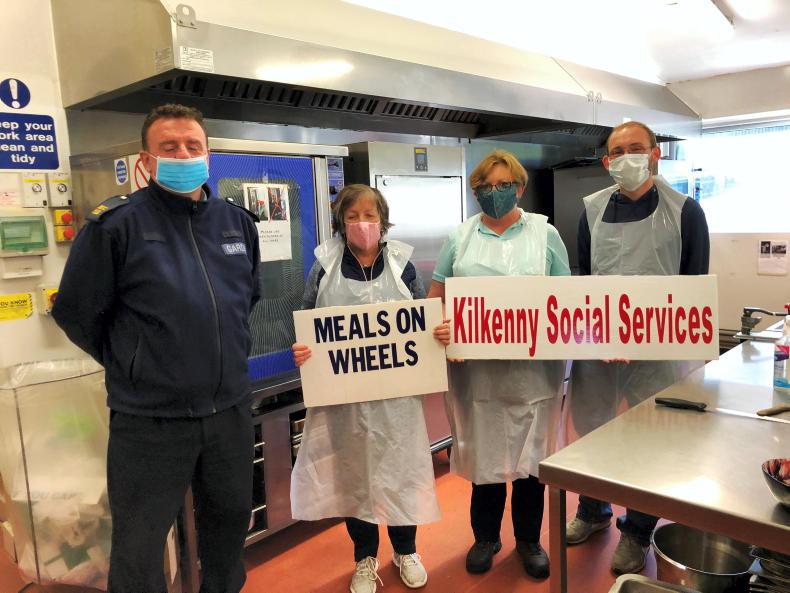
Members of Kilkenny Meals on Wheels.
Meals on Wheels is a national lifeline in providing hot, nourishing meals to those who need them.
The COVID-19 pandemic has seen a particular growth in demand for the service in Kilkenny, where a friendly face calling to the door is often just as greatly appreciated a nutritious meal.
“The demand was there, is still there and we are managing,” says Kay Hogan.
Due to COVID-19, volunteers at Meals on Wheels in Kilkenny saw a significant shift in their daily pattern of work. The organisation has always had a strong group of volunteers, who work across different areas of Kilkenny. While a lack in volunteers was inevitably challenging for continuing the service, the members adapted where possible while adhering to social distancing guidelines on delivery.
“The lockdown came and the whole system changed,” Kay says. “As many of our volunteers are over 70, they ended up cocooning in March. We lost nearly all of our volunteers. However, the demand was still fully there and we had to cope with that. We changed our food delivery system to ensure clients were still receiving their meals. It worked out fine.”
“We have no waiting list for meals and we’d never turn down a meal. We didn’t miss one single day of delivery during the whole pandemic.”
Volunteers at Meals on Wheels worked to add a positive dimension to their regular service by ensuring everyone received an Easter egg during the Easter holidays, and supplying the local newspaper on a different occasion.
“We included a surprise whenever we could,” says Kay. “Our service could be the only visit someone gets a day.”
The service has undoubtedly seen significant changes in recent months with a change in staff roles, delivery systems and continuing demand, but the coordinators insist teamwork got them through the challenging times.
In the lead up to the Christmas season, organisers are optimistic that the service will continue to play an important role in the community.
“It is an extremely busy time for us and we will be contacting all of our clients to see who will require our services,” says Kay. “Our staff have kept this service going through the very tough times. They have been outstanding and we want to commend them all. We have wonderful staff, wonderful volunteers and wonderful suppliers. We got through it so far, so we will get through it again.”
Read more
Listen: helping our healthcare heroes
Rape crisis support services more vital than ever
Life-changing work: “We’re still doing our job”
Caroline Corcoran works as a self-employed community midwife in Cork. After having two home births herself, she decided she wanted to return to education and pursue a career in midwifery. Following her degree, Caroline got involved in providing a home birth service.
Caroline’s passion and love for her profession is inherent.
“The women I look after come to me at 12 weeks and I work with them throughout their pregnancy,” she says.
“I look after them and their baby during labour and for two weeks after the baby is born. We become very close, and I think having a trusted relationship with your midwife is very powerful. Birth is such a special moment in somebody’s life and when you know them quite well, you can’t help but feel a little emotional too. It’s very special.”
The service is available for low-risk women who do not have any serious underlying medical conditions such as epilepsy or diabetes. The demand for home birth has seen a significant increase from the beginning of the pandemic.
“A lot of mums are feeling very anxious about going into hospital and potentially having to go in alone,” she explains. “It’s very scary for a first-time mum, in particular.”
Caroline explains that her work continues regardless of the pandemic.
“I’m still driving all over the county visiting my clients’ homes. The only real difference is the extra checkpoints! I’m checking blood pressure, monitoring the baby, making sure everything is okay and asking about birth plans. I provide postnatal support for new mums too,” she says.
“Every so often, I’ll get a phone call from a fellow midwife who might need assistance with a birth. Other times, it’s me getting the call from my own client. There’s the extra adrenaline rush when it’s your client in labour because you’ve built that trusted relationship with them.
“We are wearing PPE with the women, being careful and still doing the job we’re doing,” she continues. “The biggest difference is that if we had to transfer into hospital, we can’t go in with our patients because of risk of infection - which is completely understandable. It’s very hard to say goodbye to someone when they get out of the ambulance. For me, that’s probably been the hardest part.”
Christmas is always a busy time for Caroline; and especially this year.
“I actually have three women due on Christmas week alone!” she says. “I am on call 24/7, but my family and I are used to it. As long as there’s leftovers to eat on Christmas Day after work, I don’t care!
“I am passionate about my job and everything that comes with it. I think it is especially important for my daughter to see me as a strong woman who does an important job.”
Spiritual guidance: “If there was ever a year we needed Christmas, it’s this year”
Fr Chris O'Donnell, Limerick Diocesan Pastoral Centre. St Michael’s Courtyard, Denmark St, Co Limerick. \ Liam Burke Press 22
Fr Chris O’Donnell has been working throughout the COVID-19 pandemic in south Limerick. The Adare native works between the parishes of Kilmallock-Ballingaddy, Bulgaden-Martinstown and Effin-Garrienderk. His daily work has changed dramatically since March, but like many other workers during lockdown, he has adapted to the “new normal.”
Fr. Chris describes the pandemic as the “steepest learning curve” that he has ever been on.
“You couldn’t compare what we as a parish did before lockdown with what are doing now,” he says.
“Whether it be working in churches, schools or in parish settings, 90% of my work is being with people. It’s been a whole new world for us because the nature of our work is very much people-orientated.”
When lockdown commenced and churches closed, Fr Chris was met with the challenge of providing online services for local community members.
“Going online was a big change. For people whose faith is important to them, the church is a lifeline. I couldn’t have stood by and done nothing so we started live streaming. I didn’t even have Facebook in early March, but I made that change,” he says.
Fr Chris says these changes wouldn’t have been possible without the support of his parish members.
“Every time I faced a conundrum, people just responded generously,” he explains. “We had brilliant local volunteers and together we began live-streaming mass on Facebook. People’s lives had changed drastically with many feeling lost as there was nothing to punctuate their day. Every day could feel the same for some people. For those who it would help, we would stream mass every day which was followed by the Stations of the Cross. I enjoyed the challenge of it.”
“We had the rosary at half five every evening, and three nights a week we were putting on night prayer. This was our new roster.”
Locals donated old radios they had sitting at home to ensure the older generation, in particular, could tune in.
“We were very conscious that many people might not have internet access. We needed to help people who couldn’t get out of their homes, particularly the elderly and those living alone. We made use of our parish radio station,” he says.
Fr Chris commends his parishioners for their strong community effort. “Despite everyone being tired and weary over the last few months because of COVID, the good outweighed the bad. People’s kindness at a time like this will always be stronger.”
As for Christmas, Fr Chris says if there was ever a year we needed it, it’s this year.
“I was speaking to someone recently and they told me they’d prefer to have Christmas without turkey than Christmas without mass. And let me tell you, they love their turkey!” he says.
“Of course, there are challenges coming down the line regarding Christmas. We’re going to have to be very creative in keeping people connected. I’m not fully sure what that will mean but let’s try as best as we can. We have to be hopeful.
“The New Year gives us the opportunity to begin again,” he continues. “If the restrictions are lifted and we’re living in a free world, my resolution will be to attend as many concerts and matches as I can while visiting my friends and family. If we are back to some sort of normality, I will make the most of every bit of it. However, that might not be the case, so my New Year’s resolution is to keep doing what I’m doing until we can do otherwise.
“That’s what I’d say to the people of Ireland – just keep going.”
Social nourishment: “We kept the service going and we are very proud of that”
Members of Kilkenny Meals on Wheels.
Meals on Wheels is a national lifeline in providing hot, nourishing meals to those who need them.
The COVID-19 pandemic has seen a particular growth in demand for the service in Kilkenny, where a friendly face calling to the door is often just as greatly appreciated a nutritious meal.
“The demand was there, is still there and we are managing,” says Kay Hogan.
Due to COVID-19, volunteers at Meals on Wheels in Kilkenny saw a significant shift in their daily pattern of work. The organisation has always had a strong group of volunteers, who work across different areas of Kilkenny. While a lack in volunteers was inevitably challenging for continuing the service, the members adapted where possible while adhering to social distancing guidelines on delivery.
“The lockdown came and the whole system changed,” Kay says. “As many of our volunteers are over 70, they ended up cocooning in March. We lost nearly all of our volunteers. However, the demand was still fully there and we had to cope with that. We changed our food delivery system to ensure clients were still receiving their meals. It worked out fine.”
“We have no waiting list for meals and we’d never turn down a meal. We didn’t miss one single day of delivery during the whole pandemic.”
Volunteers at Meals on Wheels worked to add a positive dimension to their regular service by ensuring everyone received an Easter egg during the Easter holidays, and supplying the local newspaper on a different occasion.
“We included a surprise whenever we could,” says Kay. “Our service could be the only visit someone gets a day.”
The service has undoubtedly seen significant changes in recent months with a change in staff roles, delivery systems and continuing demand, but the coordinators insist teamwork got them through the challenging times.
In the lead up to the Christmas season, organisers are optimistic that the service will continue to play an important role in the community.
“It is an extremely busy time for us and we will be contacting all of our clients to see who will require our services,” says Kay. “Our staff have kept this service going through the very tough times. They have been outstanding and we want to commend them all. We have wonderful staff, wonderful volunteers and wonderful suppliers. We got through it so far, so we will get through it again.”
Read more
Listen: helping our healthcare heroes
Rape crisis support services more vital than ever








SHARING OPTIONS