



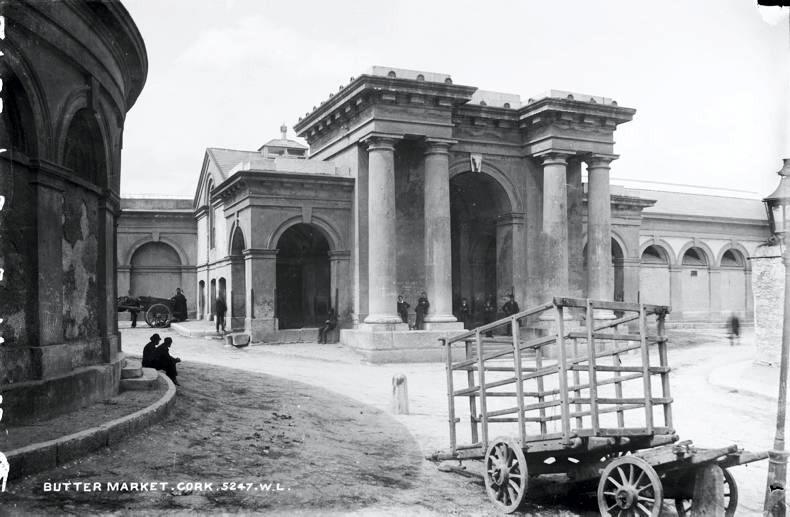
While Irish dairy farmers might consider that they are at the mercy of the world market nowadays, there was in fact a time when the world price for butter was set in Ireland. Just as it is today, back in the 18th century Munster was the heartland of dairy production in Ireland. Butter produced throughout Munster was exported through the port of Cork to many destinations internationally, to places as far away as the West Indies, the United States and much of the British Empire. Stout wooden casks, known as firkins, ensured against spoilage, even when butter was shipped to tropical regions. Together with textile production, the butter business was central to the commercial success of Cork.
In 1770, this led to the creation of the Cork Butter Market, located near Shandon on the north side of Cork City. Over the century that followed, the market regulated the quality of butter that would be produced, enabling butter from Cork to gain a larger share of international markets. Aided by railway infrastructure, the Cork Butter Market would go on to become the largest butter market in the world and therefore the market in which the world price for butter was set.
In the aftermath of the Napoleonic Wars, commodity prices declined in the first half of the 19th century, which was a major setback for the market. The position of Cork in the world butter trade went into further demise in the late 19th and early 20th century, principally due to greater competition from butter from mainland Europe.
Advances in technology such as the invention and adoption of the commercial scale cream separator allowed cream to be produced on a volume basis for the first time. These continental competitors also introduced prepackaged butter, which contrasted with the bulk firkin butter that was exported from Cork.
Ireland was slower to embrace the move towards centralised butter production. Just as the development of the Cork Butter Market imposed commodity standardisation through regulation, the move towards commercial scale butter production in Europe allowed for better quality control and better product standardisation. Consequently, mainland European butter began to displace Irish butter in international trade towards the end of the 19th century. It was only in the 1890s, with the development of the co-operative movement under Horace Plunkett, that creameries began to spring up in Ireland, but by then European competitors had stolen a march on Irish butter production which would undermine the future of the Cork Butter Market.
By the time of the Easter Rising in 1916, the future of the Cork Butter Market was growing increasingly uncertain. The advent of the first world war had made trade more difficult and Cork’s 150-year dominance of the global butter trade came to an end.
The Cork Butter Market and other exhibitions will feature at Farming and Country Life 1916 at Teagasc Mellows Campus, Athenry, Co Galway on 10 and 11 June. For more information, log on to www.teagasc.ie/1916





SHARING OPTIONS