



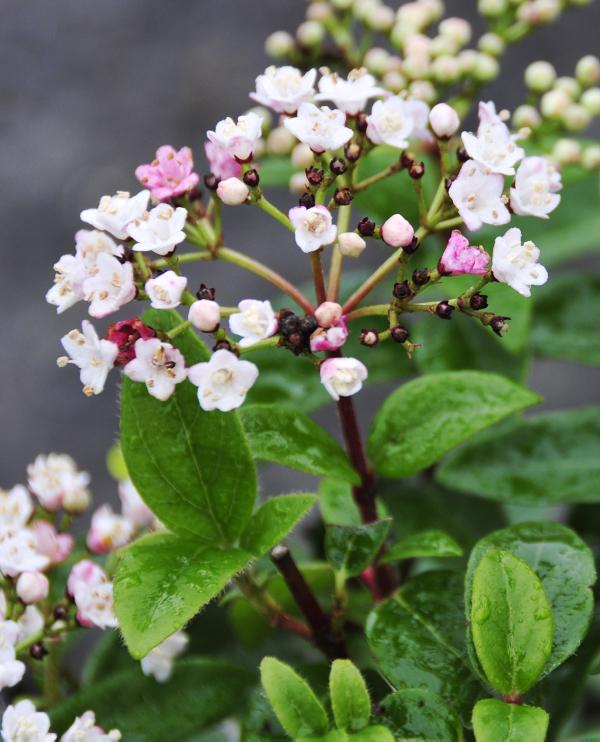
The winter-flowering viburnum is a gem, not only because of its clusters of flowers but because of its fine evergreen foliage and its versatility.
It comes from the Mediterranean region originally where it acts a bit like holly does here — growing in rocky scrub and in open oak forest. Being evergreen, it can grow in such places during the autumn and early spring when deciduous trees are dormant. It flowers in winter for the same reason and sets its bluish-black berries in spring.
Although it is Mediterranean in origin, it is quite hardy, capable of surviving all but the worst winters with ease.
Generally known as laurustinus, Viburnum tinus has been popular in gardens for centuries, especially in the late 19th century where it was used widely in parks and gardens for its dark black-green foliage. Many old gardens still have venerable specimens. Typically, the plant is a large bush or small tree with a dense rounded head of foliage.
Over the whole head of the bush, dotted about randomly, the flower clusters appear as a rounded head of small buds, often flushed pink or red. Unlike those of related viburnum species, the flowers mostly have no scent, although there may be some plants that have a touch of honey fragrance on a warm day.
During mild spells from late autumn, through winter and over a long period into early spring, the buds open in fits and starts, the flower head broadening and the white or sometimes pink-tinged flowers opening from pink buds. After flowering, the berries are of little decorative value. Occasionally in gardens, the seeds give rise to a few seedlings, especially on dry, gravelly ground, but this self-sowing is never a nuisance.
Laurustinus is usually grown as a decorative shrub, even if it can get a bit too big for some gardens, reaching three metres tall and wide, and often more. It can be cut back after flowering to keep it smaller, either cutting back hard or by thinning some shoots each year in late spring.
‘Eve Price’ is a more compact version and is the variety most often sold in garden centres. ‘Gwenllian’ is relatively small too, with a profusion of flowers, relatively large-sized. Both of these versions have relatively small leaves.
Viburnum takes clipping well and can be used for hedges and clipped into topiary shapes. It can be cut back to any height and will grow back, even if cut to the ground. This is useful if a hedge gets too big and needs to be reduced, and it is not possible to do with Lawson or other cypresses.
It is also possible to grow laurustinus as a small free-standing tree, and it looks very pretty trained like this.
When the bush has grown tall and too wide, it is easy to carefully cut out the lower branches, leaving only the main stems and tidying the side-growths off these to a suitable height.
Laurustinus is a tough plant, growing well in most conditions. It only needs the soil to be well-drained. It can survive well in dry soil but grows best in soil that stays moist with plenty of organic material, just like the leaf litter that occurs and sustains it in its native woodland and scrub habitat.
Being an under-storey species, it takes shade quite well, not growing or flowering as well, but surviving in relatively poor light in the shade of trees and buildings.
Plant fruit trees
& bushes
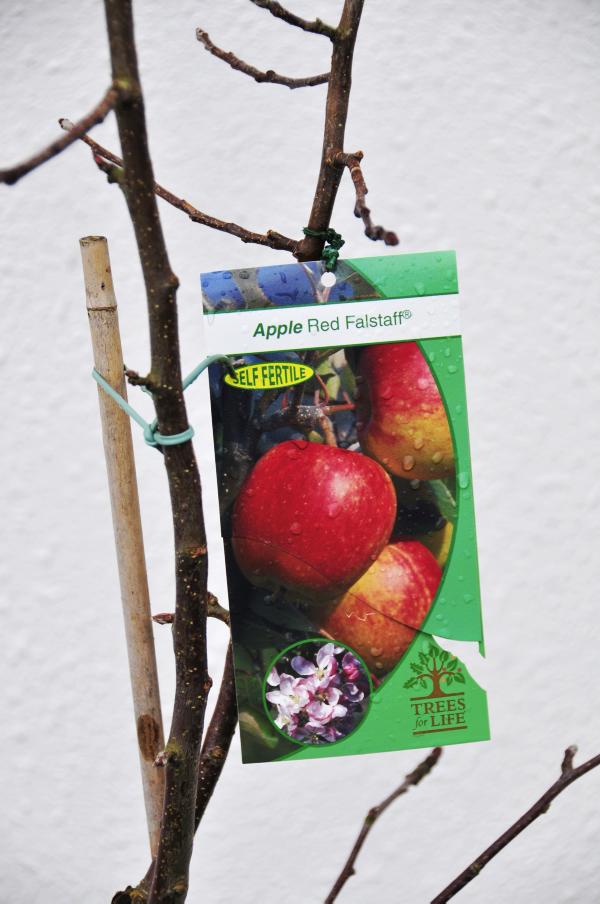
Fruit trees and bushes can be planted at any time of year, being mostly offered for sale in pots, but it is convenient to avoid or reduce watering needs by planting during the traditional planting season from November to March. Some outlets still offer fruit plants in bare-root form. A wide range of fruit tree and bush varieties are available to buy in garden centres and online.
Most kinds of fruit are easy to grow, the main consideration being to have a spot with good, fertile, deep soil, well drained, not exposed and not over-powered by big trees or hedges or their roots, which can root far away. Make sure to clear away all weeds and grass and keep the ground clear. Dig the ground over and incorporate some garden compost. Choose disease-resistant varieties, where possible, to avoid the need to spray.
Trees, shrubs & roses
Rose bushes and repeat-flowering climbers should be pruned now, if not already done so. The deciduous tree-planting season still has a while to run and this is a good time to plant, provided the ground is not too wet. Remove ivy from trees before the start of the growing season when it will become even more extensive.
Flowers
Withered flower stems can be tidied away or they can be left on the soil surface as a mulch. Sow some sweet pea seeds for an early crop of flowers this summer. Lifting and dividing of overgrown herbaceous flowers can continue if the soil is not too wet. Prepare ground, if possible, for sowing hardy annuals.
Fruit, veg & herbs
The weather has been wet so digging must wait until conditions are right. Early potatoes get a head-start by being sprouted. Sow seeds of early varieties of cabbage, cauliflower, carrots, lettuce and onions in a tunnel or glasshouse to get a head-start for planting out later. Herbs such as mint and marjoram can be tidied.
Lawns
It has been too wet to mow grass but lawns should be mown as soon as conditions allow, as grass grows at a low rate all winter. If there is heavy moss growth, sulphate of iron lawn mosskiller can be applied at this stage, with nitrogen feeding later in spring to boost competitive grass growth against moss.
Greenhouse & house plants
Soak any plant that is showing growth. Permanent greenhouse plants that have grown too large can be pruned back in the next few weeks. Pollinate glasshouse peaches. Start off begonia, canna and dahlias. Sow bedding plants and tomato seeds with the aid of a propagator or gentle heat mat.




SHARING OPTIONS