


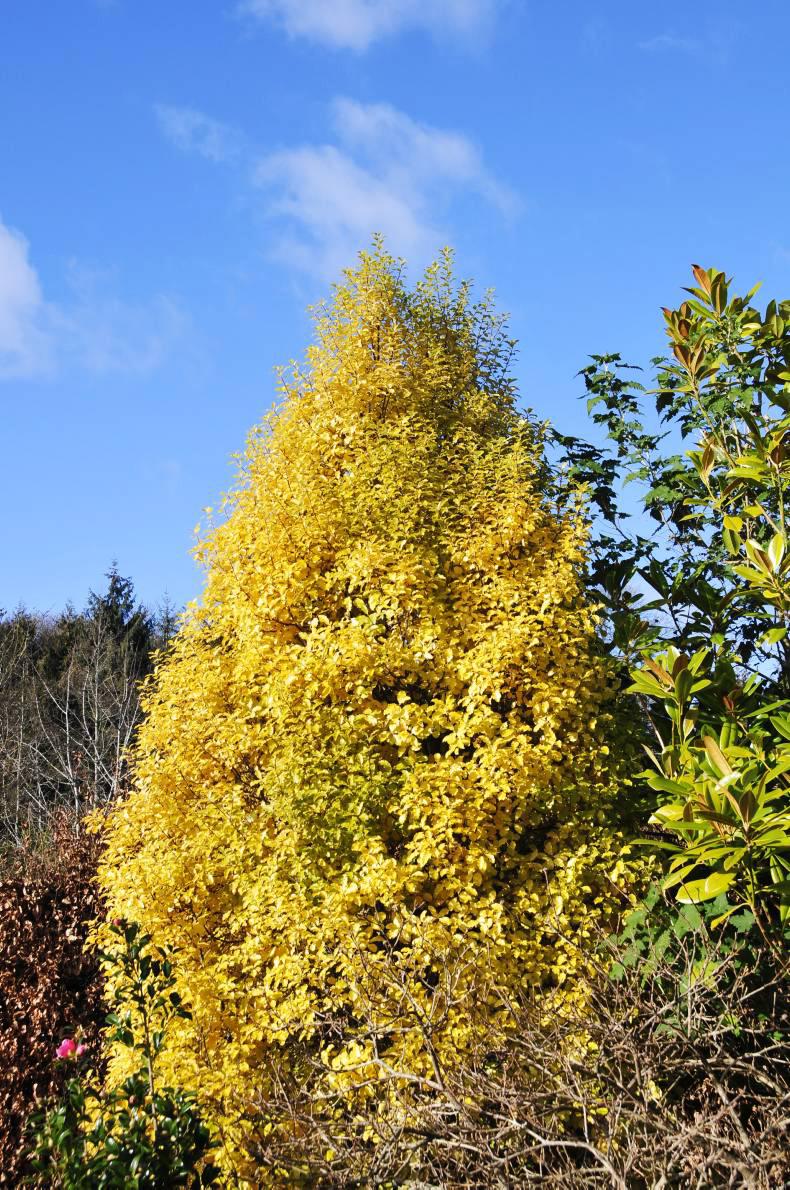
The golden pittosporum is a variety called Warnham Gold, which appeared in an English garden about 40 years ago and has become reasonably popular since. It makes a fine garden tree of narrow conical shape, not quite a pillar, though it could be shaped as a pillar if desired.
It is much larger-growing than generally given credit for, capable of five or six metres eventually. The leaves are green-gold in spring and summer when they push out, but gradually become bright golden yellow in autumn and winter, until the new set of leaves arrives. The tree makes a superb specimen when planted with other small trees and shrubs, its golden colour brightening all around it.
Warnham Gold is a variety of pittosporum tenuifolium, native to New Zealand. The tree is evergreen with narrow, light green, smallish leaves and dark purple, scented flowers in May. There are other pittosporum species, but none as hardy as this one. Even so, this hardy pittosporum was badly damaged and even killed in the hard frosts of 2010 and 2011. This species was used as a hedge and many hedges of it were killed or severely burned.
While this history might put people off pittosporum, such frosts are rare and lots of trees in eastern areas, where the frost was not as bad, survived without any damage, including the golden form. While there is a risk of frost damage, especially inland, it is a risk worth taking. But perhaps not for hedging, because the loss of a single specimen is not too bad, but the loss of a whole hedge is a lot of bother.
When grown from seeds, pittosporum can be quite variable, with slight differences of leaf colour and size. Occasionally, something very different arises and, by selection, a range of varieties have been raised. These include variegated, golden and purple-leaf kinds. Some of these kinds have become popular in gardens. Silver Queen was one of the first popular kinds. It has grey-green leaves with a white margin and gives an overall effect of lightness. It is relatively small but still capable of over four metres. Irene Paterson is a smaller tree or bush, slow-growing, the new leaves creamy white and later green speckled with white, giving a light foliage effect. Its white parts take on a pink tinge in winter.
Deborah has very small leaves on a small tree with green and white-marked leaves. Garnettii is a bigger bush or small tree that grows to five metres, with greyish green leaves margined with creamy white, with wine-coloured flushing and spotting in winter. James Stirling is small with silver-green leaves. There are several purple-leaved kinds. The most widely grown is the small grower Tom Thumb, a small bush or tree that grows to two metres or so. Its leaves emerge green and darken in colour during summer sunlight, turning to a rich dark purple-red. Although this one is small, a seed selection from it made in Ireland, called Nutty’s Leprechaun, is even smaller, forming a low-mounded bush.
There are also the older purple forms Purpureum and Nigricans, both producing green leaves that turn purple-bronze on dark twigs. Of the golden forms, Warnham Gold is the best, but there are others, such as Abbotsbury Gold which has gold leaves with green margins, the variegation fading. Stirling Gold is blotched in the centre of its small leaves with bright yellow. Golden King is upright, tall and has green-gold leaves. In general, only the popular kinds show up in garden centres for sale.
Pittosporum can be planted in spring in any good soil, not heavy or wet, and in sunshine. It is pretty tolerant of wind but suffers some damage in severe exposure. CL
Prune pear trees
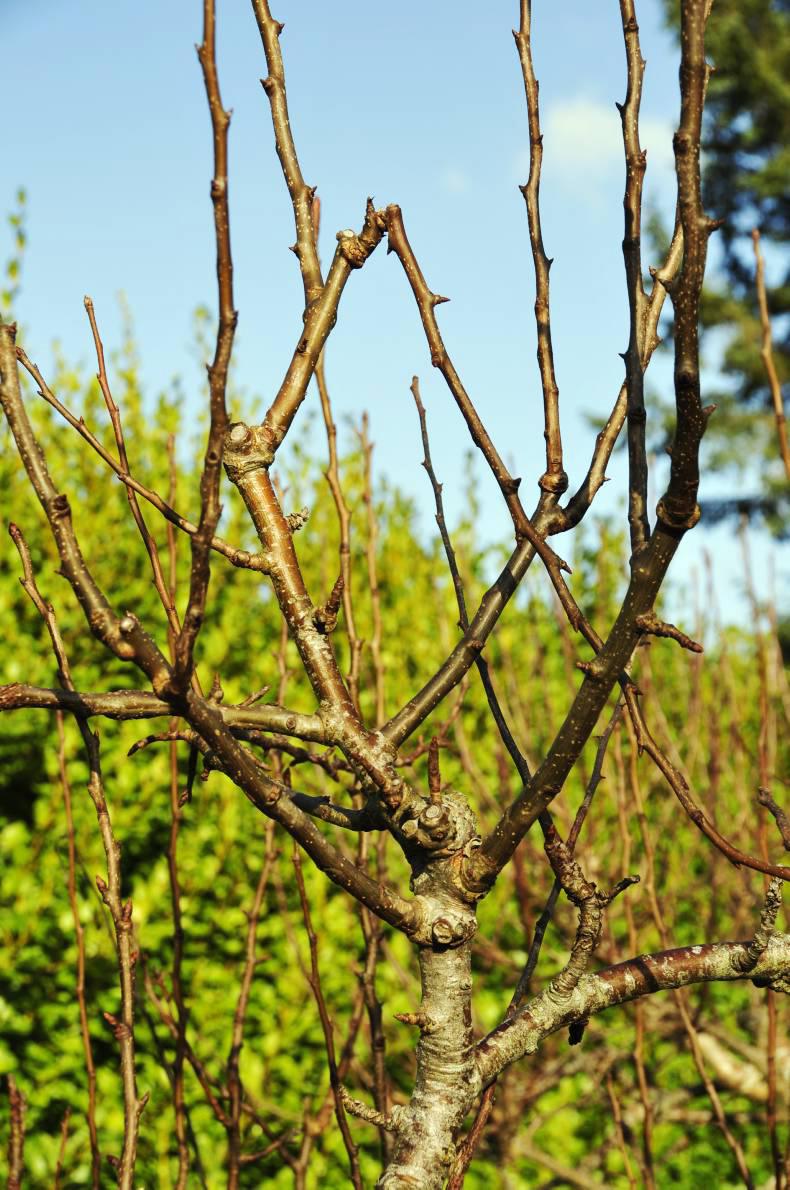
Pear trees flower earlier than apples and, while there is still some leeway on apple pruning, pear flower buds will soon be swelling prior to opening. Pruning can damage these. Pears can be hard to prune because they can be very vigorous and produce a lot of shoots. In this case, summer pruning to reduce vigour, as well as winter pruning, is needed. But when a pear tree settles into cropping and crops regularly, much of its growth goes into the crop and not into the whippy shoots. The aim should be to get the tree to crop regularly by pruning. However, in colder areas, frost can damage the early blossom and it can be difficult to get the tree to settle into cropping. If there is no set of fruit, make sure to summer prune in July and August.
Trees, shrubs & roses
Finish planting all outstanding bare-root or root-balled deciduous trees or shrubs within the next couple of weeks. There is still plenty of time with evergreens. Control weeds around young trees. Bush roses and repeat-flowering climbers should be pruned right away, if not already done. Rose bushes can be planted from pots.
Flowers
Sow seeds of dahlias, French marigolds, alyssum, ageratum and petunias. Perennial flowers are showing good growth in many cases and lifting and dividing of herbaceous flowers can be carried out if the soil is not sticky. It is too late to move the early-flowering kinds. Control weeds in flower beds and apply mulch on light soil.
Fruit, veg & herbs
Sow early peas, broad beans, early cabbage, lettuce, carrots and onion seeds. Start them off indoors if soil is heavy and wet. Plant sets of onions and shallots as soon as possible, also garlic. Tidy up old rhubarb crowns and asparagus plants now. Pruning of apple trees and blackcurrant bushes should be completed soon.
Lawns
Begin lawn mowing if the ground is firm enough, otherwise wait a while. It was a mild winter and there has been heavy moss growth. To control moss and some kinds of weeds, apply sulphate of iron on large areas if necessary. While the soil is moist and the sod is easy to cut, lawn edges at flower borders can be straightened.
Greenhouse and house plants
Increase watering and start feeding as growth begins. Prune a grapevine. Sow seeds of tomatoes, peppers and chillies for greenhouse growing. Delayed sowing will mean late cropping and ripening in October. If green algae has grown, clean the glass to improve the amount of sunlight and heat.





SHARING OPTIONS