



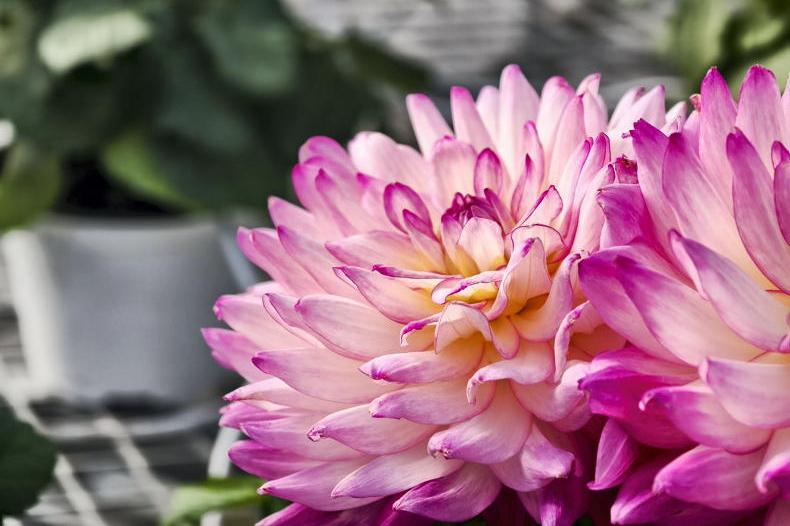
All seasons have their garden highlights and all gardeners have their favourite plants. However, it is hard to beat the dahlia as the epitome of the summer garden, which makes it our favourite.
Many gardens, even in the distant past, had at least one dahlia that flowered for the length of summer and into autumn, providing cut flowers for the home and for friends.
Dahlias have been grown in our gardens for over two centuries. They are native to Mexico and Central America, consisting of 35 species and over 50,000 cultivars, so it isn’t difficult to find one that suits your taste or colour scheme.
Within the huge range of dahlias available to the gardener today, we can’t ignore the vast range of species that exist. These are flowers with a single outer ring of ray florets, surrounding a clearly visible central disc.
Dahlia merckii is low growing and spreading with a profusion of small mauve single flowers, 2cm in diameter, flowering throughout the summer.
D. merckii ‘Alba’ is a white-flowered variant and equally beautiful. The tall and striking D. australis is native to the southern parts of Mexico and Central America, attaining 2m in height with single pink nodding flowers. It needs a warm summer to thrive.
D. coccinea tends to be variable in flower colour growing to 1.2m, reaching greater heights depending on location. The flowers produced in yellow, orange or dark maroon are part of its charm.
Within the dahlia group there is a large range of exciting flower types available to the gardener, due to many years of plant breeding expertise.
These range from improved selections of single varieties, to the mop head or dinner plate types, which have a multitude of petals and a wide range of colours.
The Bishop Series brings us good-quality plants, with striking purple foliage setting off the flower display. D.‘Bishop of Llandaff’ has rich red flowers held over dark purple foliage, growing to a height of 90cm. D.‘Bishop of York’ has bright yellow flowers again, with dark purple foliage.
Wonderful variety
French plant breeders developed collarette dahlias around 1900 as a further development of the single dahlia flower. These have an outer ray of petals with shorter inner ones, which are somewhat frilled. D. ‘Edith Jones’ has wonderful salmon pink petals with a paler coloured frilled collar inside. It grows to a height of 1.2m. D. ‘Kelsey Anne Joy’ is another stunning colour. The outer petals are light orange with smaller inner pink petals.
Double-flowered types such as waterlily dahlias, have a greater number of petals. These are so named because the flower shape is reminiscent of a waterlily.
Again, there are some wonderful varieties here including D.‘Gerry Hoek’, with pale pink flowers with hints of yellow and D. ‘Cameo’ in rich cream with shades of yellow in the petal. Both grow to just over a metre in height. Pompon dahlias are almost all round and perfectly formed, often chosen by exhibitors for competition. They are perfect in their shape and form.
D. ‘Lismore Moonlight’ is pale yellow, growing to a little over a metre in height. In the dim light of summer evenings, it glows like moonlight. It is also an Irish cultivar bred in Lismore, Co Waterford.
Another good pompon dahlia is D. ‘Moor Place’, which is truly beautiful with its purple flowers. This is a highlight when planted in the midst of all yellow flowering perennials.
All gardeners love flowering plants that are showstoppers and if that is what you want, then cactus dahlias are for you. These are plants that demand attention with their outstanding beauty, and it is difficult to choose one over the other.
However, we have favourites that we would not be without. D. ‘Black Jack’ has dark chocolate flowers growing to a height of 1.2m. Its rich intense flowers glow in the midday border like rich red wine.
D. ‘Café au Lait’ is another stunning plant, much sought after for wedding bouquets. It is categorised as a dinnerplate dahlia because of its size. The flower is rich cream with hints of peach and palest coffee, each flower growing to 20cm.
Dahlias are summer season plants and in most parts of the country need to be lifted and stored over winter in dry, spent potting compost.
Start them into growth again in March or April in pots of compost, ready to plant out after the threat of frost has passed. Summer isn’t summer without a dahlia in your garden.
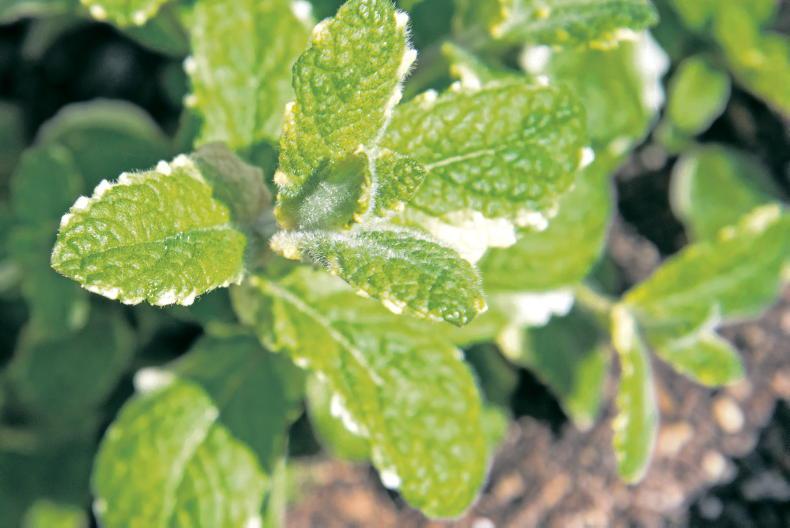
My previously very healthy mint plant has big white spots on the leaves. What are they? What can I do to remedy the problem? – Deirdre, Co Tipperary.
Your mint plant is a victim of the recent drought and has succumbed to powdery mildew. This arises due to lack of water and poor air circulation around the plant. It will recover if you remove the worst of the infected leaves by cutting back the stems to cleaner growth.
You should also try to thin out some of the denser growth to allow more air circulation. Take care to remove all infected stems and foliage off-site, to break the circle of infection. Use all recycled water to give the plant a helping hand to recover. Mint regrows quickly.
Roses: dead-head and tie-in any wayward shoots of rambling roses that have finished flowering.
Lawns: continue to keep your cutting level high, as lawns are stressed. Do not water lawns, they will recover.
Bedding plants: there is still time to sow wallflowers, myosotis and bellis for next spring’s bedding display. Sow in a spare patch of ground or in seed trays and thin seedlings to allow for development.
Water: conserve as much water as possible from your kitchen and water needy plants.
Bulbs: Spring bulbs are now available in garden centres, so stock up.
Do you have a gardening question? Email icl@farmersjournal.ie or post to Irish Country Living, Irish Farm Centre, Bluebell, Dublin 12.


SHARING OPTIONS