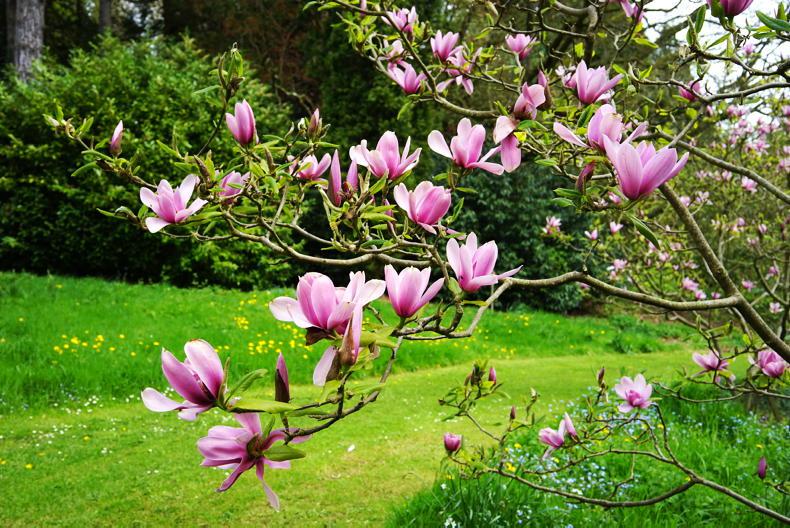
Magnolias are survivors from the age of the dinosaur and bring ancient elegance to our gardens today. Their flowers are simple and always beautiful, whether they vary in shape from a goblet or a spidery form. They are planted as small garden shrubs or large parkland trees, so there is something for everybody’s taste and space.
Magnolia x soulangeana is probably the most commonly grown in our gardens over many years. It has large upright goblet shaped flowers, creamy white flushed with pink. It grows to a 8m tall tree with the flowers appearing on bare stems heralding spring. M. sieboldii is a wonderful spectacle and one of the highlights of the spring or early summer garden.
The flowers are perfectly formed and look like finest white porcelain. They have a central cluster of deep red stamens adding to its beauty. M. wilsonii is similar though smaller, growing to 6m. Its flowers are nodding and scented.
Magnolia stellata is known as the star magnolia and a familiar garden plant. It is seen as a bushy shrub growing to 4m high. Its flowers are white and spidery shaped, held in profusion and suitable for small gardens or courtyards. M. grandiflorais an evergreen large tree that can achieve over 10m in height, so it is only suitable for large gardens. The flowers are creamy white and perfectly formed, like a work of art and are scented too.
If you are seeking a rich pink colour there are plenty to choose from.
Magnolia ‘Star Wars’ is tall growing to 5m with rosy-pink flowers that can be as large as 25cm across. It can make a perfect specimen tree with great presence. Equally capable of becoming a specimen tree of great stature is M. campbellii or M. campbellii susp. mollicomata. They can achieve 30m in height and live for well over a hundred years. The former is early flowering, starting at the end of February, and can be damaged by frost, however M. campbellii subsp. mollicomata is later flowering and tends to escape damage.
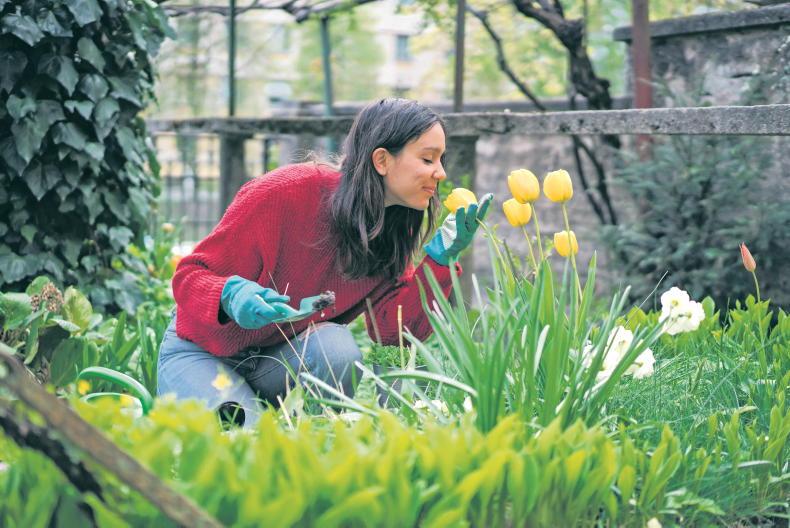
Darwin hybrids are reliable bloomers. \iStock
Colour scheme
If it is a richer pink or red that your colour scheme requires, you can cater for that too with Magnolia. It is a colour that is eye-catching and a perhaps seen as a curiosity. Magnolia ‘Red Emperor’ is a small growing tree to 5m producing large pink to burgundy-wine flowers. The beautifully formed goblet shaped blooms are up to 30cm in size and appear on bare branches. M. ‘Black Tulip’ is similar in height, the flower colour is dark burgundy in its goblet shaped flowers.
In some nursery catalogues the flower colour is described as ‘almost black’. In bright, spring sunshine these colours are certainly captivating.
Magnolia acuminata, commonly known as the cucumber tree, is large and can grow to over 20m. It makes a stately specimen in a parkland setting. Its flowers are variable from greenish-yellow to yellow-orange. It is significant for our gardens today because it is one of the parents of yellow-flowered magnolias.
M. ‘Yellow Lantern’ has flowers that are light primrose to pale lemon in colour, who appear in April just before the foliage. It is an upright grower that in time can reach 10m.
M. ‘Daphne’ is an upright grower too, with richer yellow flowers. It will get to a height of 8m given time and is good for smaller gardens. Magnolias are always a welcome sight with their flower, form and colour.
Cultivation: Magnolias are among the most rewarding trees and large shrubs you can grow. They are long-lived so careful planning is needed before planting. You need to allow the tree develop to its full potential as flowering improves with age.
Moist but well-drained soil is ideal, so avoid areas where waterlogging is likely. The planting site must be prepared well by incorporating well-rotted compost or leaf mould.
Magnolias are happy in neutral to acidic soil. Choose a site that is in full sun or dappled shade and protect them from harsh winds. Magnolias are shallow rooting, so plant where you will not need to cultivate in future years.
If you need to curtail branches, prune in late summer or early autumn.
Q&A: Why have my tulips not flowered?

Darwin hybrids are reliable bloomers. \iStock
This is the second year in a row that my tulips have not flowered. The first year they were beautiful, but ever since they only produce green leaves. – Audrey, Co Kildare.
This is a common problem and there are several reasons. Firstly, tulips are not guaranteed to reliably flower the second year. In part it relates to our climate today, where we have mild winters and wet summers, but also the varieties that we plant.
Tulips require free draining soil and an open sunny position to make the most of available summer sun. After flowering remove spent flowers immediately and allow foliage to wither naturally.
When choosing bulbs look for Darwin hybrids as they are more reliable to flower from year to year. You should also look at some of the species tulips like Tulip clusiana or T. sylvestris cultivars as they do well.
Trees, shrubs and roses: there is still a little time available to transplant trees and shrubs, so choose a dry day for the work. Sap is now rising so avoid pruning of birch or maple.
Continue with rose pruning, remove old woody stems and encourage fresh new shoots.
Apply proprietary rose feed now.
Greenhouse: continue sowing
half hardy annuals. Prick off young seedlings but only cater for what you need.
Store seed in a cool, dry area.
Lawn: the lawn may still be wet, however, grass is growing. Plan to mow after a dry day. Set blades high and use a grass box.
Apply a proprietary lawn fertiliser.

Magnolias are survivors from the age of the dinosaur and bring ancient elegance to our gardens today. Their flowers are simple and always beautiful, whether they vary in shape from a goblet or a spidery form. They are planted as small garden shrubs or large parkland trees, so there is something for everybody’s taste and space.
Magnolia x soulangeana is probably the most commonly grown in our gardens over many years. It has large upright goblet shaped flowers, creamy white flushed with pink. It grows to a 8m tall tree with the flowers appearing on bare stems heralding spring. M. sieboldii is a wonderful spectacle and one of the highlights of the spring or early summer garden.
The flowers are perfectly formed and look like finest white porcelain. They have a central cluster of deep red stamens adding to its beauty. M. wilsonii is similar though smaller, growing to 6m. Its flowers are nodding and scented.
Magnolia stellata is known as the star magnolia and a familiar garden plant. It is seen as a bushy shrub growing to 4m high. Its flowers are white and spidery shaped, held in profusion and suitable for small gardens or courtyards. M. grandiflorais an evergreen large tree that can achieve over 10m in height, so it is only suitable for large gardens. The flowers are creamy white and perfectly formed, like a work of art and are scented too.
If you are seeking a rich pink colour there are plenty to choose from.
Magnolia ‘Star Wars’ is tall growing to 5m with rosy-pink flowers that can be as large as 25cm across. It can make a perfect specimen tree with great presence. Equally capable of becoming a specimen tree of great stature is M. campbellii or M. campbellii susp. mollicomata. They can achieve 30m in height and live for well over a hundred years. The former is early flowering, starting at the end of February, and can be damaged by frost, however M. campbellii subsp. mollicomata is later flowering and tends to escape damage.

Darwin hybrids are reliable bloomers. \iStock
Colour scheme
If it is a richer pink or red that your colour scheme requires, you can cater for that too with Magnolia. It is a colour that is eye-catching and a perhaps seen as a curiosity. Magnolia ‘Red Emperor’ is a small growing tree to 5m producing large pink to burgundy-wine flowers. The beautifully formed goblet shaped blooms are up to 30cm in size and appear on bare branches. M. ‘Black Tulip’ is similar in height, the flower colour is dark burgundy in its goblet shaped flowers.
In some nursery catalogues the flower colour is described as ‘almost black’. In bright, spring sunshine these colours are certainly captivating.
Magnolia acuminata, commonly known as the cucumber tree, is large and can grow to over 20m. It makes a stately specimen in a parkland setting. Its flowers are variable from greenish-yellow to yellow-orange. It is significant for our gardens today because it is one of the parents of yellow-flowered magnolias.
M. ‘Yellow Lantern’ has flowers that are light primrose to pale lemon in colour, who appear in April just before the foliage. It is an upright grower that in time can reach 10m.
M. ‘Daphne’ is an upright grower too, with richer yellow flowers. It will get to a height of 8m given time and is good for smaller gardens. Magnolias are always a welcome sight with their flower, form and colour.
Cultivation: Magnolias are among the most rewarding trees and large shrubs you can grow. They are long-lived so careful planning is needed before planting. You need to allow the tree develop to its full potential as flowering improves with age.
Moist but well-drained soil is ideal, so avoid areas where waterlogging is likely. The planting site must be prepared well by incorporating well-rotted compost or leaf mould.
Magnolias are happy in neutral to acidic soil. Choose a site that is in full sun or dappled shade and protect them from harsh winds. Magnolias are shallow rooting, so plant where you will not need to cultivate in future years.
If you need to curtail branches, prune in late summer or early autumn.
Q&A: Why have my tulips not flowered?

Darwin hybrids are reliable bloomers. \iStock
This is the second year in a row that my tulips have not flowered. The first year they were beautiful, but ever since they only produce green leaves. – Audrey, Co Kildare.
This is a common problem and there are several reasons. Firstly, tulips are not guaranteed to reliably flower the second year. In part it relates to our climate today, where we have mild winters and wet summers, but also the varieties that we plant.
Tulips require free draining soil and an open sunny position to make the most of available summer sun. After flowering remove spent flowers immediately and allow foliage to wither naturally.
When choosing bulbs look for Darwin hybrids as they are more reliable to flower from year to year. You should also look at some of the species tulips like Tulip clusiana or T. sylvestris cultivars as they do well.
Trees, shrubs and roses: there is still a little time available to transplant trees and shrubs, so choose a dry day for the work. Sap is now rising so avoid pruning of birch or maple.
Continue with rose pruning, remove old woody stems and encourage fresh new shoots.
Apply proprietary rose feed now.
Greenhouse: continue sowing
half hardy annuals. Prick off young seedlings but only cater for what you need.
Store seed in a cool, dry area.
Lawn: the lawn may still be wet, however, grass is growing. Plan to mow after a dry day. Set blades high and use a grass box.
Apply a proprietary lawn fertiliser.
SHARING OPTIONS