


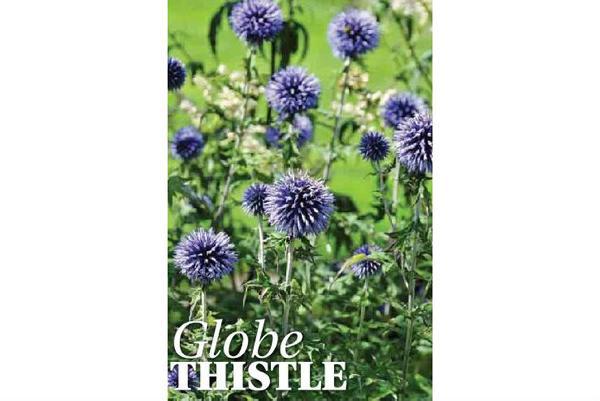
The shape of a globe is uncommon in nature, and very few garden plants have it — just the globe thistle, alliums, drumstick primula, some forms of viburnum and hydrangea, and some dahlias. But the geometric globe shape is very strong and eye-catching.
It makes a powerful contrast with other plant shapes, such as spikes, flat umbels, flower clusters and drooping panicles. For this reason, the globe thistle is always very striking when planted in a mixed border, and it is an effect that lasts for many months.
Globe thistle or echinops is a member of the thistle branch of the daisy family. Other members of the family have rounded buds, such as the globe artichoke and knapweed, or centaurea, but the flowers open from the top of the globular bud and the globe shape is then lost. In the case of the globe thistle, the entire rounded head is composed of tiny individual florets.
These are spiky and pointed before they open and little petals are pushed out. Later, when each flower is pollinated, the soft flower parts wither, but the bristly seed head remains.
Before flowering, the globe of flower buds is relatively small and greyish-blue, the tip of each floret lighter in colour. The little petals are a nice bright blue and fade back to grey-blue afterwards.
There are a few kinds of globe flower, some of manageable size and a few giants. In general, they suit a rural garden very well because they are big plants that fill space and they have a wonderfully natural appearance.
The most common kind grown is Echinops ritro, which is the most compact, grows to about 120cm and makes a solid clump of sturdy stems with dark green, spiny leaves with some grey webbing and white undersides. The flowers are grey-blue and open blue in late summer and into early autumn, about 5cm across. The form ‘Veitch’s Blue’ has darker blue flowers and keeps on flowering.
Flowering from July and into September, Echinops bannaticus is about the same size with greyish-blue or pale blue flowerheads, and the variety ‘Blue Globe’ is dark blue with flowers 6cm in diameter. There is a white variety called ‘Albus’ which has a dreamy effect in a border. There are some big species, such as Echinops sphaerocephalus, which can tower to two metres and looks very dramatic with large spiny, grey-green thistle leaves on the tall stems and 6cm globe flowers. Echinops niveus is nearly as tall with grey stems, much divided spiny leaves, and grey-blue or white flowers.
Globe thistle is native to a swathe of territory from central and southern Europe and across to India, growing in dry rocky places and dry grassland, much as its thistle relatives do in most places where they appear.
They thrive in dry, poor soil in full sunshine. They are very robust and easy to grow. If grown in good soil with plenty of moisture, they tend to be leafy and grow taller than they might otherwise.
This can cause wind-throw, necessitating staking which is not at all needed on dry soil. In the right conditions, they may self-sow. If the spent flowers are taken off, this prevents seeding and, when done in summer, can encourage a late second show of flowers.
However, the seed-heads last into winter and look well when frost-coated, the globe shape still attractive. It is a very hardy plant, never affected by frost.
White butterflies
Butterflies of all kinds have been present in low numbers this summer due to the very cold and late spring. Until recently, white cabbage butterflies have also been in short supply, but now the later generations have been building up and the large and small white butterflies have been visiting cabbage family crops.
The large white lays a batch of orange-yellow eggs and these hatch out and feed as a cluster of green and black-patterned caterpillars, making them easy enough to locate and pick off.
The small white is more problematic. It lays white-cream eggs singly and the caterpillar is green and furry with fine white hairs. While the large white caterpillars can usually be easily seen on the surface or undersides of the outer leaves, the caterpillars of the small white usually burrow into the cabbage or cauliflower heart. Often the frass or droppings can be seen but no caterpillar. While picking off caterpillars is possible, it may not work with the small white as it is too hard to find. Preventing access for the egg-laying female butterflies is the best solution, using close-mesh net or bionet, which also keeps pigeons at bay.


SHARING OPTIONS