




Obesity treatment drugs often come with a hefty price tag – they can be upwards of €350 per month, and more – depending on the medication. That’s a big chunk of a person’s income or pension.
In week one of our two-week series on weight-loss treatment drugs, we detailed that if someone has diabetes, they can get Ozempic covered by the State. Saxenda, another medication licensed to treat obesity, can also be reimbursed by the Government under very restrictive criteria.
If you have private health insurance, you may be able to get some visits to the consultant or GP reimbursed, and you may even have coverage for visits to a dietician. This will vary according to your policy.
The high cost of anti-obesity medications is creating economic divisions in Ireland where wealthy users can pay for private prescriptions while others on lower incomes struggle to access it.
Professor Francis Finucane, consultant endocrinologist at Galway University Hospital, tells Irish Country Living that around half of the patients he sees in clinic who want to start medications for the treatment of obesity simply cannot afford to go on them.
“It just adds to the social gradient that exists in terms of who is affected by obesity in Ireland and on every level, this is deeply problematic,” says Professor Finucane. “There’s a perception that obesity is somehow self-inflicted and a personal choice and a manifestation of a lack of personal responsibility, rather than it being seen as the complex neuro behavioural disorder that it is.”
The price of the medication is forcing people down unregulated routes, where drugs are given with no supervision, including in gyms, beauty clinics and on the black market. This is happening not only in Ireland but around the world.
Other people are heading across the border as these medications are more cost-effective in Northern Ireland.
“Patients can access these drugs with a prescription from a doctor based in the Republic of Ireland and they can take that prescription to Northern Ireland,” says Professor Finucane.
Under EU rules, a prescription from a doctor in one EU country is valid throughout the EU and the European Economic Area. Patients may use their medical prescription from a health professional registered in Ireland in Northern Ireland.

Heading up North
Sligo man Paddy Cunningham, who shares his treatment journey on social media, has been bringing his prescription to Northern Ireland for the past year. Paddy was prescribed Mounjaro by an endocrinologist in Ireland at the end of May 2024. Mounjaro became available in the UK two months before (March 2024) but it only became available in Ireland in February 2025.
“I’m right on the border, so I was able to bring my script up North,” says Paddy. “If I paid for my dose of the medication in the Republic, I could be looking at upwards of €400 a month. Up North it’s about €208. There’s a massive price difference.”
Paddy has lost around eight stone since he started the treatment, but he doesn’t put it all down to Mounjaro. “A big part of that is making sure I’m putting focus on my nutrition and particularly the movement as well. That’s one part that I think people leave on the back burner and don’t fully understand – the importance of exercise, particularly strength and resistance training. Since week one, I’ve been getting into the gym three or four times per week.”
In terms of side effects, Paddy said he was feeling very cold initially, due to the calorie reduction but has experienced “minimal side effects” otherwise.
“There has been the odd day here or there where you might get a little bit of acid reflux or that. But at least the majority of time, I can link it back to what I have eaten that day, and the more supportive I can be nutritionally in terms of the things I should be eating, the lesser the chance of side effects.”
Another big difference between UK and Ireland is not only the cost of medications but also that pharmacists in Northern Ireland can prescribe this medication. In Ireland, only a GP or a specialist in the area can prescribe.
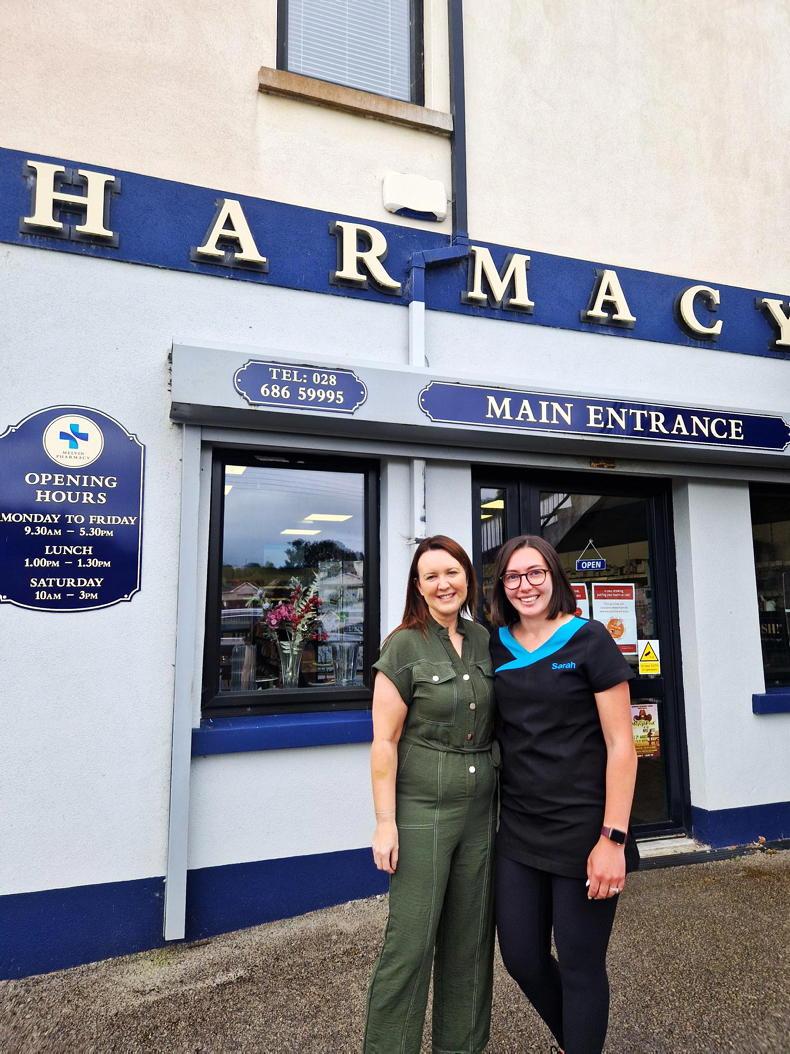
Irish Country Living spoke to Melvin Pharmacy in Garrison, Co Fermanagh who say that nearly three-quarters of their patients are from the Republic, including patients who travel from as far as Dublin.
Melvin Pharmacy has been operating for 16 years but it is only in the past year that pharmacist and owner, Siobhan McNulty and pharmacist, Sarah McCutcheon, started prescribing these medications.
“We had a few patients who had come in and told us that they were buying the drugs online, and had a few scary and hairy experiences. I just thought, you know what? If this is how people are going to access this, I think we need to do this right,” says Siobhan.
As part of the weight management service, a pharmacist provides consultations and advises patients alongside prescribing the medication, and prices start at €294 per month.
“When they start, they see me for quite a lengthy consultation [one to two hours] and I check medical conditions and that they are fully eligible [for the medication],” explains Sarah.
“Then when they’re first started on the medication, I see how they’re tolerating that and if there’s anything they might need to change.
“After that, I see them every four weeks.”
Siobhan tells Irish Country Living that most of the people using this service are from the Republic and are referred to Melvin Pharmacy by a GP.
“Everybody we see has to agree that their doctor will be informed, and we will send that doctor a letter saying that your patient has joined our service,” says Siobhan. “We will have checked all medical conditions with the patient.”
Pick up medication
Other clients come to Melvin Pharmacy every month just to pick up the medication and not for the extra support service. In this instance, prices start at around €159.
While some pharmacies in Northern Ireland offer a delivery service and ship medications to a postal address, patients have to go in-person to Melvin Pharmacy.
“We never got into the posting because we just never thought it wasn’t right to be putting prescription medication in the post, especially with needles and also something that really should be in the fridge before you use it,” says Sarah.
According to the licensing of the medication, it needs to be refrigerated before its first use. This, in principle, means that any pharmacy shipping the drugs should transport them temperature controlled with ice packs, to ensure it stays within two to eight degrees. Not every pharmacy is shipping it that way.
“It just didn’t sit well with us and we decided that was too much of a grey area,” Sarah continues. “It’s better to actually be giving it physically out to patients. I’m able to take them into a consultation, show them how to use it, how to administer an injection.”
“The whole point of a community pharmacy is you see your patients,” says Siobhan.
Both women say they hear of many people still getting medication online. “People tell me they went to an online pharmacies, filled out a questionnaire, and it was delivered within five days,” says Sarah. “I see [the effects] first-hand when people get it online. They ring me and they’re not well on it, they want to switch over to a new one because they haven’t got the information and support that they need.”
Some say that the high cost and inaccessibility of the medication for those who need it is what is forcing people down these roads. “I think that until the drugs become less expensive, we’re not going to see an improvement in access,” says Professor Finucane.
“That is probably the single greatest challenge that we face as a health care system. We have to persuade drug companies to reduce their prices so that it becomes economically viable for governments to pay for these drugs for affected individuals.
“Then we’d be able to demonstrate cost effectiveness in reductions in onset of diabetes and cardiovascular disease.
“These drugs are effective at helping people to modify their diet and thus lose weight, but they are too expensive. The literature that I have read on this suggests that the drugs need to come down by more than half the price to be potentially good value for money for governments.”
Commenting on the trend of Irish patients taking their prescription to Northern Ireland, the Irish Pharmacy Union (IPU) said they “have noticed an increase in queries regarding such prescriptions in recent times.”
When asked whether there were plans to reduce the price of medication, the IPU said: “the cost price of a medication on the market is determined by the manufacturer and reflects local operating costs and market conditions.”
The IPU also said that they “welcomed” the recommendation on the introduction of independent pharmacist prescribing in Ireland. This recommendation was made by the Expert Taskforce established in 2023 to support the expansion of the role of pharmacies in Ireland.





SHARING OPTIONS