



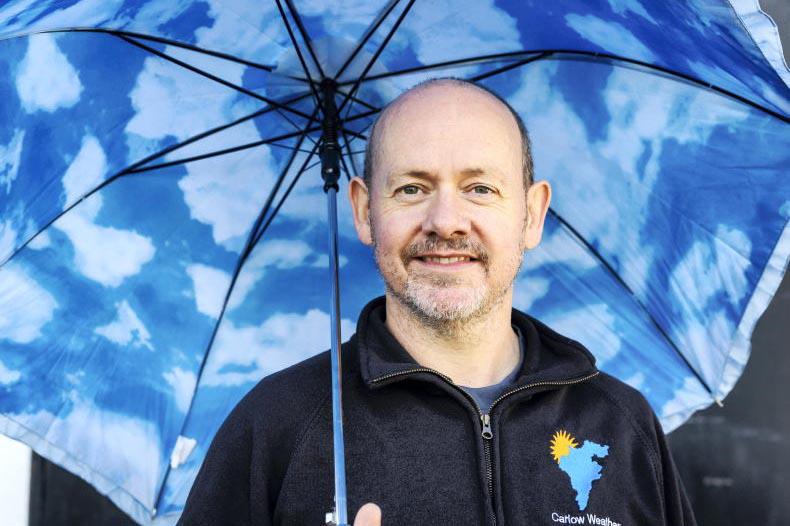
Like many children, Alan O’Reilly was enamoured with the idea of white snow and the fun it could bring.
Growing up, he could see snow settling on the Blackstairs Mountains and it sparked a fascination in him and a curiosity about the conditions that would cause it.
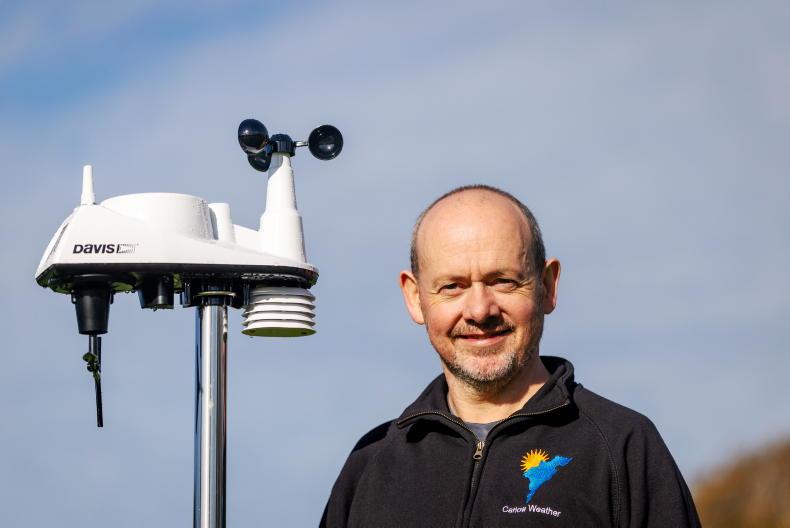
Years later, Alan’s interest in weather and technology became a perfect combination. The Tullow-based IT worker bought a weather station, connected it to his computer and set it up to update online.
“I’ve always been interested in technology,” says Alan, who is known to many as the Carlow Weather man (@carlowweather). “Getting a weather station and connecting it to a computer and setting it up to update on the internet… that was a nice marrying between the technology and the interest in weather.”
Then came the big freeze of 2010. In January of that year, Alan’s home weather station recorded a bone-chilling -17.7°C. It wasn’t an official weather station, but because his website was updating the temperature every 60 seconds, people could watch the mercury dropping in real time.
The unusual reading began attracting attention online and soon after Alan found himself doing his first string of radio interviews, including one with the late Gerry Ryan on 2FM.
At that stage, however, his growing online presence was still a long way from what Carlow Weather would eventually become.
His earliest social media posts weren’t even really posts at all: his weather station automatically tweeted the latest conditions every hour. Gradually, Alan began sharing something he was already doing for himself – reading and analysing weather charts.
“I remember when I hit 5,000 followers on Facebook, it was kind of like, ‘wow’. And then when I hit 10,000 followers, it was really ‘wow’.”
The major turning point came in 2018, when Alan began spotting signs in the weather models of what would become the Beast from the East and storm Emma.
People, especially farmers, are looking at you for some hope of rain. Then there are times when all they want is for the rain to stop
Around two weeks out, he was already discussing the developing pattern on social media. As the event drew closer, his confidence in what the charts were showing increased – and people noticed that he had been talking about the possibility of a major weather event before it had become a news story.
Weather guru
Today, whether it’s a farmer desperately watching for rain, a family planning a christening or thousands wondering what to pack for Electric Picnic, many people turn to the Carlow Weatherman.
He says he is frequently contacted by brides-to-be looking for assurance that the sun will shine on their big day, and despite being in absolutely no control of what happens during the nuptials, he frequently receives thank you messages from relieved newlyweds when the day passes without rain.
Perhaps part of Alan’s appeal is he doesn’t sound particularly interested in presenting himself as a weather guru. His style is conversational and, crucially, he is comfortable admitting when the weather simply isn’t certain. He doesn’t consider himself a ‘brand’, but if he is, his appeal is of that uniquely Irish kind that belongs to us.
“I take what the weather models are showing, and I try and communicate in a style that people can understand, and relate to it,” he says.
“And include the uncertainty, include that this might happen, this might not happen. And this is a risk of this happening.”
Alan is acutely aware of the impact the weather can have for farmers. He grew up around farming, spending considerable time on his uncle and cousins’ sheep farm, and remembers the physical work involved.
“I’ve lambed more lambs than I want to remember,” he says with a laugh.
So he knows that a forecast he puts online can be be read very differently by somebody whose livelihood depends upon what happens next. The droughts, especially those that occurred this summer, are particularly difficult.
“People, especially farmers, are looking at you for some hope of rain,” he says. “Then there are times when all they want is for the rain to stop.”
With such a large audience now watching his updates, Alan says he has become more restrained about sharing what weather models might be suggesting far into the future.
A chart showing the possibility of rain in 10 days might look encouraging, but if that rain never materialises, the consequences for someone desperately waiting for it can be significant.
“I’m a glass-half-full person,” he says. “Anyone that follows me will probably know that I’m very positive.”
Alan does worry about managing people’s expectations and also the effect of negative news on people’s mental health.
“If I put out a chart saying, ‘Oh, there’s a good chance of rain coming in 10 days,’ and then it doesn’t come, that can have a big impact on people’s mental health.”
He recalls this summer cycling around his local area during the first week of August. He spotted a farmer bringing bags of nuts to sheep standing in a field where there was virtually no grass. At a time when grass should have been plentiful, the farmer was effectively having to feed animals as though it were winter.
“I just thought, I mean, the hardship that’s involved in feeding animals in the winter is bad enough,” he says.
“But having to do that in August when you would expect there to be lots of grass out there… I think that was the moment I really realised the impact of the droughts. A lot of people really enjoyed the fine summer, but it cost farmers a lot of money. It’s also a lot more effort and work.”
After years spent studying Ireland’s weather, Alan says one of the clearest changes he has observed is not simply how much rain falls, but how it falls.
Long dry spells can be followed by intense rainfall over a short period, while prolonged droughts, such as those experienced in 2018 and again this year, can create very different problems.
“The growing season has changed,” he says. “But the biggest thing really is the intense rainfall and the intense amount of rainfall in a short period of time.”
Prolonged droughts
As somebody who still loves snow, he has noticed another change too: fewer of the proper frosts and cold spells he remembers from winters past. Flooding is what concerns him the most. There are at least some measures farmers can take during drought, he points out – supplementary feed can be bought, or alternative water sources explored. Floodwater is different; it’s extreme and difficult to prepare for.
“With a flood, when the water comes, there’s no way to stop it,” he says. “Anyone that’s had a house flooded or land flooded – they know the reality of that.”
I think that was the moment I really realised the impact of the droughts. A lot of people really enjoyed the fine summer, but it cost farmers a lot of money
Despite the huge audience now following his forecasts, Alan still has a full-time career in IT, something which also provides a useful separation from the weather charts. He took on an intense fitness journey in recent years and credits his long runs as a great way to really relax.
“I enjoy running and I go running the roads,” he says. “I find that’s the greatest way of switching off.”
He leaves Irish Country Living wondering if he checks the weather before lacing up the running shoes.
Follow Alan on X/Twitter:@CarlowWeather, Instagram: @carlowweather and Facebook: @CarlowWeather




SHARING OPTIONS