




Well, we got all our slurry out on time and now we are working on the dung. The father is currently flinging it all up and down the fields.
It’s a noisy operation – those chains in the dung spreader have set off some racket. You can nearly see the birds and small animals in the hedgerows holding their ears while he is working. I stay well away while he is at it because you never know which way it’s going to come out, but there is a lot of good stuff in that dung – it will please the worms and bacteria that live in the soil.
At this time of year, as the evenings get shorter, you start to think about all the jobs you should have gotten done during the longer (and drier) days. I missed the opportunity to reseed this year; the timing just didn’t work out with all of the other distractions both on and off the farm. The other problem was the area where the reseeding was needed also required other bits of work just to make reseeding possible.
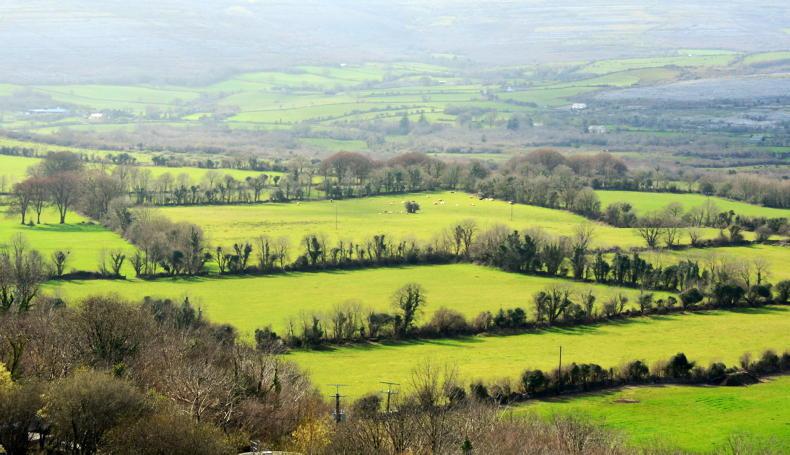
It’s located at the bottom corner of our land – it’s a little bit marshy with poor drainage. It also has a hedge in the middle of the paddock. I call it “The Brazilian Strip”.
In the auld days, the decision to take that hedge out would be simple. Just pull those trees down, pile up the branches and set the whole thing alight. In fact, in the past, farmers would have been encouraged to take out scrub or risk being penalised in their single farm payment if there were sections of their land not classified as productive, but this has changed with the emphasis moving from food production to also encapsulating environmental benefits.
We can’t hide the negative impact this had on wildlife and biodiversity. With this in mind, though, old habits tend to die hard and I had a very difficult job convincing my father (and OK, even myself) not to remove the hedge. In my head, I was thinking: ‘It’s just in the way; I could get a few more metres of grass; sure most of the trees in it are rotten anyway.’
It also has a hedge in the middle of the paddock. I call it “The Brazilian Strip”
I was almost hoping for a lightning storm to come along.
In the end, there were a few things which stopped me – the most obvious being current regulations. The EU and our Government have finally copped that we need to stop the practice of hedge removal. They realised the push on farmers to be more productive was having a knock-on effect on the environment.
Right now, there is an eye in the sky protecting my hedges that will snitch to the Government if I dare lay a finger on a tree. There will be repercussions in the order of fines and bans for schemes if I do.
The second reason I didn’t go ahead was peer pressure. I consulted my Teagasc advisor who simply said: “For the sake of some convenience, you will set back hundreds of years of biodiversity. Is it really worth it?”
My wife then added to the pressure; making me think of the homes for birds and insects that would be lost.
She also threatened to send the kids down there to march with posters saying, ‘hands off our strip’ and ‘no to stripping nature’.
The last push came from a more unusual source. I’ve been listening to podcasts about Irish mythology and old farming traditions. I learned that in the past, there was a deep respect – even a fear of – disturbing nature.
This respect has been falling away over the years. We see these traditions more like fairytales today. But fairytales almost always share a message to warn future generations.
In a way, I feel a new sense of pride and duty in being a protector of the land. I know there are choices I can make to not only make a living but also save the living things currently residing in that strip.
Anyone who isn’t a farmer or connected in some way to the land would probably find my struggle baffling. Surely, in this day and age, farmers wouldn’t dream of pulling up trees to make their farm more productive.
But when you’re trying to make a living, it can be easy to make a mistake for the sake of progress.
Maybe our future definition of progress will be different.



SHARING OPTIONS