



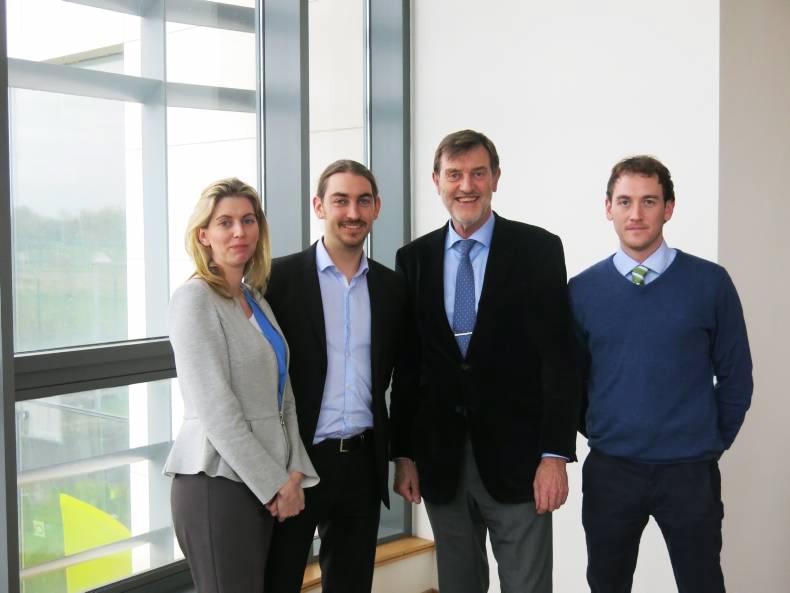
John Scrivener of Farmhand fame, who turned 65 last November, decided to step away from the role of MD of the company last year, one he had taken over at the age of 24 from his father Denis. John joked that Scrivener is not a traditional Irish name and gave us an insight into how Denis Scrivener came to Ireland.
His father was a tank driver in the army in what is now known as the Czech Republic during World War II. He met Irish nurse Nano Keating in Prague during the war.
The couple married in London and returned to the Scrivener family fur business in Prague. John’s sister was born in Prague during that time.
The country fell into communism and was nationalised overnight. At this point, the Scriveners set out for Ireland to John’s mother’s home in Clonmel, Co Tipperary.
From there, his father worked as a delivery driver for Bulmers for a while until his break into the machinery business came.
His first job in sales was for Massey Ferguson dealer King and Keating. At that time, Denis was introduced to Con Smith, with whom he would go on to have long and friendly working relationship over the years.
Smith’s business model suited the country at that time; he took tractors off farms in the UK and rebuilt them for sale in Ireland, known as Smith’s rebuilds.
The job that Denis Scrivener had was to source a suitable business for Con to buy. After taking it over, Denis installed the management systems, appointed a manager and moved on. So John and the rest of the family moved around quite a bit in his early life, never spending more than six months in the one location.
Denis believed the future was in implements. From travelling around the country, he saw the need for good tools to work the land.
Krone was one of the big German companies he approached about supplying him and, in 1962, Farmhand was founded. The company had split ownership between the Scrivener family and Krone – another family business.
In 1993, Farmhand bought Krone out of the business. It moved to Blanchardstown in 2008 from Castleknock, where Farmhand had operated since 1972.
The facility in Blanchardstown is custom-built and set for expansion in the coming year with the growth of the Fastparts operation. The building is ahead of its time, with renewable energy and natural light providing heat.
John’s father died in 2000. John then set up a board of directors. On the board is current managing director Paul Scrivener, Sinead Scrivener, Dr Bernard Krone, John Brady, David Borland and John acts as chair.
“I am blessed to have my kids following on into the family business. I am totally out of the day-to-day running of affairs and I’m only here to offer advice when needed,” says John.
He also went on to say that he loved every minute of his job, meeting some of the most interesting characters and developing Farmhand over the years.
The last 40 years
“The 1970s in Ireland was a real boom period for machinery – it flew out the door. Irish farmers were gearing up for production after joining the EU. Then along came the crash in the 1980s. With loan interest rates at 23%, over half of the machinery companies disappeared. I believe this time in Ireland was far worse than the current crash after the building boom,” says John.
“Farming is less lucrative now. In very simple terms, in the past, a farmer could buy a Zetor tractor, or any other make, by selling three or four heifers or finished cattle. Now, that tractor will need finance over five years.
“The farmers today have a tight-margin business and I believe they don’t get enough for their produce. Increased costs are crippling them. Farming is a vocation – I don’t think they’re in it for the money. The first deal I made on my own was in 1972 for a Kuhn potato digger to Pat Taaffe in Ardee. I sold it for £150 and sold many more of them after that.
“My favourite machine is the Quicke loader. My dad was the first importer of any Scandinavian-built machine. We sold over 50,000 loaders and each one has made a huge difference on the farm.
“My least favourite machine that we sold was the Pottinger Haystar. With 300 sold in the first year, every one of them came back for repairs.
“At the moment, I think Farmhand is missing a good plough to boost the range. I regret that we have nothing to offer at the moment. If Amazone come up with the goods, it might be here in the future.
John has strong views on family in business: “Family companies, such as Krone and Amazone, have a real affinity to their brands and customers. Krone CEO Bernard Krone will often speak to a farmer on the phone or visit and listen to what they need from a machine. They have unbelievable pride in what they do. We like sourcing our parts and machines from them, as they have similar values to us.”
According to John, the number of importers in Ireland has dwindled and this probably reflects the number of farmers.
The consolidation of dealer numbers has seen over 50% disappear since Farmhand opened for business.
John still believes that the local family dealer with area knowledge will play a vital role. The next generation of Paul, Sinead and Stephen Scrivener is set to lead this family business to a bright future in changing times.


SHARING OPTIONS