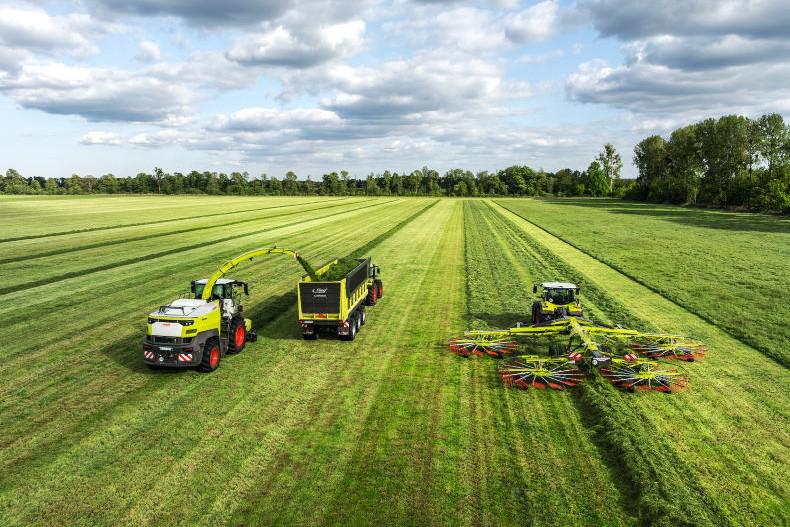
Claas has taken the wraps off four new forage harvesters from its newly-introduced Jaguar 1000 series. Claiming to have the widest crop flow on the market, it says the new series enables throughput capacities of up to 480t/hour. With more than 50 years of experience in the development and construction of forage harvesters, the Jaguar name is synonymous in machinery circles.
The Jaguar 1080, 1090, 1100 and 1200 are powered by a transverse-mounted 24l MAN V12 engine. Claas explains that the drive concept has been integrated into the overall design concept to save space, resulting in an identical external width to the Jaguar 800 and 900.
Claas says the new series has been based on many years of development and practical testing, which has resulted in a series that’s more than just its engine power.
The new features include the self-acclaimed widest crop flow on the market, fully hydraulic pre-compression, homogeneous chop quality, the large corn cracker, the drive concept with two independent variable front attachment drives, new pick-up and Orbis front attachments, driver assistance systems, the new Nutrimeter and an updated chassis.
The new forager series will be one of the highlights on the firm’s stand at the upcoming Agritechnica trade fair in November in Germany. Series production will start in autumn 2025.
Hydraulic pre-compression
Claas is claiming that with the new Jaguar 1000 it has developed the widest crop flow channel on the market in conjunction with a new pre-compression system.
The four pre-compression rollers work with a fully hydraulic pre-compression system, which it says enables a uniform crop flow regardless of the layer thickness. It says that this guarantees uniform feeding of the V-Flex chopping cylinder and ensures maximum throughput with consistent chop quality.
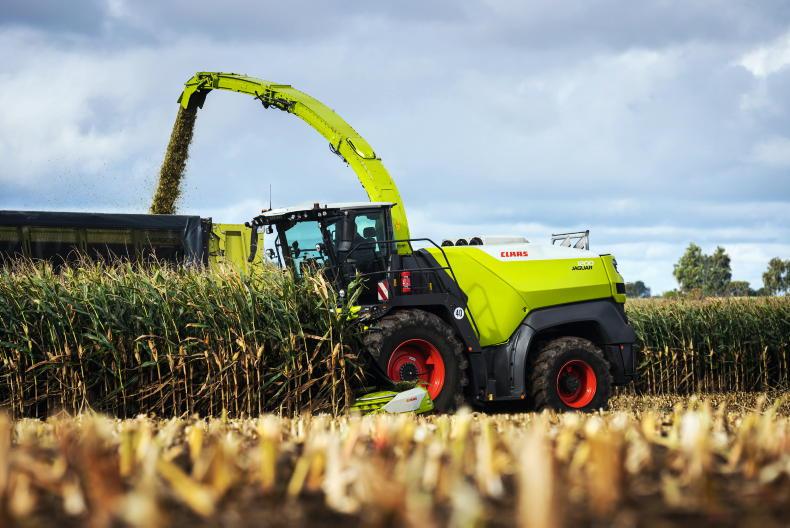
Auto crop flow monitors the engine speed to ensure the forager is operating correctly and stops the crop flow if the engine speed drops below the set minimum speed.
The pre-compression rollers can be raised hydraulically for cleaning work using the maintenance function. Thanks to the Quick Access feature, the full pre-compression unit can be swivelled up to 80 degrees for maintenance works. The tilting frame with hydraulic centring for the header is located on the pre-compression unit.
New V-Flex chopping cylinder
In 2024, Claas introduced the new V-Flex chopping cylinder for the Jaguar 900. Thanks to its 910mm width, the Jaguar 1000 comes with more space for more throughput. It says the crop is cut even more efficiently thanks to the steep knife angle of 10 degrees, which also reduces noise levels.
The chopping cylinder can be fitted with either full or half knife sets, as well as half-section knives, for a wide chop length range. The knives, fastened from above with three bolts, are fixed in the drum stars and automatically aligned. Setting the knives to the shear bar and readjusting them is not necessary.
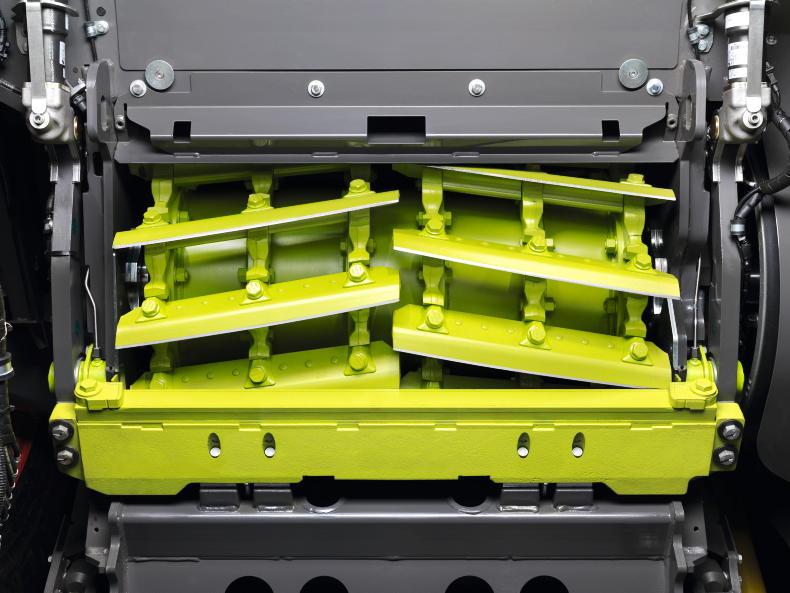
The new V-Flex chopping cylinder features a 910mm width.
New Multi Crop Cracker
The Jaguar 1000 can be equipped with the Multi Crop Cracker XL, available either as the MCC XL Classic with a sawtooth profile with various teeth and a 40% speed difference, or as the MCC XL Shredlage with a 50% speed difference. It offers a large contact surface between the rollers, with a 310mm roller diameter.
The chop quality analysis in Claas connect can be used to determine the processing score via smartphone in the field, by taking a photo of the chopped material and sending it to the cloud via Claas Connect.
Within a few minutes, the AI-based programme determines the score and transmits the result back to the smartphone. Claas says this enables the optimum setting of the corn cracker for the respective conditions of use.
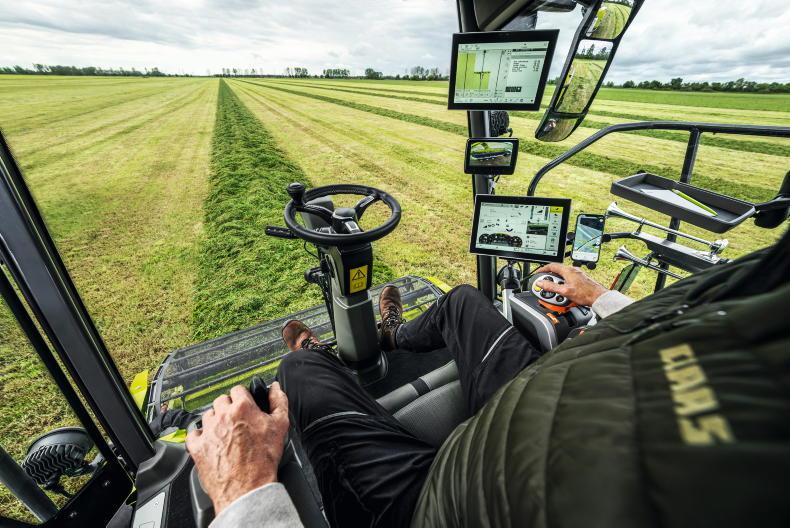
For the first time, Claas are now offering the Jaguar with optional joystick steering for field use.
Powerful blow
Claas says the throwing accelerator has been adapted to the increased output of the Jaguar 1000. Depending on the desired blow, the hydraulically adjustable gap of up to 60mm can be altered to allow the throw to be adjusted.
Claas says the discharge manifold concept is also new. It explains that by swapping the manifold end piece, the length of the blow can be optimised for the respective crop at hand.
The pickup now feature independent variable drive of pick-up and intake auger speed.
New generation pick-up
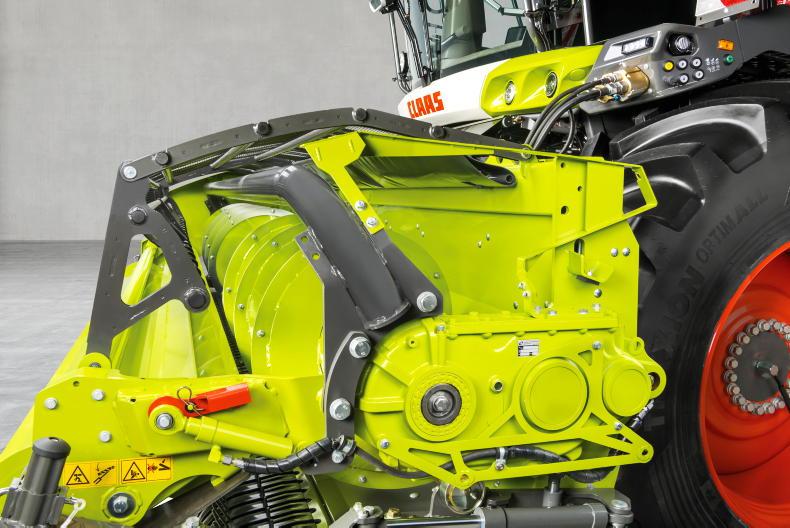
Claas has developed new front attachments for the 1000 series – the Pick-up 3000, 3800 and the new 4500 with independent variable drive of pick-up and intake auger speed. With Cemos Auto Header, Claas notes that the auger and pick-up speeds are automatically adjusted to the length of cut and the driving speeds during harvesting.
The models cover working widths of 3m, 3.8m and 4.5m. Instead of chain drives, mechanical power is transmitted via PTO drive shafts and gearboxes. With its constant hydraulic pre-press pressure, Claas says the intake auger ensures an even crop flow to the feeder unit.
The two cam track gears of the five-row pick-up are oil-lubricated. In addition, the strippers between the tines are made of plastic and, thanks to the clip system, can be removed individually using just a screwdriver.
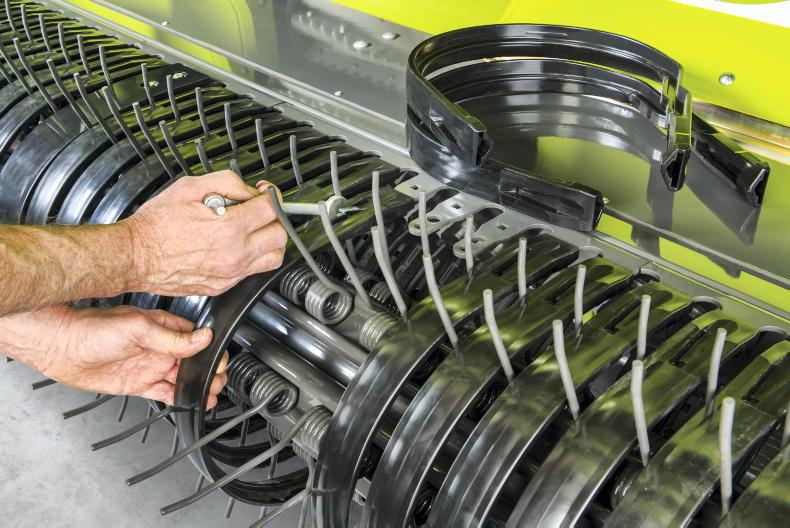
The bands/strippers between the tines are made of plastic and, thanks to the clip system, can be removed using a screwdriver.
After attachment, only the electronics and the multi-coupler for the second independent variable drive are connected to the Jaguar on all front attachments.
New Orbis heads are available with working widths of 9m and 10.5m (12 and 14 rows). Another new feature here is the independent variable drive of the knife and transport discs, as well as the feed drums.
New drive concept
Since 1994, transversely mounted engines in the Jaguar have been driving the knife drum and other units directly. In the new 1000 series, a powerband takes the power directly from the crankshaft of the 24l V12 engine from MAN and transfers it to the chopping cylinder, throwing accelerator and from there to the corn cracker.
For the ground drive, Claas says the pre-compression rollers and the two independent variable attachment drives, a pump transfer case is located at the rear left of the engine, which drives the hydraulic motors.
Thanks to the independent variable attachment drives, the pick-up and intake auger on the pick-up and the knife and transport discs and feed drums on the Orbis can be adjusted independently of each other in terms of speed to suit the harvesting conditions.

Claas say the engine bonnet of the 1000 series has been designed to be very slim and flat, so that the view to the rear is no more restricted than with its smaller foragers.
During road travel, only the ground drive is active; the drive of the chopping unit, intake and front attachments is then decoupled in the pump transfer case. Claas says the engine bonnet of the 1000 series has been designed to be very slim and flat, so that the view to the rear is no more restricted than with forage harvesters in the medium and lower performance classes.
The series comes with four-wheel drive and intelligent all-wheel management as standard. Differential locks on the front axle and on the rear axle are also offered as an option, as is a tyre pressure control system for the front and rear axles.
The drive design allows for 800/70 R42 front axle tyres with a total machine width of 3.3m, with the largest possible front axle tyre being 900/60 R42, with an outer diameter of 2.15m. In addition, tyres up to 710/60 R30 can be selected for the rear axle.
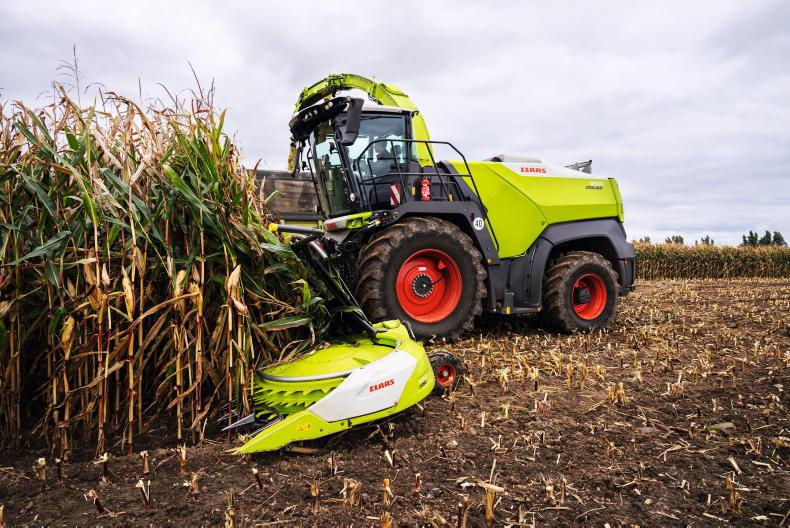
New Orbis heads are available with working widths of 9m and 10.5m (12 and 14 rows).
Driver automation
The series is equipped with Cemos auto crop flow and auto performance. The auto performance engine and drive management system ensures a constant/maximum throughput by adjusting the driving speed to the engine load, and automatically adjusts the engine power if necessary.
Auto crop flow automatically monitors the engine speed at all times to ensure that the forage harvester is operating correctly and stops the crop flow if the engine speed drops below the set minimum speed.
Nutrimeter
With the new series, Claas has introduced the latest generation of the NIR sensor named Nutrimeter. Thanks to real-time determination of the dry matter content, it can automatically adjust the chop length based on the desired length.
In addition to dry matter content, the Nutrimeter also records other ingredients, such as starch, crude protein and sugar content. A new feature is the mobile use of the NIR sensor as an IsoBus device, which enables easy conversion from machine to machine.
The data collected by the Nutrimeter is stored, analysed and put together with the machine data from the Jaguar in Claas connect, the firm’s online machine platform.

The Jaguar 1080, 1090, 1100 and 1200 are powered by a transverse-mounted 24l MAN V12 engine.
More comfortable cab
The cab is operated using familiar controls such as the Cmotion ground speed control lever in the right-hand armrest console, as well as the integrated Cebis terminal with its 12-inch screen. The GPS Pilot Cemis 1200 is available for satellite steering and smart farming tasks such as vehicle fleet and order management as well as documentation.
Claas notes that various seat variants are now available, including a swivelling leather seat – available with seat heater and seat ventilation, automatic air conditioning and a lower noise level for fatigue-free working.
For the first time, Claas is now offering the Jaguar with optional joystick steering for field use. This will allow the Jaguar to be manoeuvred with just two fingers. The joystick steering has two steering modes and can be customised in various intensity levels. In addition, three switches are integrated into the armrest for individually assignable functions, such as lowering and raising the discharge spout, the horn or the work lighting.
In addition to the satellite-based GPS Pilot Cemis 1200, other automatic steering systems are available, such as Auto Pilot and Cam Pilot.

The pickup now feature independent variable drive of pick-up and intake auger speed.
Claas connect
Claas connect offers a platform for smart farming that integrates machine and farm management. Data such as fields, reference lines, machines and labour can be recorded, analysed and optimised.
Users have an overview of their machines, and can compare them in terms of performance and efficiency. In addition, yield maps can be used to create application maps.
From 2026, live yield mapping will also be available on the Cemis 1200. This allows yield and moisture to be displayed live on the Cemis display as a map during harvest.
With the Cemis 1200 and a Machine connect licence, job management for the Jaguar is done in a few clicks via the mobile phone connection and yield maps can be created live.
Jobs, including reference tracks, can be planned in advance in Claas connect and transferred to the machine. For example, GPS Pilot Cemis 1200 can steer the Jaguar months later using the tracks from the maize sowing. After completing the job, the operator can send the collected machine data, including yield data, back to the office.
Claas has taken the wraps off four new forage harvesters from its newly-introduced Jaguar 1000 series. Claiming to have the widest crop flow on the market, it says the new series enables throughput capacities of up to 480t/hour. With more than 50 years of experience in the development and construction of forage harvesters, the Jaguar name is synonymous in machinery circles.
The Jaguar 1080, 1090, 1100 and 1200 are powered by a transverse-mounted 24l MAN V12 engine. Claas explains that the drive concept has been integrated into the overall design concept to save space, resulting in an identical external width to the Jaguar 800 and 900.
Claas says the new series has been based on many years of development and practical testing, which has resulted in a series that’s more than just its engine power.
The new features include the self-acclaimed widest crop flow on the market, fully hydraulic pre-compression, homogeneous chop quality, the large corn cracker, the drive concept with two independent variable front attachment drives, new pick-up and Orbis front attachments, driver assistance systems, the new Nutrimeter and an updated chassis.
The new forager series will be one of the highlights on the firm’s stand at the upcoming Agritechnica trade fair in November in Germany. Series production will start in autumn 2025.
Hydraulic pre-compression
Claas is claiming that with the new Jaguar 1000 it has developed the widest crop flow channel on the market in conjunction with a new pre-compression system.
The four pre-compression rollers work with a fully hydraulic pre-compression system, which it says enables a uniform crop flow regardless of the layer thickness. It says that this guarantees uniform feeding of the V-Flex chopping cylinder and ensures maximum throughput with consistent chop quality.

Auto crop flow monitors the engine speed to ensure the forager is operating correctly and stops the crop flow if the engine speed drops below the set minimum speed.
The pre-compression rollers can be raised hydraulically for cleaning work using the maintenance function. Thanks to the Quick Access feature, the full pre-compression unit can be swivelled up to 80 degrees for maintenance works. The tilting frame with hydraulic centring for the header is located on the pre-compression unit.
New V-Flex chopping cylinder
In 2024, Claas introduced the new V-Flex chopping cylinder for the Jaguar 900. Thanks to its 910mm width, the Jaguar 1000 comes with more space for more throughput. It says the crop is cut even more efficiently thanks to the steep knife angle of 10 degrees, which also reduces noise levels.
The chopping cylinder can be fitted with either full or half knife sets, as well as half-section knives, for a wide chop length range. The knives, fastened from above with three bolts, are fixed in the drum stars and automatically aligned. Setting the knives to the shear bar and readjusting them is not necessary.

The new V-Flex chopping cylinder features a 910mm width.
New Multi Crop Cracker
The Jaguar 1000 can be equipped with the Multi Crop Cracker XL, available either as the MCC XL Classic with a sawtooth profile with various teeth and a 40% speed difference, or as the MCC XL Shredlage with a 50% speed difference. It offers a large contact surface between the rollers, with a 310mm roller diameter.
The chop quality analysis in Claas connect can be used to determine the processing score via smartphone in the field, by taking a photo of the chopped material and sending it to the cloud via Claas Connect.
Within a few minutes, the AI-based programme determines the score and transmits the result back to the smartphone. Claas says this enables the optimum setting of the corn cracker for the respective conditions of use.

For the first time, Claas are now offering the Jaguar with optional joystick steering for field use.
Powerful blow
Claas says the throwing accelerator has been adapted to the increased output of the Jaguar 1000. Depending on the desired blow, the hydraulically adjustable gap of up to 60mm can be altered to allow the throw to be adjusted.
Claas says the discharge manifold concept is also new. It explains that by swapping the manifold end piece, the length of the blow can be optimised for the respective crop at hand.

The pickup now feature independent variable drive of pick-up and intake auger speed.
New generation pick-up
Claas has developed new front attachments for the 1000 series – the Pick-up 3000, 3800 and the new 4500 with independent variable drive of pick-up and intake auger speed. With Cemos Auto Header, Claas notes that the auger and pick-up speeds are automatically adjusted to the length of cut and the driving speeds during harvesting.
The models cover working widths of 3m, 3.8m and 4.5m. Instead of chain drives, mechanical power is transmitted via PTO drive shafts and gearboxes. With its constant hydraulic pre-press pressure, Claas says the intake auger ensures an even crop flow to the feeder unit.
The two cam track gears of the five-row pick-up are oil-lubricated. In addition, the strippers between the tines are made of plastic and, thanks to the clip system, can be removed individually using just a screwdriver.

The bands/strippers between the tines are made of plastic and, thanks to the clip system, can be removed using a screwdriver.
After attachment, only the electronics and the multi-coupler for the second independent variable drive are connected to the Jaguar on all front attachments.
New Orbis heads are available with working widths of 9m and 10.5m (12 and 14 rows). Another new feature here is the independent variable drive of the knife and transport discs, as well as the feed drums.
New drive concept
Since 1994, transversely mounted engines in the Jaguar have been driving the knife drum and other units directly. In the new 1000 series, a powerband takes the power directly from the crankshaft of the 24l V12 engine from MAN and transfers it to the chopping cylinder, throwing accelerator and from there to the corn cracker.
For the ground drive, Claas says the pre-compression rollers and the two independent variable attachment drives, a pump transfer case is located at the rear left of the engine, which drives the hydraulic motors.
Thanks to the independent variable attachment drives, the pick-up and intake auger on the pick-up and the knife and transport discs and feed drums on the Orbis can be adjusted independently of each other in terms of speed to suit the harvesting conditions.

Claas say the engine bonnet of the 1000 series has been designed to be very slim and flat, so that the view to the rear is no more restricted than with its smaller foragers.
During road travel, only the ground drive is active; the drive of the chopping unit, intake and front attachments is then decoupled in the pump transfer case. Claas says the engine bonnet of the 1000 series has been designed to be very slim and flat, so that the view to the rear is no more restricted than with forage harvesters in the medium and lower performance classes.
The series comes with four-wheel drive and intelligent all-wheel management as standard. Differential locks on the front axle and on the rear axle are also offered as an option, as is a tyre pressure control system for the front and rear axles.
The drive design allows for 800/70 R42 front axle tyres with a total machine width of 3.3m, with the largest possible front axle tyre being 900/60 R42, with an outer diameter of 2.15m. In addition, tyres up to 710/60 R30 can be selected for the rear axle.

New Orbis heads are available with working widths of 9m and 10.5m (12 and 14 rows).
Driver automation
The series is equipped with Cemos auto crop flow and auto performance. The auto performance engine and drive management system ensures a constant/maximum throughput by adjusting the driving speed to the engine load, and automatically adjusts the engine power if necessary.
Auto crop flow automatically monitors the engine speed at all times to ensure that the forage harvester is operating correctly and stops the crop flow if the engine speed drops below the set minimum speed.
Nutrimeter
With the new series, Claas has introduced the latest generation of the NIR sensor named Nutrimeter. Thanks to real-time determination of the dry matter content, it can automatically adjust the chop length based on the desired length.
In addition to dry matter content, the Nutrimeter also records other ingredients, such as starch, crude protein and sugar content. A new feature is the mobile use of the NIR sensor as an IsoBus device, which enables easy conversion from machine to machine.
The data collected by the Nutrimeter is stored, analysed and put together with the machine data from the Jaguar in Claas connect, the firm’s online machine platform.

The Jaguar 1080, 1090, 1100 and 1200 are powered by a transverse-mounted 24l MAN V12 engine.
More comfortable cab
The cab is operated using familiar controls such as the Cmotion ground speed control lever in the right-hand armrest console, as well as the integrated Cebis terminal with its 12-inch screen. The GPS Pilot Cemis 1200 is available for satellite steering and smart farming tasks such as vehicle fleet and order management as well as documentation.
Claas notes that various seat variants are now available, including a swivelling leather seat – available with seat heater and seat ventilation, automatic air conditioning and a lower noise level for fatigue-free working.
For the first time, Claas is now offering the Jaguar with optional joystick steering for field use. This will allow the Jaguar to be manoeuvred with just two fingers. The joystick steering has two steering modes and can be customised in various intensity levels. In addition, three switches are integrated into the armrest for individually assignable functions, such as lowering and raising the discharge spout, the horn or the work lighting.
In addition to the satellite-based GPS Pilot Cemis 1200, other automatic steering systems are available, such as Auto Pilot and Cam Pilot.

The pickup now feature independent variable drive of pick-up and intake auger speed.
Claas connect
Claas connect offers a platform for smart farming that integrates machine and farm management. Data such as fields, reference lines, machines and labour can be recorded, analysed and optimised.
Users have an overview of their machines, and can compare them in terms of performance and efficiency. In addition, yield maps can be used to create application maps.
From 2026, live yield mapping will also be available on the Cemis 1200. This allows yield and moisture to be displayed live on the Cemis display as a map during harvest.
With the Cemis 1200 and a Machine connect licence, job management for the Jaguar is done in a few clicks via the mobile phone connection and yield maps can be created live.
Jobs, including reference tracks, can be planned in advance in Claas connect and transferred to the machine. For example, GPS Pilot Cemis 1200 can steer the Jaguar months later using the tracks from the maize sowing. After completing the job, the operator can send the collected machine data, including yield data, back to the office.
SHARING OPTIONS