


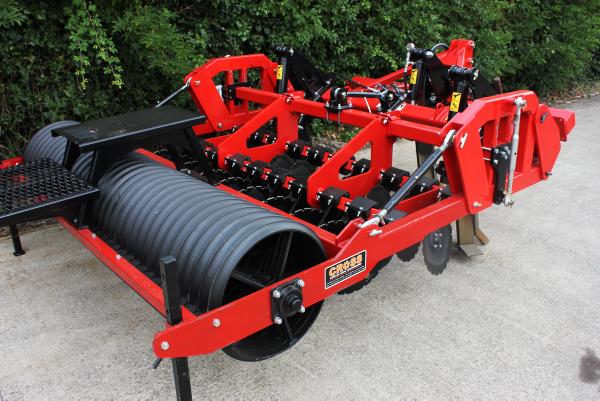
Cross will be supplying the Flatlift range of subsoilers and cultivators to Irish dealers and farmers, coupled with a parts and service back-up.
The Flatlift range subsoiler range is comprised of two and three-leg machines.
The machines can be fitted with a number of attachments for a range of applications. Cross will provide some of the attachments from its own range to widen the versatility of the machines.
The first machine in the new range is the 2.85 metres wide unit with three subsoiler legs. All legs are fitted with hydraulic break-back mechanisms. The pressure on these units can be adjusted to achieve an auto-trip system using a heavy duty hydraulic ram.
This is pressurised by a hydro-pneumatic accumulator designed to allow the leg to trip back. The ball joint ram design is claimed to give the Flatlift legs the capacity to swivel to reduce side stress.
The machine can be fitted with an integral toolbar design to allow the use of a range of attachments. These include an hydraulic thrash disc assembly, depth wheels, a spiker, ring or flat roller and a seeding unit.
With the roller and the seeding unit, Simon Cross sees the machine having a place as an oilseed rape seeding machine, doubling up as a subsoiler. Mole draining conversion kits are also available.
The cost of the two-leg machine is €7,500 plus VAT, while the three-leg machine costs €1,000 extra plus VAT. The power requirement is from 200hp for the three-leg machine.
sugar beet
Meanwhile, Cross is conducting its own sugar beet variety testing at a site close the company’s factory in Rathangan.
The company has sown 12 beet varieties in a 2.4ha (6ac) field with a view to establishing crop production costs, variety performance and yields across a range of varieties.
The crop was sown on the flat at 45cm (18in) row spacings by a spike harrow and seeder combination following ploughing. There was no other secondary tillage treatment.
The crop has received two herbicide applications for weed control and is thriving this week despite the dry weather conditions.
Simon Cross said that the most important lesson that he has learned from his first crop of sugar beet is the necessity for early weed control.
“We found that it is so important to check the weeds early on so that the crop gets an opportunity to reach its full potential. We expect that the crop will yield close to 75 tonnes per hectare (30 tonnes/acre) which we believe will deliver a margin of close to €600 at the prices proposed by Beet Ireland for the return of the sugar beet crop,” said Simon.
The crop will be harvested during two open days at the site in October next, where a new sugar beet harvester and a range of new sugar beet machinery will be unveiled by the company.
The company is currently looking at the production of a three-row belt type beet harvester based on the original Armer design.
Cross also aims to offer a self-propelled sugar beet harvester in future.
Simon Cross has been part of the consortium to encourage the return of sugar beet in Ireland through his involvement in Beet Ireland.
His farm machinery company was a long time supplier to Armer Salmon for beet machinery prior to the closure of the beet industry in Ireland.


SHARING OPTIONS