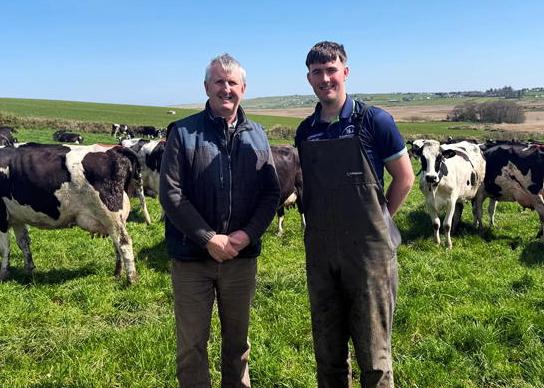
On a picturesque farm in north Mayo, looking out across the Atlantic Ocean and Killala Bay, father and son duo Alan and Craig McCormick are running a herd of 350 cows with a real focus on growing and utilising grass.
The farm sits in a pocket of strong dairy country but still, the McCormicks have managed to grow the business over the years.
Starting out as a mixed farm enterprise, Alan decided to focus on dairying in the early 2000s.
“When I finished in Gurteen Ag college and returned home, we were farming around 200 acres with a mix of beef, sheep and a bit of tillage. We started the dairying in the 1990s with 30 or 40 cows and secured whatever quota we could over the years. By the early 2000s dairying was the sole focus of the farm business and by the time quotas lifted in 2015, we were milking 180 cows,” Alan says.
Salt marsh
Today, the family is farming 260ha in total with 40% owned and 60% leased. Of the 260ha, 230ha is in grass with a further 30ha of unfarmable salt marsh alongside the sea. The milking platform is 105ha and stocked at 3.33 cows/ha.
There are four people working full time on the farm, Alan and Craig, Alan’s brother Allastair who also does some contracting and Alec Farrell who has been with the McCormicks for 15 years.
Two students, Shane and Caelan, work part-time and do some relief milkings at weekends.
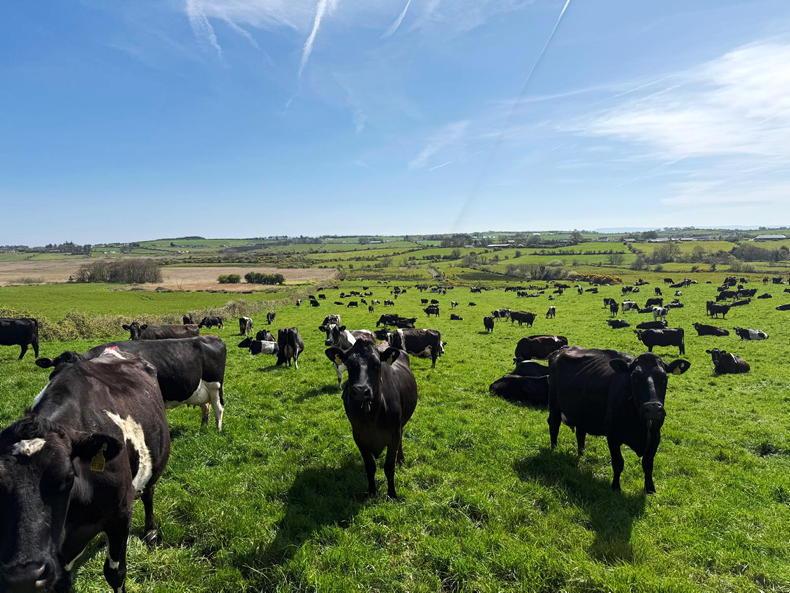
The farm grew 15.2t of grass in 2025 and received the county winners award for Mayo at the Grass10 pasture progress awards.
The McCormicks were recently crowned the county winners for Mayo, at the Teagasc Grass10 Pasture Progress Awards.
The award highlighted the improvements that were made in the last couple of years in regards to grassland management on the farm. In 2025, the McCormicks grew 15.2t DM/ha and reseed between 10% and 15% of the platform annually.
While both Alan and Craig are involved, Craig has taken charge of the grassland management since returning home full-time in 2024.
Craig completed a degree in ag business from ATU Galway/Mountbellew in 2022. As part of the degree, he spent a placement working on a large-scale farm in Scotland operated by Brendan Muldowney and the Farming Partners business.
In 2023 after a stint travelling Australia, Craig spent a season working on another large-scale farm owned and operated by the Guiney family in New Zealand.
These experiences, along with the opportunity to make mistakes and learn from them at home, have helped develop his knowledge base.
The farm is well equipped to grow grass, with a continuous level of rainfall throughout the year and relatively free-draining soil.
“I don’t think we get the same peaks and troughs in terms of growth that farms in the south or east might get.
“Without a doubt they will grow more grass in the shoulders of the year and might be able to graze that bit earlier but we’re avoiding those mid-summer pinch points and it’s allowing us to carry more cows,” Alan says.
Cows were out on/off grazing by day only, from 12 February. This continued into March with just three or four-night grazings in total.
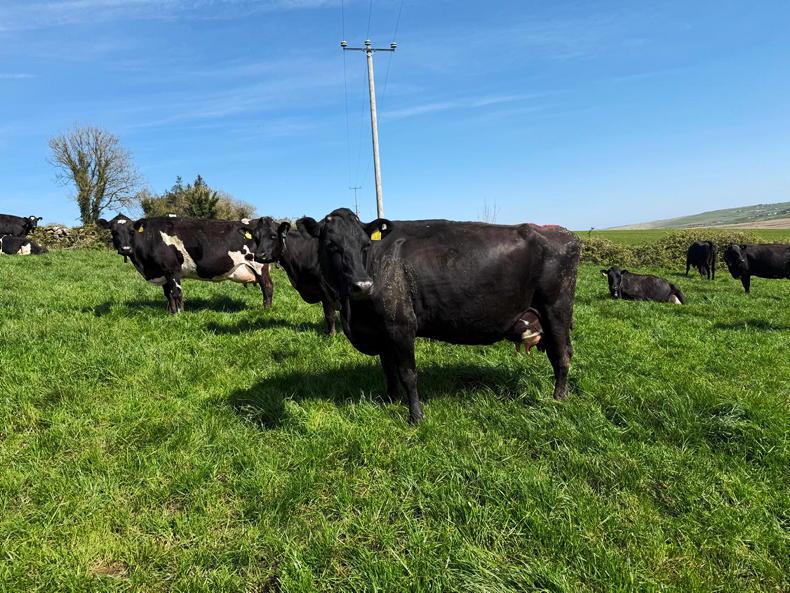
The herd is now predominantly high EBI Holstein Freisian genetics with a proportion of Jersey breeding in some of the cows.
According to the pair, this spring was one of the most difficult they had experienced in terms of weather and this made management very challenging.
Last week’s spell of good weather came just in time as silage stocks were a couple of days from running out and things were starting to get tight in terms of average farm cover.
The second round started on 13 April and the cows are starting to motor through grass now.
Growth bounced to 64kg DM/ha last Friday with a demand of 54kg DM/ha, while average farm cover was sitting at 587kg DM/ha or 173kg DM/cow.
The cows are on 4kg of meal, with the plan being to re-evaluate the situation after the next walk and drop feeding levels if growth is up again.
The platform has gotten two rounds of 23 units/acre protected urea as well as two bags/acre of 18-5-12 + S. This means the farm is on target with just over 80 units/acre of nitrogen spread by the start of May.
The first paddock marked for reseeding will be sprayed off this week, with more planned for the coming weeks.
Over the last three years, the McCormicks have pushed breeding back slightly to better match the calving pattern to grass growth on the farm.
This year breeding will start on 11 May.
“In previous years, cows were calving too early and as they were starting to get towards peak, they were running into a deficit of grass on the farm and therefore they couldn’t sustain peak,” Craig says.
This hasn’t been an issue since moving the breeding date back.
There are collars on the farm and cows are tail painted as a backup. Pre-breeding was just starting at the time of the visit. The plan for this year is to mate the cows as normal for the first week, before commencing the why wait protocol.
This is a shot of prostaglandin given to cycling cows at the beginning of week two which brings the cows that would be cycling in week three into week two.
This means, the majority of the cows will be in-calf within two weeks of breeding and the repeats will come closer together.
The McCormicks started crossbreeding with Jersey genetics in 2012 but decided to go back to high EBI Holstein Friesian bulls a number of years ago. There were two main reasons for this.
The first reason was the improvement in Holstein Friesian genetics from a solids production point of view, and the second reason was the calf and cull cow price received.
The maintenance figure of the herd is €42. Based on the ICBF’s ready-reckoner tool, that’s a mature cow weight of 530kg. The PTAs of the herd are 0.17% for fat and 0.11% protein.
The cows produced 480kg of milk solids in 2025, off 918kg of concentrate.
This figure for total solids is skewed by the fact that replacement rate has been running at between 25% and 30% in the previous three years, as cows were culled hard to fix an SCC and lameness problem.
This year the McCormicks are expecting to produce 510kg of milk solids from 830kg of concentrate on the back of a lower replacement rate last year.
This year, 185 sexed straws will be used across the herd. A total of 75 straws will be used on the heifers with 110 used on the cows.
The criteria for identifying the cows for a sexed straw is straightforward but takes time. They are chosen based on their EBI and milk solids potential using the cow’s own worth tool on ICBF. The cows must be 45 days calved and they are AI’d twice a day.
The remaining animals are bred with beef AI. Conception rate to first service with sexed semen on the cows was 71% in 2025 with average conception rate to first service at 66%.
The empty rate last year was just 8% after 10 weeks and the six-week calving rate of the herd was 91% this spring.
Local discussion groups have been a key part of the learning journey for Alan and now Craig too.
The pair are involved in two discussion groups, the local Teagasc discussion group and the West Awake group which is made up of farmers from all across Connacht. “We’re very lucky to be involved with two excellent groups and we benefit differently off each one.
“You always pick up something from other people who are progressive and eager to learn,” Alan says.
Putting price on benefits of sexed semen
Sexed semen has been growing in popularity, year on year since its introduction to Ireland in 2019.
According to ICBF, in 2025, 29% of the dairy AI straws used in Irish herds were sexed. While this is big growth in six years, it’s still a relatively small number.
So why are many farmers hesitant to commit to the product?
The main reason is fears of lower conception rates to first service, a valid concern as there is a small drop off in conception rates with sexed compared to that of conventional semen.
However, that impact is small and the benefits are still likely to outweigh the drawbacks. A basic analysis has been completed below to help paint a picture of the potential financial returns.
Across a 100-cow herd, the estimated economic benefit is €6,550. This figure is calculated as per below.
Benefits
The possibility to breed replacement heifers from the cows with the best genetics
By selecting dams in the top 60% ranked on EBI, there is an opportunity to increase the average EBI of replacement dams by €20. Over four lactations, this is equivalent to €80.
Across 25 replacement females/year (per 100 cows), that’s €2,000 per 100 cows.
More beef on dairy calves to sell
Data from ICBF, indicates that weighted average price for male and female beef on dairy calves for the main beef breeds, was €424 year to date.
This is compared to €274 for Holstein Friesian male calves, a difference of €150/calf.
Per 100 cows, a breeding strategy based on sexed dairy AI as opposed to conventional dairy AI, will result in 22 more beef on dairy calves for sale each year.
Based on ICBF calf price data, this has the potential to realise an extra €3,300 per 100 cows.
All heifer replacements born and reared together, resulting in lower replacement costs and higher production in first year
One of the key benefits of sexed semen is that more dairy heifers are born early in the season.
Median calving date
Analysis of ICBF data indicates median calving date for dairy heifers is now seven days earlier than male calves.
Per 100 cows and 25 replacement heifers, this equates to seven days fewer rearing costs at €3/day, or €525 for 25 heifers.
Seven days more milk production in the first year of production at €10/day (25 litres/day * 40 cents/litre), across 25 heifers = €1,750.
Across 25 replacement females/year (per 100 cows), this equates to €2,250 for 100 cows.
Therefore, the total combined financial return from the three benefits is €7,550.
Costs
Costs of extra straws
Compared to conventional dairy AI, sexed semen is €25/straw more expensive. To produce 25 replacement heifers, assume that we need; 55 sexed semen straws to produce 25 heifers; (55 straws * 50% pregnancy rate to AI * 92% heifers). With conventional 95 straws will produce 25 heifers. (95 straws * 55% pregnancy rate to AI * 50% heifers)
The difference in the cost of straws to produce 25 replacements is €1,000. To produce 25 replacements heifers is €1,000 of additional costs, from using sexed semen.
Therefore the €7,550 benefit less the extra €1,000 cost equates to €6,550 return.
On a picturesque farm in north Mayo, looking out across the Atlantic Ocean and Killala Bay, father and son duo Alan and Craig McCormick are running a herd of 350 cows with a real focus on growing and utilising grass.
The farm sits in a pocket of strong dairy country but still, the McCormicks have managed to grow the business over the years.
Starting out as a mixed farm enterprise, Alan decided to focus on dairying in the early 2000s.
“When I finished in Gurteen Ag college and returned home, we were farming around 200 acres with a mix of beef, sheep and a bit of tillage. We started the dairying in the 1990s with 30 or 40 cows and secured whatever quota we could over the years. By the early 2000s dairying was the sole focus of the farm business and by the time quotas lifted in 2015, we were milking 180 cows,” Alan says.
Salt marsh
Today, the family is farming 260ha in total with 40% owned and 60% leased. Of the 260ha, 230ha is in grass with a further 30ha of unfarmable salt marsh alongside the sea. The milking platform is 105ha and stocked at 3.33 cows/ha.
There are four people working full time on the farm, Alan and Craig, Alan’s brother Allastair who also does some contracting and Alec Farrell who has been with the McCormicks for 15 years.
Two students, Shane and Caelan, work part-time and do some relief milkings at weekends.

The farm grew 15.2t of grass in 2025 and received the county winners award for Mayo at the Grass10 pasture progress awards.
The McCormicks were recently crowned the county winners for Mayo, at the Teagasc Grass10 Pasture Progress Awards.
The award highlighted the improvements that were made in the last couple of years in regards to grassland management on the farm. In 2025, the McCormicks grew 15.2t DM/ha and reseed between 10% and 15% of the platform annually.
While both Alan and Craig are involved, Craig has taken charge of the grassland management since returning home full-time in 2024.
Craig completed a degree in ag business from ATU Galway/Mountbellew in 2022. As part of the degree, he spent a placement working on a large-scale farm in Scotland operated by Brendan Muldowney and the Farming Partners business.
In 2023 after a stint travelling Australia, Craig spent a season working on another large-scale farm owned and operated by the Guiney family in New Zealand.
These experiences, along with the opportunity to make mistakes and learn from them at home, have helped develop his knowledge base.
The farm is well equipped to grow grass, with a continuous level of rainfall throughout the year and relatively free-draining soil.
“I don’t think we get the same peaks and troughs in terms of growth that farms in the south or east might get.
“Without a doubt they will grow more grass in the shoulders of the year and might be able to graze that bit earlier but we’re avoiding those mid-summer pinch points and it’s allowing us to carry more cows,” Alan says.
Cows were out on/off grazing by day only, from 12 February. This continued into March with just three or four-night grazings in total.

The herd is now predominantly high EBI Holstein Freisian genetics with a proportion of Jersey breeding in some of the cows.
According to the pair, this spring was one of the most difficult they had experienced in terms of weather and this made management very challenging.
Last week’s spell of good weather came just in time as silage stocks were a couple of days from running out and things were starting to get tight in terms of average farm cover.
The second round started on 13 April and the cows are starting to motor through grass now.
Growth bounced to 64kg DM/ha last Friday with a demand of 54kg DM/ha, while average farm cover was sitting at 587kg DM/ha or 173kg DM/cow.
The cows are on 4kg of meal, with the plan being to re-evaluate the situation after the next walk and drop feeding levels if growth is up again.
The platform has gotten two rounds of 23 units/acre protected urea as well as two bags/acre of 18-5-12 + S. This means the farm is on target with just over 80 units/acre of nitrogen spread by the start of May.
The first paddock marked for reseeding will be sprayed off this week, with more planned for the coming weeks.
Over the last three years, the McCormicks have pushed breeding back slightly to better match the calving pattern to grass growth on the farm.
This year breeding will start on 11 May.
“In previous years, cows were calving too early and as they were starting to get towards peak, they were running into a deficit of grass on the farm and therefore they couldn’t sustain peak,” Craig says.
This hasn’t been an issue since moving the breeding date back.
There are collars on the farm and cows are tail painted as a backup. Pre-breeding was just starting at the time of the visit. The plan for this year is to mate the cows as normal for the first week, before commencing the why wait protocol.
This is a shot of prostaglandin given to cycling cows at the beginning of week two which brings the cows that would be cycling in week three into week two.
This means, the majority of the cows will be in-calf within two weeks of breeding and the repeats will come closer together.
The McCormicks started crossbreeding with Jersey genetics in 2012 but decided to go back to high EBI Holstein Friesian bulls a number of years ago. There were two main reasons for this.
The first reason was the improvement in Holstein Friesian genetics from a solids production point of view, and the second reason was the calf and cull cow price received.
The maintenance figure of the herd is €42. Based on the ICBF’s ready-reckoner tool, that’s a mature cow weight of 530kg. The PTAs of the herd are 0.17% for fat and 0.11% protein.
The cows produced 480kg of milk solids in 2025, off 918kg of concentrate.
This figure for total solids is skewed by the fact that replacement rate has been running at between 25% and 30% in the previous three years, as cows were culled hard to fix an SCC and lameness problem.
This year the McCormicks are expecting to produce 510kg of milk solids from 830kg of concentrate on the back of a lower replacement rate last year.
This year, 185 sexed straws will be used across the herd. A total of 75 straws will be used on the heifers with 110 used on the cows.
The criteria for identifying the cows for a sexed straw is straightforward but takes time. They are chosen based on their EBI and milk solids potential using the cow’s own worth tool on ICBF. The cows must be 45 days calved and they are AI’d twice a day.
The remaining animals are bred with beef AI. Conception rate to first service with sexed semen on the cows was 71% in 2025 with average conception rate to first service at 66%.
The empty rate last year was just 8% after 10 weeks and the six-week calving rate of the herd was 91% this spring.
Local discussion groups have been a key part of the learning journey for Alan and now Craig too.
The pair are involved in two discussion groups, the local Teagasc discussion group and the West Awake group which is made up of farmers from all across Connacht. “We’re very lucky to be involved with two excellent groups and we benefit differently off each one.
“You always pick up something from other people who are progressive and eager to learn,” Alan says.
Putting price on benefits of sexed semen
Sexed semen has been growing in popularity, year on year since its introduction to Ireland in 2019.
According to ICBF, in 2025, 29% of the dairy AI straws used in Irish herds were sexed. While this is big growth in six years, it’s still a relatively small number.
So why are many farmers hesitant to commit to the product?
The main reason is fears of lower conception rates to first service, a valid concern as there is a small drop off in conception rates with sexed compared to that of conventional semen.
However, that impact is small and the benefits are still likely to outweigh the drawbacks. A basic analysis has been completed below to help paint a picture of the potential financial returns.
Across a 100-cow herd, the estimated economic benefit is €6,550. This figure is calculated as per below.
Benefits
The possibility to breed replacement heifers from the cows with the best genetics
By selecting dams in the top 60% ranked on EBI, there is an opportunity to increase the average EBI of replacement dams by €20. Over four lactations, this is equivalent to €80.
Across 25 replacement females/year (per 100 cows), that’s €2,000 per 100 cows.
More beef on dairy calves to sell
Data from ICBF, indicates that weighted average price for male and female beef on dairy calves for the main beef breeds, was €424 year to date.
This is compared to €274 for Holstein Friesian male calves, a difference of €150/calf.
Per 100 cows, a breeding strategy based on sexed dairy AI as opposed to conventional dairy AI, will result in 22 more beef on dairy calves for sale each year.
Based on ICBF calf price data, this has the potential to realise an extra €3,300 per 100 cows.
All heifer replacements born and reared together, resulting in lower replacement costs and higher production in first year
One of the key benefits of sexed semen is that more dairy heifers are born early in the season.
Median calving date
Analysis of ICBF data indicates median calving date for dairy heifers is now seven days earlier than male calves.
Per 100 cows and 25 replacement heifers, this equates to seven days fewer rearing costs at €3/day, or €525 for 25 heifers.
Seven days more milk production in the first year of production at €10/day (25 litres/day * 40 cents/litre), across 25 heifers = €1,750.
Across 25 replacement females/year (per 100 cows), this equates to €2,250 for 100 cows.
Therefore, the total combined financial return from the three benefits is €7,550.
Costs
Costs of extra straws
Compared to conventional dairy AI, sexed semen is €25/straw more expensive. To produce 25 replacement heifers, assume that we need; 55 sexed semen straws to produce 25 heifers; (55 straws * 50% pregnancy rate to AI * 92% heifers). With conventional 95 straws will produce 25 heifers. (95 straws * 55% pregnancy rate to AI * 50% heifers)
The difference in the cost of straws to produce 25 replacements is €1,000. To produce 25 replacements heifers is €1,000 of additional costs, from using sexed semen.
Therefore the €7,550 benefit less the extra €1,000 cost equates to €6,550 return.
SHARING OPTIONS